



PGLYRP4/PGRP-I beta Protein, Human (HEK293, His)

Based on 1 Customer Validation
PGLYRP4/PGRP-I beta protein is a model receptor that binds to the cell wall peptide peptidoglycan (PGN) in Gram-positive bacteria and exerts bactericidal activity by interfering with peptidoglycan biosynthesis. Its antimicrobial properties extend to Gram-negative bacteria, although it also binds to them. PGLYRP4/PGRP-I beta Protein, Human (HEK293, His) is the recombinant human-derived PGLYRP4/PGRP-I beta protein, expressed by HEK293 , with C-His labeled tag.
- Species: Human
- Source: HEK293
-
Storage:Stored at -20°C for 2 years from date of receipt. After reconstitution, it is stable at 4°C for 1 week or -20°C for longer (with carrier protein). It is recommended to freeze aliquots at -20°C or -80°C for extended storage.


To place orders, for customer services and technical support, please contact: MedChemExpress USA
Tel: 609-228-6898 E-mail: [email protected] [email protected]


-
 Biological Activity
-
Technical Parameters
-
Product Properties
- Documentation
- Help & FAQs




Biological Activity
Description
PGLYRP4/PGRP-I beta protein is a model receptor that binds to the cell wall peptide peptidoglycan (PGN) in Gram-positive bacteria and exerts bactericidal activity by interfering with peptidoglycan biosynthesis. Its antimicrobial properties extend to Gram-negative bacteria, although it also binds to them. PGLYRP4/PGRP-I beta Protein, Human (HEK293, His) is the recombinant human-derived PGLYRP4/PGRP-I beta protein, expressed by HEK293 , with C-His labeled tag.
Background
PGLYRP4/PGRP-I beta Protein, a pattern receptor, exhibits binding affinity to murein peptidoglycans (PGN) found in Gram-positive bacteria, showcasing bactericidal activity against this bacterial group. Its antimicrobial properties may be attributed to its interference with peptidoglycan biosynthesis, leading to the killing of Gram-positive bacteria. Additionally, PGLYRP4/PGRP-I beta demonstrates bacteriostatic activity against Gram-negative bacteria, despite also binding to this bacterial class. As part of innate immunity, this protein plays a crucial role in recognizing and responding to bacterial pathogens. It forms homodimers connected by disulfide bonds and can heterodimerize with PGLYRP3, further expanding its functional repertoire in host defense mechanisms.
Verified Bioactivity
Measured by its binding ability in a functional ELISA. Immobilized peptidoglycan at 1 μg/mL (100 μL/well) on the plate can bind Biotinylated Human PGLYRP4/PGRP-I beta Protein. The ED50 for this effect is 3.541 μg/mL.
MCE Validation Data
-
Purity - SDS-PAGE
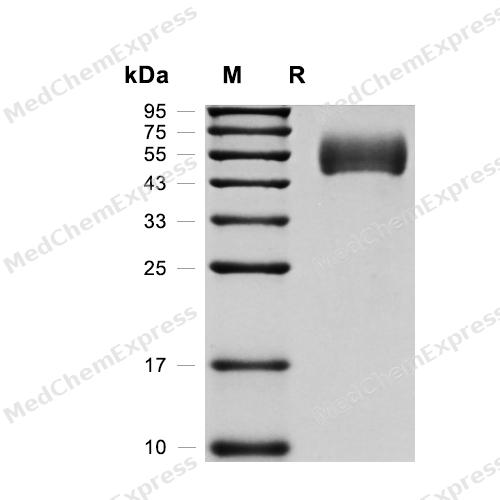
Purity - SDS-PAGE
-
Bioactivity - ELISA
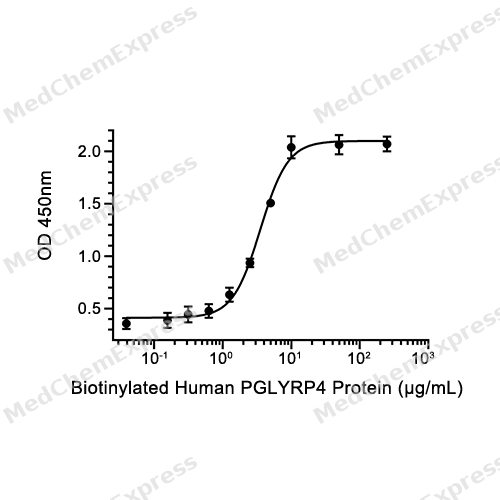
Bioactivity - ELISA


Technical Parameters
-
Species Human
-
Source HEK293
-
Tag C-His
-
Accession
Q96LB8-1 (D18-H373)
-
Gene ID57115 [NCBI]
-
Molecular Construction
-
N-term
-
PGLYRP4 (D18-H373)
Accession # Q96LB8-1 -
His
-
C-term
-
-
Protein Length
Full Length of Isoform-1 Mature Protein
-
Synonyms
PGLYRP4; SBBI67; Peptidoglycan Recognition Protein 4; Peptidoglycan Recognition Protein Intermediate Beta; PGLYRPIbeta; Peptidoglycan Recognition Protein I-Beta; PGRPIB; PGRP-I-Beta; PGRP-Ibeta; Peptidoglycan Recognition Protein I Beta Precursor
-
AA Sequence
DSSWNKTQAKQVSEGLQYLFENISQLTEKGLPTDVSTTVSRKAWGAEAVGCSIQLTTPVNVLVIHHVPGLECHDQTVCSQRLRELQAHHVHNNSGCDVAYNFLVGDDGRVYEGVGWNIQGVHTQGYNNISLGFAFFGTKKGHSPSPAALSAMENLITYAVQKGHLSSSYVQPLLGKGENCLAPRQKTSLKKACPGVVPRSVWGARETHCPRMTLPAKYGIIIHTAGRTCNISDECRLLVRDIQSFYIDRLKSCDIGYNFLVGQDGAIYEGVGWNVQGSSTPGYDDIALGITFMGTFTGIPPNAAALEAAQDLIQCAMVKGYLTPNYLLVGHSDVARTLSPGQALYNIISTWPHFKH
-
Molecular Weight
Approximately 50-72 kDa, based on SDS-PAGE under reducing conditions, due to the glycosylation.
-
Glycosylation
Yes
-
Purity
≥ 95%, as determined by reducing SDS-PAGE.


Product Properties
Lyophilized powder.
Lyophilized from a 0.22 μm filtered solution of 20 mM Tris-HCl, 100 mM NaCl, pH 8.5.
Note: For SPR assay, please replace the buffer. Primary amine components (e.g., Tris, imidazole) can affect protein-coupled chips.
<1 EU/μg, determined by LAL method.
It is not recommended to reconstitute to a concentration less than 100 μg/mL in ddH2O. For long term storage it is recommended to add a carrier protein (0.1% BSA, 5% HSA, 10% FBS or 5% Trehalose).
Stored at -20°C for 2 years from date of receipt. After reconstitution, it is stable at 4°C for 1 week or -20°C for longer (with carrier protein). It is recommended to freeze aliquots at -20°C or -80°C for extended storage.
Room temperature in continental US; may vary elsewhere.


Documentation
-
Data Sheet (238 KB)
-
SDS (251 KB)
- English - EN (251 KB)
- Français - FR (251 KB)
- Deutsch - DE (251 KB)
- Norwegian - NO (251 KB)
- Español - ES (251 KB)
- Swedish - SV (251 KB)
- Italian - IT (251 KB)
- Korean - KR (251 KB)
- Portuguese - PT (251 KB)
-
Handling Instructions (2659 KB)

Calculators
Concentration (start) × Volume (start) = Concentration (final) × Volume (final)


 Powered by Bioz

