



Placenta-expressed transcript 1 Protein, Mouse (His-SUMO)

Based on 1 Customer Validation
PLET1 protein orchestrates leading keratinocyte migration and enhances cellular adhesion to matrix proteins, crucial for wound healing. Its role extends to promoting efficient wound repair, emphasizing its significance in tissue regeneration. Additionally, PLET1 may influence trichilemmal differentiation in the hair follicle, indicating a broader impact on skin biology and homeostasis. Placenta-expressed transcript 1 Protein, Mouse (His-SUMO) is the recombinant mouse-derived Placenta-expressed transcript 1 protein, expressed by E. coli , with N-His, N-SUMO labeled tag.
- Species: Mouse
- Source: E. coli
-
Storage:Stored at -20°C for 2 years from date of receipt. After reconstitution, it is stable at 4°C for 1 week or -20°C for longer (with carrier protein). It is recommended to freeze aliquots at -20°C or -80°C for extended storage.


To place orders, for customer services and technical support, please contact: MedChemExpress USA
Tel: 609-228-6898 E-mail: [email protected] [email protected]


-
 Biological Activity
-
Technical Parameters
-
Product Properties
- Documentation
- Help & FAQs




Biological Activity
Description
PLET1 protein orchestrates leading keratinocyte migration and enhances cellular adhesion to matrix proteins, crucial for wound healing. Its role extends to promoting efficient wound repair, emphasizing its significance in tissue regeneration. Additionally, PLET1 may influence trichilemmal differentiation in the hair follicle, indicating a broader impact on skin biology and homeostasis. Placenta-expressed transcript 1 Protein, Mouse (His-SUMO) is the recombinant mouse-derived Placenta-expressed transcript 1 protein, expressed by E. coli , with N-His, N-SUMO labeled tag.
Background
Placenta-expressed transcript 1 (PLET1) protein plays a pivotal role in orchestrating leading keratinocyte migration and facilitating cellular adhesion to matrix proteins, thereby contributing to the intricate process of wound healing. Its involvement extends to promoting efficient wound repair, underscoring its significance in tissue regeneration. Furthermore, PLET1 may exert its influence during trichilemmal differentiation within the context of the hair follicle, suggesting a broader impact on skin biology and homeostasis.
Verified Bioactivity
Immobilized Mouse Placenta-expressed transcript 1 at 1 μg/mL (100 μL/well) can bind Anti- Placenta-expressed transcript 1. The ED50 for this effect is 0.03 μg/mL.
MCE Validation Data
-
Purity - SDS-PAGE
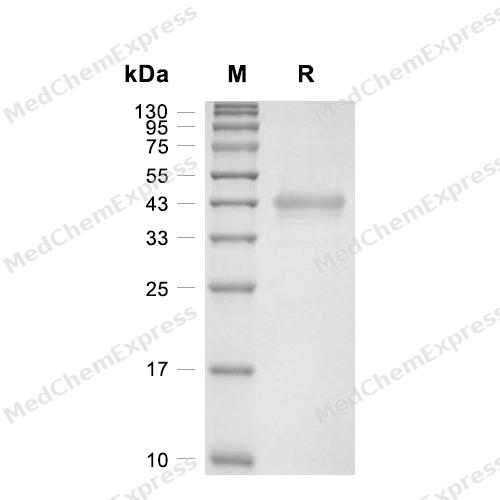
Purity - SDS-PAGE
-
Bioactivity - ELISA
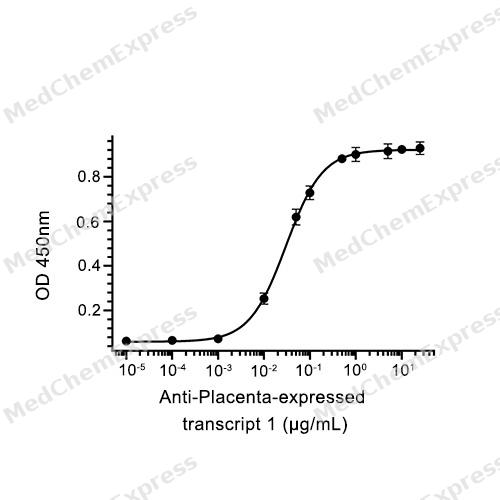
Bioactivity - ELISA


Technical Parameters
-
Species Mouse
-
Source E. coli
-
Tag N-His;N-SUMO
-
Accession
Q8VEN2-1 (S28-S218)
-
Molecular Construction
-
N-term
-
6*His-SUMO
-
PLET1 (S28-S218)
Accession # Q8VEN2 -
C-term
-
-
Protein Length
Full Length of Mature Protein
-
Synonyms
PLET1; Placenta-Expressed Transcript 1 Protein; Prev. C11orf34; Placenta-Expressed Transcript 1; Placenta Expressed Transcript 1; Chromosome 11 Open Reading Frame 34
-
AA Sequence
SDNGSCVVLDNIYTSDILEISTMANVSGGDVTYTVTVPVNDSVSAVILKAVKEDDSPVGTWSGTYEKCNDSSVYYNLTSQSQSVFQTNWTVPTSEDVTKVNLQVLIVVNRTASKSSVKMEQVQPSASTPIPESSETSQTINTTPTVNTAKTTAKDTANTTAVTTANTTANTTAVTTAKTTAKSLAIRTLGS
-
Molecular Weight
Approximately 43 kDa, based on SDS-PAGE under reducing conditions.
-
Purity
≥ 90%, as determined by reducing SDS-PAGE.


Product Properties
Lyophilized powder.
Lyophilized from a 0.22 μm filtered solution of PBS, pH 7.4, 6% trehalose.
<1 EU/μg, determined by LAL method.
It is not recommended to reconstitute to a concentration less than 100 μg/mL in ddH2O.
Stored at -20°C for 2 years from date of receipt. After reconstitution, it is stable at 4°C for 1 week or -20°C for longer (with carrier protein). It is recommended to freeze aliquots at -20°C or -80°C for extended storage.
Room temperature in continental US; may vary elsewhere.


Documentation
-
Data Sheet (236 KB)
-
SDS (251 KB)
- English - EN (251 KB)
- Français - FR (251 KB)
- Deutsch - DE (251 KB)
- Norwegian - NO (251 KB)
- Español - ES (251 KB)
- Swedish - SV (251 KB)
- Italian - IT (251 KB)
- Korean - KR (251 KB)
- Portuguese - PT (251 KB)
-
Handling Instructions (2659 KB)

Calculators
Concentration (start) × Volume (start) = Concentration (final) × Volume (final)


 Powered by Bioz

