



PSG1 Protein, Human (HEK293, hFc)

Based on 1 Customer Validation
Pregnancy-specific beta-1-glycoprotein 1 (PSG1) is derived from the syncytiotrophoblast and reaches concentrations in the serum of term pregnant women of 100 to 290 mg/l. As an important component of the human placenta, PSG1's molecular signature within the immunoglobulin (Ig) superfamily contributes to its important role in supporting pregnancy. PSG1 Protein, Human (HEK293, hFc) is the recombinant human-derived PSG1 protein, expressed by HEK293 , with C-hFc labeled tag.
- Species: Human
- Source: HEK293
-
Storage:Stored at -20°C for 2 years from date of receipt. After reconstitution, it is stable at 4°C for 1 week or -20°C for longer (with carrier protein). It is recommended to freeze aliquots at -20°C or -80°C for extended storage.


To place orders, for customer services and technical support, please contact: MedChemExpress USA
Tel: 609-228-6898 E-mail: [email protected] [email protected]


-
 Biological Activity
-
Technical Parameters
-
Product Properties
- Documentation
- Help & FAQs




Biological Activity
Description
Pregnancy-specific beta-1-glycoprotein 1 (PSG1) is derived from the syncytiotrophoblast and reaches concentrations in the serum of term pregnant women of 100 to 290 mg/l. As an important component of the human placenta, PSG1's molecular signature within the immunoglobulin (Ig) superfamily contributes to its important role in supporting pregnancy. PSG1 Protein, Human (HEK293, hFc) is the recombinant human-derived PSG1 protein, expressed by HEK293 , with C-hFc labeled tag.
Background
Pregnancy-specific beta-1-glycoprotein 1 (PSG1) is a prominent constituent of the human placenta, a vital endocrine organ crucial for sustaining fetal well-being. Originating from the syncytiotrophoblast, PSG1 attains concentrations of 100 to 290 mg/l in the serum of pregnant women at term. Classified within the immunoglobulin (Ig) superfamily, PSG1's molecular characteristics contribute to its essential role in supporting pregnancy. With a restricted expression primarily localized to the placenta (RPKM 224.3), PSG1 underscores its significance as a major contributor to the hormonal milieu essential for fetal survival and development during pregnancy.
MCE Validation Data
-
Purity - SDS-PAGE
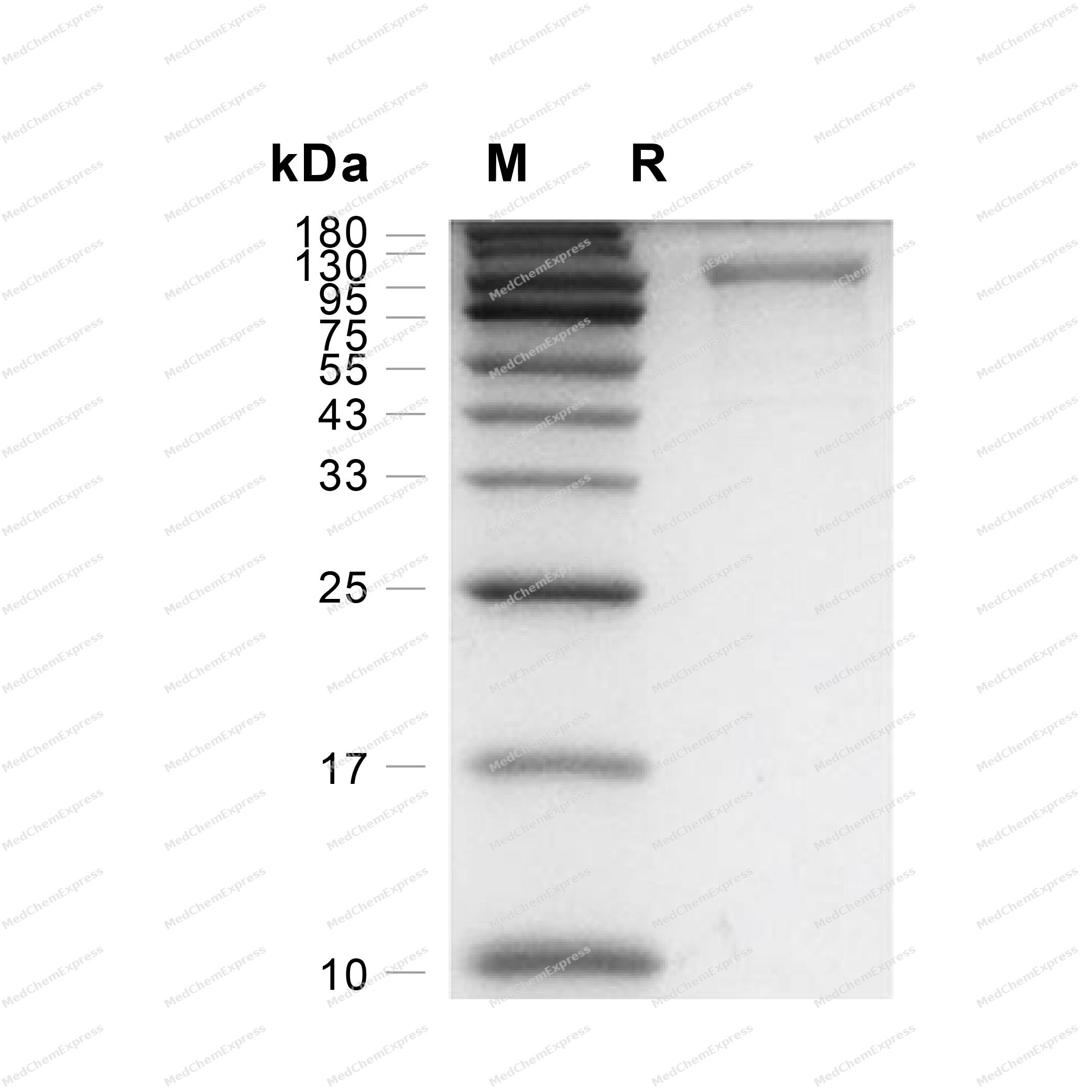
Purity - SDS-PAGE


Technical Parameters
-
Species Human
-
Source HEK293
-
Tag C-hFc
-
Accession
P11464-1/NP_001171754.1 (Q35-P419)
-
Gene ID5669
-
Molecular Construction
-
N-term
-
PSG1 (Q35-P419)
Accession # P11464-1/NP_001171754.1 -
hFc
-
C-term
-
-
Protein Length
Full Length of Mature Protein
-
Synonyms
PSG1; B1G1; Prev. PSBG1; Pregnancy Specific Beta-1-Glycoprotein 1, Isoform CRA_h; PSGGA; Pregnancy-Specific Beta-1 Glycoprotein; Pregnancy-Specific Beta-1-Glycoprotein 1; Pregnancy-Specific B-1 Glycoprotein; CD66f; Pregnancy-Specific Glycoprotein 1; PBG1;
-
AA Sequence
QVTIEAEPTKVSEGKDVLLLVHNLPQNLTGYIWYKGQMRDLYHYITSYVVDGEIIIYGPAYSGRETAYSNASLLIQNVTREDAGSYTLHIIKGDDGTRGVTGRFTFTLHLETPKPSISSSNLNPRETMEAVSLTCDPETPDASYLWWMNGQSLPMTHSLKLSETNRTLFLLGVTKYTAGPYECEIRNPVSASRSDPVTLNLLPKLPKPYITINNLNPRENKDVLNFTCEPKSENYTYIWWLNGQSLPVSPRVKRPIENRILILPSVTRNETGPYQCEIRDRYGGIRSDPVTLNVLYGPDLPRIYPSFTYYRSGEVLYLSCSADSNPPAQYSWTINEKFQLPGQKLFIRHITTKHSGLYVCSVRNSATGKESSKSMTVEVSDWTVP
-
Predicted Molecular Mass
69.6 kDa
-
Molecular Weight
Approximately 95 kDa, based on SDS-PAGE under reducing conditions.
-
Purity
≥ 90%, as determined by reducing SDS-PAGE.


Product Properties
Lyophilized powder.
Lyophilized from a 0.22 μm filtered solution of PBS, pH 7.4.
<1 EU/μg, determined by LAL method.
It is not recommended to reconstitute to a concentration less than 100 μg/mL in ddH2O. For long term storage it is recommended to add a carrier protein (0.1% BSA, 5% HSA, 10% FBS or 5% Trehalose).
Stored at -20°C for 2 years from date of receipt. After reconstitution, it is stable at 4°C for 1 week or -20°C for longer (with carrier protein). It is recommended to freeze aliquots at -20°C or -80°C for extended storage.
Room temperature in continental US; may vary elsewhere.


Documentation
-
Data Sheet (237 KB)
-
SDS (251 KB)
- English - EN (251 KB)
- Français - FR (251 KB)
- Deutsch - DE (251 KB)
- Norwegian - NO (251 KB)
- Español - ES (251 KB)
- Swedish - SV (251 KB)
- Italian - IT (251 KB)
- Korean - KR (251 KB)
- Portuguese - PT (251 KB)
-
Handling Instructions (2659 KB)

Calculators
Concentration (start) × Volume (start) = Concentration (final) × Volume (final)


 Powered by Bioz

