



PYCARD Protein, Human (HEK293, His-Myc)
Based on 1 publication(s) in Google Scholar
PYCARD proteins are key mediators of apoptosis and inflammation and promote caspase-mediated apoptosis, specifically involving caspase-8 and, in certain cells, caspase-9. It activates the mitochondrial apoptotic pathway, promoting caspase-8-dependent BID maturation and BAX-dependent apoptosis through caspase-9, -2, and -3. PYCARD Protein, Human (HEK293, His-Myc) is the recombinant human-derived PYCARD protein, expressed by HEK293 , with C-Myc, N-10*His labeled tag.
- Species: Human
- Source: HEK293
-
Storage:Stored at -20°C for 2 years from date of receipt. After reconstitution, it is stable at 4°C for 1 week or -20°C for longer (with carrier protein). It is recommended to freeze aliquots at -20°C or -80°C for extended storage.


To place orders, for customer services and technical support, please contact: MedChemExpress USA
Tel: 609-228-6898 E-mail: [email protected] [email protected]


-
 Biological Activity
-
Technical Parameters
-
Product Properties
- Documentation
- Help & FAQs




Biological Activity
Description
PYCARD proteins are key mediators of apoptosis and inflammation and promote caspase-mediated apoptosis, specifically involving caspase-8 and, in certain cells, caspase-9. It activates the mitochondrial apoptotic pathway, promoting caspase-8-dependent BID maturation and BAX-dependent apoptosis through caspase-9, -2, and -3. PYCARD Protein, Human (HEK293, His-Myc) is the recombinant human-derived PYCARD protein, expressed by HEK293 , with C-Myc, N-10*His labeled tag.
Background
PYCARD protein serves as a pivotal mediator in apoptosis and inflammation, playing multifaceted roles in cellular processes. It facilitates caspase-mediated apoptosis, predominantly involving caspase-8 and, in specific cell types, caspase-9. PYCARD is integral to the activation of the mitochondrial apoptotic pathway, promoting caspase-8-dependent proteolytic maturation of BID independently of FADD, as well as mediating mitochondrial translocation of BAX, initiating BAX-dependent apoptosis coupled with the activation of caspase-9, -2, and -3. Furthermore, PYCARD is a crucial adapter in the assembly of various inflammasomes, including NLRP1, NLRP2, NLRP3, NLRP6, AIM2, and likely IFI16, leading to caspase-1 activation, pro-inflammatory cytokine processing, and inflammation. In cooperation with NOD2, PYCARD participates in an inflammasome activated by bacterial muramyl dipeptide. Additionally, it may be involved in RIGI-triggered pro-inflammatory responses and inflammasome activation. In adaptive immunity, PYCARD contributes to dendritic cell maturation, stimulating T-cell immunity, and modulates cytoskeletal rearrangements associated with chemotaxis and antigen uptake. Furthermore, it plays a role in the transcriptional activation of cytokines and chemokines, independently of the inflammasome, through signaling pathways involving AP-1, NF-kappa-B, MAPK, and caspase-8. The regulatory functions of PYCARD include modulation of NF-kappa-B induction at the IKK complex level, inhibiting kinase activity of CHUK and IKBK. It is proposed to compete with RIPK2, down-regulating CASP1-mediated RIPK2-dependent NF-kappa-B activation, and activating interleukin-1 beta processing. In host resistance to DNA virus infection, PYCARD likely induces the cleavage and inactivation of CGAS in the presence of cytoplasmic double-stranded DNA, showcasing its diverse and critical roles in cellular responses.
Verified Bioactivity
Measured in a cytotoxicity assay using A549 cells. The ED50 of this effect is 2.018 μg/mL, corresponding to a specific activity is 495.54 units/mg.
MCE Validation Data
-
Purity - SDS-PAGE
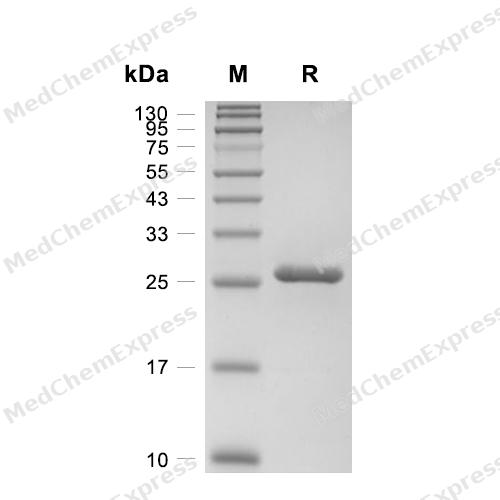
Purity - SDS-PAGE
-
Bioactivity - Cell-Based Assay
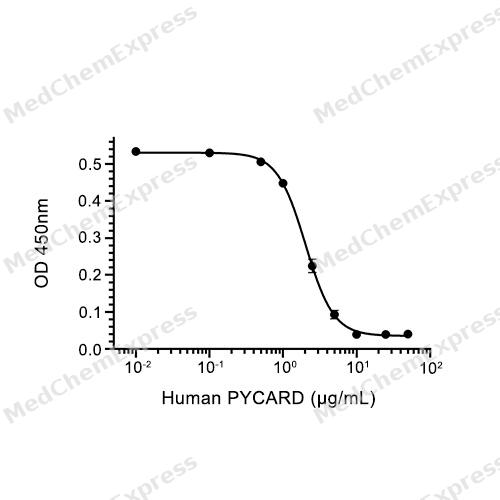
Bioactivity - Cell-Based Assay


Publications (1)
-
Journal Impact Factor
-
Most Recent


Technical Parameters
-
Species Human
-
Source HEK293
-
Tag C-Myc;N-10*His
-
Accession
Q9ULZ3-1 (M1-S195)
-
Gene ID29108
-
Molecular Construction
-
N-term
-
10*His
-
PYCARD (M1-S195)
Accession # Q9ULZ3-1 -
C-term
-
-
Protein Length
Full Length of Isoform-1
-
Synonyms
PYCARD; Target Of Methylation-Induced Silencing 1; PYD And CARD Domain Containing; TMS1; CARD5; PYD And CARD Domain-Containing Protein; ASC; Apoptosis-Associated Speck-Like; Apoptosis-Associated Speck-Like Protein Containing A CARD; HASC; TMS-1; TMS; Casp
-
AA Sequence
MGRARDAILDALENLTAEELKKFKLKLLSVPLREGYGRIPRGALLSMDALDLTDKLVSFYLETYGAELTANVLRDMGLQEMAGQLQAATHQGSGAAPAGIQAPPQSAAKPGLHFIDQHRAALIARVTNVEWLLDALYGKVLTDEQYQAVRAEPTNPSKMRKLFSFTPAWNWTCKDLLLQALRESQSYLVEDLERS
-
Molecular Weight
Approximately 26-30 kDa, based on SDS-PAGE under reducing conditions.
-
Purity
≥ 90%, as determined by reducing SDS-PAGE.


Product Properties
Lyophilized powder
Lyophilized from 0.22 μm filtered solution of PBS, 6-8% Trehalose, pH 7.4.
<1 EU/μg, determined by LAL method.
It is not recommended to reconstitute to a concentration less than 100 μg/mL in ddH2O.
Stored at -20°C for 2 years from date of receipt. After reconstitution, it is stable at 4°C for 1 week or -20°C for longer (with carrier protein). It is recommended to freeze aliquots at -20°C or -80°C for extended storage.
Room temperature in continental US; may vary elsewhere.


Documentation
-
Data Sheet (237 KB)
-
SDS (252 KB)
- English - EN (252 KB)
- Français - FR (252 KB)
- Deutsch - DE (252 KB)
- Norwegian - NO (252 KB)
- Español - ES (252 KB)
- Swedish - SV (252 KB)
- Italian - IT (252 KB)
- Korean - KR (252 KB)
- Portuguese - PT (252 KB)
-
Handling Instructions (2659 KB)

Calculators
Concentration (start) × Volume (start) = Concentration (final) × Volume (final)


 Powered by Bioz

