



QPCT Protein, Mouse (His)

Based on 1 Customer Validation
The QPCT protein plays a key role in pyroglutamyl peptide biosynthesis and exhibits substrate preference for N-terminal glutamine residues while showing specificity for residues near the N-terminus. Notably, its catalytic activity is independent of chain length beyond the second residue, emphasizing the importance of QPCT in the precise biosynthesis of pyroglutamyl peptides with diverse N-termini, contributing to various biological background. QPCT Protein, Mouse (His) is the recombinant mouse-derived QPCT protein, expressed by E. coli , with N-6*His tag.
- Species: Mouse
- Source: E. coli
-
Almacenamiento:Stored at -20°C for 2 years from date of receipt. After reconstitution, it is stable at 4°C for 1 week or -20°C for longer (with carrier protein). It is recommended to freeze aliquots at -20°C or -80°C for extended storage.


To place orders, for customer services and technical support, please contact: MedChemExpress USA
Tel: 609-228-6898 E-mail: [email protected] [email protected]


-
 Actividad biológica
-
Technical Parameters
-
Product Properties
- Documentación
- Help & FAQs




Actividad biológica
Descripciòn
The QPCT protein plays a key role in pyroglutamyl peptide biosynthesis and exhibits substrate preference for N-terminal glutamine residues while showing specificity for residues near the N-terminus. Notably, its catalytic activity is independent of chain length beyond the second residue, emphasizing the importance of QPCT in the precise biosynthesis of pyroglutamyl peptides with diverse N-termini, contributing to various biological background. QPCT Protein, Mouse (His) is the recombinant mouse-derived QPCT protein, expressed by E. coli , with N-6*His tag.
Background
The QPCT protein plays a pivotal role in the biosynthesis of pyroglutamyl peptides, exhibiting a preference for substrates with an N-terminal glutaminyl residue while displaying a bias against adjacent acidic and tryptophan residues. Notably, its substrate specificity is more pronounced for the residues proximal to the N-terminal glutaminyl residue, showing a distinctive substrate recognition pattern. Additionally, QPCT demonstrates a lack of significant dependence on chain length beyond the second residue, suggesting that the protein's catalytic activity is less influenced by elongation beyond this point. This selectivity and flexibility in substrate recognition highlight QPCT's significance in the precise biosynthesis of pyroglutamyl peptides, contributing to the diverse array of peptides with pyroglutamylated N-termini in various biological contexts.
MCE Validation Data
-
Purity - SDS-PAGE
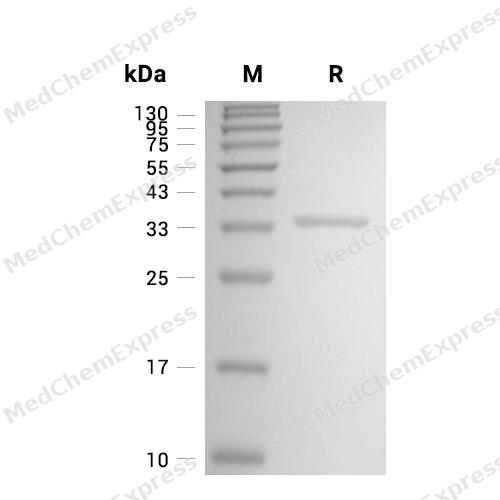
Purity - SDS-PAGE


Technical Parameters
-
Species Mouse
-
Source E. coli
-
Tag N-6*His
-
Accession
Q9CYK2-1 (A36-L362)
-
Molecular Construction
-
N-term
-
6*His
-
QPCT (A36-L362)
Accession # Q9CYK2-1 -
C-term
-
-
Protein Length
Full Length of Mature Protein
-
Synonyms
QPCT; GCT; Glutaminyl-Peptide Cyclotransferase; Glutamyl Cyclase; Glutaminyl Cyclase; SQC; QC; EC; Glutaminyl-TRNA Cyclotransferase
-
AA Sequence
AWTQEKNHHQPAHLNSSSLQQVAEGTSISEMWQNDLRPLLIERYPGSPGSYSARQHIMQRIQRLQAEWVVEVDTFLSRTPYGYRSFSNIISTLNPEAKRHLVLACHYDSKYFPRWDSRVFVGATDSAVPCAMMLELARALDKKLHSLKDVSGSKPDLSLRLIFFDGEEAFHHWSPQDSLYGSRHLAQKMASSPHPPGSRGTNQLDGMDLLVLLDLIGAANPTFPNFFPKTTRWFNRLQAIEKELYELGLLKDHSLERKYFQNFGYGNIIQDDHIPFLRKGVPVLHLIASPFPEVWHTMDDNEENLHASTIDNLNKIIQVFVLEYLHL
-
Predicted Molecular Mass
38.4 kDa
-
Peso molecular
Approximately 36 kDa, based on SDS-PAGE under reducing conditions.
-
Pureza
≥ 95%, as determined by reducing SDS-PAGE.


Product Properties
Lyophilized powder.
Lyophilized from a 0.22 μm filtered solution of PBS, pH 7.4, 8% trehalose.
<1 EU/μg, determined by LAL method.
It is not recommended to reconstitute to a concentration less than 100 μg/mL in ddH2O.
Stored at -20°C for 2 years from date of receipt. After reconstitution, it is stable at 4°C for 1 week or -20°C for longer (with carrier protein). It is recommended to freeze aliquots at -20°C or -80°C for extended storage.
Room temperature in continental US; may vary elsewhere.


Documentación
-
Ficha de datos (237 KB)
-
SDS (252 KB)
- English - EN (252 KB)
- Français - FR (252 KB)
- Deutsch - DE (252 KB)
- Norwegian - NO (252 KB)
- Español - ES (252 KB)
- Swedish - SV (252 KB)
- Italian - IT (252 KB)
- Korean - KR (252 KB)
- Portuguese - PT (252 KB)
-
Instrucciones de manejo (2659 KB)

Calculators
Concentration (start) × Volume (start) = Concentration (final) × Volume (final)


 Powered by Bioz

