



Ribonuclease R (rnr) protein, E.coli (His)
Based on 2 publication(s) in Google Scholar
Ribonuclease R (RNase R) is a 3'-5' exoribonuclease crucial for structured RNA maturation, degrading rRNAs, tRNAs, and SsrA/tmRNA. It modulates ompA mRNA stability in the stationary phase, exhibiting processive activity and helicase function. RNase R, along with PNPase, ensures rRNA quality during steady-state growth and contributes to virulence gene expression in E. coli. Ribonuclease R (rnr) protein, E.coli (His) is the recombinant E. coli-derived Ribonuclease R, expressed by E. coli , with N-6*His labeled tag.
- Species: E.coli
- Source: E. coli
-
Storage:Stored at -80°C for 1 year from date of receipt. It is stable at -20°C for 3 months after opening. It is recommended to freeze aliquots at -80°C for extended storage. Avoid repeated freeze-thaw cycles.


To place orders, for customer services and technical support, please contact: MedChemExpress USA
Tel: 609-228-6898 E-mail: [email protected] [email protected]


-
 Biological Activity
-
Technical Parameters
-
Product Properties
- Documentation
- Help & FAQs




Biological Activity
Description
Ribonuclease R (RNase R) is a 3'-5' exoribonuclease crucial for structured RNA maturation, degrading rRNAs, tRNAs, and SsrA/tmRNA. It modulates ompA mRNA stability in the stationary phase, exhibiting processive activity and helicase function. RNase R, along with PNPase, ensures rRNA quality during steady-state growth and contributes to virulence gene expression in E. coli. Ribonuclease R (rnr) protein, E.coli (His) is the recombinant E. coli-derived Ribonuclease R, expressed by E. coli , with N-6*His labeled tag.
Background
Ribonuclease R (RNase R) is a 3'-5' exoribonuclease that plays a crucial role in the maturation of structured RNAs, including rRNAs, tRNAs, and SsrA/tmRNA. It acts by releasing 5'-nucleoside monophosphates during the degradation process. Additionally, in the stationary phase, RNase R is involved in post-transcriptional regulation, specifically in the modulation of ompA mRNA stability. It exhibits processive activity, shortening RNA molecules to di- and trinucleotides. Interestingly, RNase R also possesses helicase activity, which is distinct from its RNase function. During starvation, RNases 2 and R (rnb and RNase R) contribute to the degradation of rRNA. However, under normal growth conditions, RNase R, along with PNPase, plays a more significant role in quality control of rRNA. These enzymes work together to ensure proper functioning and integrity of rRNA during steady-state growth. Additionally, RNase R is required for the expression of virulence genes in enteroinvasive strains of E. coli.
Verified Bioactivity
Measured by its ability to digest RNA, it reacted at 37°C for 30 minutes under a certain reaction system, and was identified by agar-gel electrophoresis. The optimal reaction concentration measured under the above conditions was 80 μg/mL-320 μg/mL.
MCE Validation Data
-
Purity - SDS-PAGE
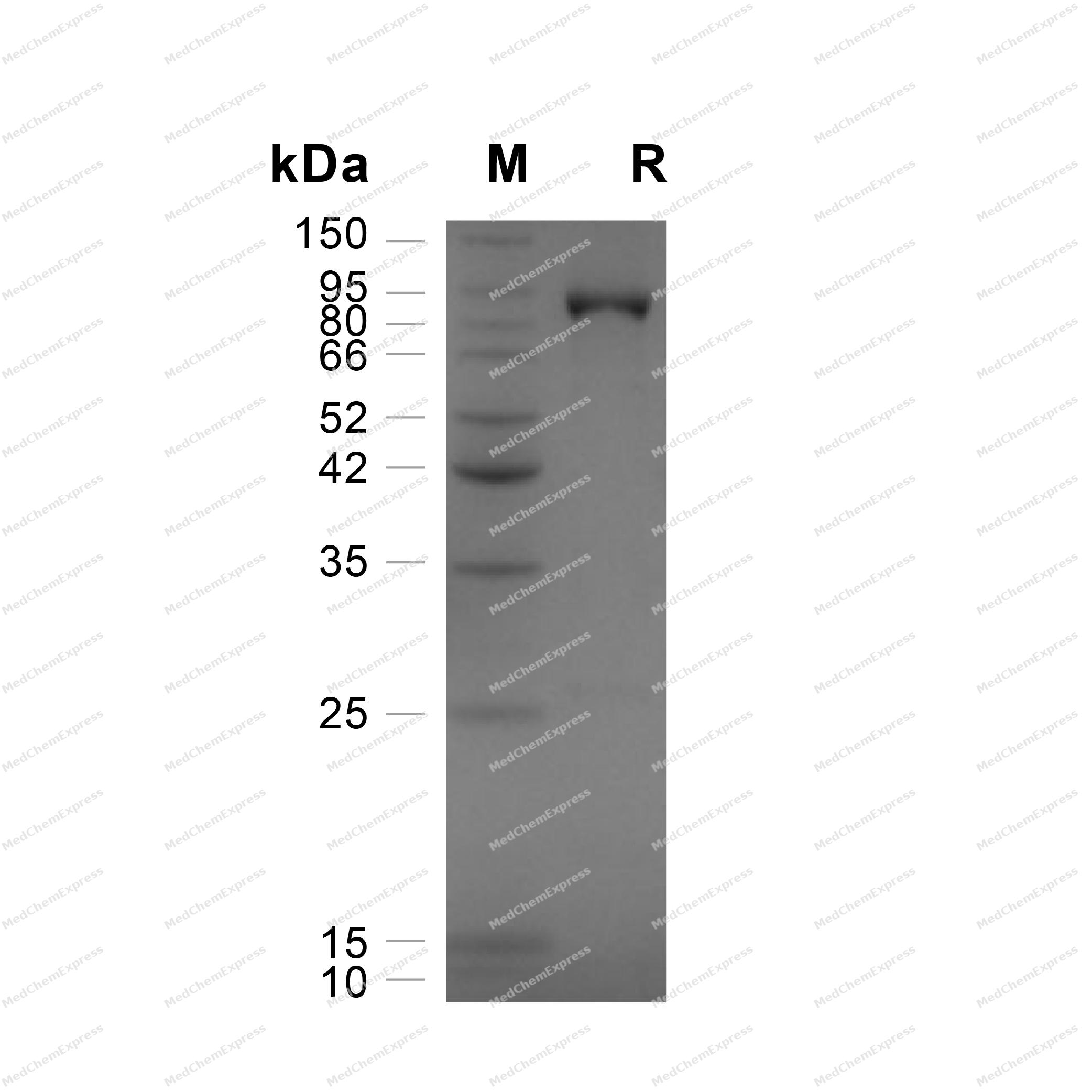
Purity - SDS-PAGE


Publications (2)
-
Journal Impact Factor
-
Most Recent
-
Kaohsiung J Med Sci
Circ_0006174 Drives Triple Negative Breast Cancer Progression and Immune Escape Through Regulating miR-3139/PD-L1 Axis. [Abstract]2025 Dec 24:e70156. PMID: 41439406 -
Mutat Res
CircRNA ATF6 suppresses bladder cancer cell proliferation and migration via miR-146a-5p/FLNA axis. [Abstract]2024 Jul-Dec:829:111876. PMID: 39182401


Technical Parameters
-
Species E.coli
-
Source E. coli
-
Tag N-6*His
-
Accession
P21499 (M1-E813)
-
Gene ID948692
-
Molecular Construction
-
N-term
-
6*His
-
RNase R (M1-E813)
Accession # P21499 -
C-term
-
-
Protein Length
Full Length
-
Synonyms
NR2E3; Rd7; Nuclear Receptor Subfamily 2 Group E Member 3; RNR; PNR; Nuclear Receptor Subfamily 2, Group E, Member 3; Photoreceptor-Specific Nuclear Receptor; NR2E3 Protein; Retina-Specific Nuclear Receptor; ESCS1; RP37; ESCS
-
AA Sequence
MSQDPFQEREAEKYANPIPSREFILEHLTKREKPASRDELAVELHIEGEEQLEGLRRRLRAMERDGQLVFTRRQCYALPERLDLVKGTVIGHRDGYGFLRVEGRKDDLYLSSEQMKTCIHGDQVLAQPLGADRKGRREARIVRVLVPKTSQIVGRYFTEAGVGFVVPDDSRLSFDILIPPDQIMGARMGFVVVVELTQRPTRRTKAVGKIVEVLGDNMGTGMAVDIALRTHEIPYIWPQAVEQQVAGLKEEVPEEAKAGRVDLRDLPLVTIDGEDARDFDDAVYCEKKRGGGWRLWVAIADVSYYVRPSTPLDREARNRGTSVYFPSQVIPMLPEVLSNGLCSLNPQVDRLCMVCEMTVSSKGRLTGYKFYEAVMSSHARLTYTKVWHILQGDQDLREQYAPLVKHLEELHNLYKVLDKAREERGGISFESEEAKFIFNAERRIERIEQTQRNDAHKLIEECMILANISAARFVEKAKEPALFRIHDKPSTEAITSFRSVLAELGLELPGGNKPEPRDYAELLESVADRPDAEMLQTMLLRSMKQAIYDPENRGHFGLALQSYAHFTSPIRRYPDLTLHRAIKYLLAKEQGHQGNTTETGGYHYSMEEMLQLGQHCSMAERRADEATRDVADWLKCDFMLDQVGNVFKGVISSVTGFGFFVRLDDLFIDGLVHVSSLDNDYYRFDQVGQRLMGESSGQTYRLGDRVEVRVEAVNMDERKIDFSLISSERAPRNVGKTAREKAKKGDAGKKGGKRRQVGKKVNFEPDSAFRGEKKTKPKAAKKDARKAKKPSAKTQKIAAATKAKRAAKKKVAE
-
Predicted Molecular Mass
92.1 kDa
-
Molecular Weight
Approximately 88-100 kDa, based on SDS-PAGE under reducing conditions.
-
Purity
≥ 95%, as determined by reducing SDS-PAGE.


Product Properties
Solution
Supplied as a 0.22 μm filtered solution of 50 mM Tris, 100 mM NaCl, 1 mM DTT, 0.1 mM EDTA, 50% Glycerol, 0.1% TX-100, pH 7.5.
Note: For SPR assay, please replace the buffer. Primary amine components (e.g., Tris, imidazole) can affect protein-coupled chips.
<1 EU/μg, determined by LAL method.
Stored at -80°C for 1 year from date of receipt. It is stable at -20°C for 3 months after opening. It is recommended to freeze aliquots at -80°C for extended storage. Avoid repeated freeze-thaw cycles.
Shipping with dry ice.


Documentation
-
Data Sheet (240 KB)
-
SDS (252 KB)
- English - EN (252 KB)
- Français - FR (252 KB)
- Deutsch - DE (252 KB)
- Norwegian - NO (252 KB)
- Español - ES (252 KB)
- Swedish - SV (252 KB)
- Italian - IT (252 KB)
- Korean - KR (252 KB)
- Portuguese - PT (252 KB)
-
Handling Instructions (2659 KB)

Calculators
Concentration (start) × Volume (start) = Concentration (final) × Volume (final)


 Powered by Bioz

