



Semaphorin-4D/SEMA4D Protein, Rat (HEK293, His)

Based on 1 Customer Validation
Semaphorin-4D (SEMA4D) is predicted to participate in the same protein binding, signaling receptor binding, and transmembrane signaling receptor activities. Its multiple roles, including negative regulation of osteoblast differentiation and modulation of neuronal projection development, highlight its functional versatility. Semaphorin-4D/SEMA4D Protein, Rat (HEK293, His) is the recombinant rat-derived Semaphorin-4D/SEMA4D protein, expressed by HEK293 , with C-His labeled tag.
- Species: Rat
- Source: HEK293
-
Storage:Stored at -20°C for 2 years from date of receipt. After reconstitution, it is stable at 4°C for 1 week or -20°C for longer (with carrier protein). It is recommended to freeze aliquots at -20°C or -80°C for extended storage.


To place orders, for customer services and technical support, please contact: MedChemExpress USA
Tel: 609-228-6898 E-mail: [email protected] [email protected]


-
 Biological Activity
-
Technical Parameters
-
Product Properties
- Documentation
- Help & FAQs




Biological Activity
Description
Semaphorin-4D (SEMA4D) is predicted to participate in the same protein binding, signaling receptor binding, and transmembrane signaling receptor activities. Its multiple roles, including negative regulation of osteoblast differentiation and modulation of neuronal projection development, highlight its functional versatility. Semaphorin-4D/SEMA4D Protein, Rat (HEK293, His) is the recombinant rat-derived Semaphorin-4D/SEMA4D protein, expressed by HEK293 , with C-His labeled tag.
Background
Semaphorin-4D (SEMA4D) is predicted to possess identical protein binding activity, signaling receptor binding activity, and transmembrane signaling receptor activity. Its involvement in various processes, including negative regulation of osteoblast differentiation, regulation of neuron projection development, and regulation of phosphate metabolic processes, underscores its diverse functions. SEMA4D is anticipated to act upstream of or within the positive regulation of axonogenesis, suggesting a role in neuronal development. The predicted activity in the extracellular space and its status as an integral component of the plasma membrane further emphasize its potential significance in intercellular communication. With biased expression observed in tissues such as the spleen, thymus, and nine other tissues, SEMA4D's intricate involvement in cellular processes and its potential impact on tissue-specific functions become areas of interest for further exploration.
Verified Bioactivity
Measured by its ability to inhibit survival of SK-OV-3 human ovarian carcinoma cells. The ED50 for this effect is 1.211 µg/mL, corresponding to a specific activity is 825.8 U/mg.
MCE Validation Data
-
Purity - SDS-PAGE
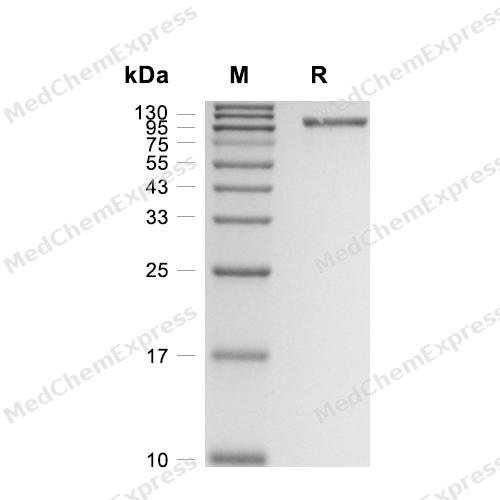
Purity - SDS-PAGE
-
Bioactivity - Cell-Based Assay
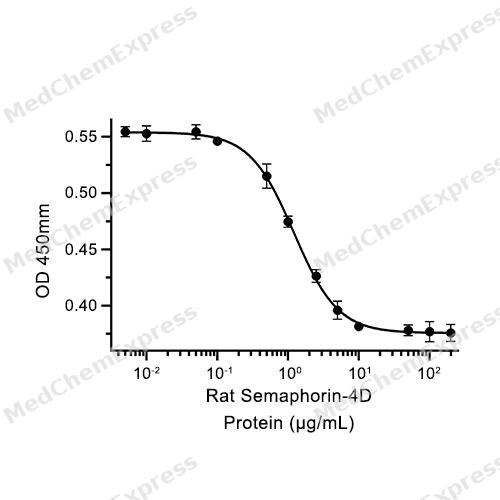
Bioactivity - Cell-Based Assay


Technical Parameters
-
Species Rat
-
Source HEK293
-
Tag C-10*His
-
Accession
A0A8I6G5Q1/NP_001164034 (F24-M712)
-
Molecular Construction
-
N-term
-
SEMA4D (F24-M712)
Accession # A0A8I6G5Q1/NP_001164034 -
His
-
C-term
-
-
Protein Length
Partial
-
Synonyms
SEMA4D; BB18; Prev. C9orf164; A8; Prev. SEMAJ; Sema Domain, Immunoglobulin Domain (Ig), Transmembrane Domain (TM) And Short Cytoplasmic Domain, 4D; CD100; Chromosome 9 Open Reading Frame 164; Semaphorin-4D; CD100 Antigen; Coll-4; M-Sema G; Sema Domain, Im
-
AA Sequence
FAPVPRITWEHGEVGLVKFHEPGIFNYSSLLMSEDKDTLYVGAREAVFAVNALDISEKQHEVYWKVSEDKKSKCAEKGKSKQTECLNYIRVLQPLSSTSLYVCGTNAFQPTCDHLNLTSFKFLGKSEDGKGRCPFDPAHSYTSVMVGGELYSGTSYNFLGSEPIISRNSSHSPLRTEYAIPWLNEPSFVFADVIHKSPDGTEAEDDKVYFFFTEVSVEYEFVFKLMIPRVARVCKGDQGGLRTLQKKWTSFLKARLICSRPDSGLVFNILQDVFVLRAPGLKEPVFYAVFTPQLNNVGLSAVCAYTLSTVEAVFSRGKYMQSATVEQSHTKWVRYNGPVPTPRPGACIDSEARAANYTSSLNLPDKTLQFVKDHPLMDDSVTPIDNRPKLIKKDVNYTQIVVDRTQALDGTFYDVMFLSTDRGALHKAVILAKEVHVVEETQLFQDFEPVLSLLLSSKKGRKFVYAGSNSGVVQAPLAFCGKHSSCEDCVLARDPYCAWSPAIKACVTLHQAEGSSRGWIQDMSGDTSSCLDKSKESFHQHFFKHGGTAELKCFQKSNLARVVWKFQNGELKAVSPKYGFVGRKHLLIFNLSDGDSGVYQCLSEERVRNKTVSQLLAKHILEVKMVARIPPSPTSQTAQTEGSRITSKMPVASTQGSSPPTPALWATSPRAATLPPKSSSTGTSCEPKM
-
Molecular Weight
Approximately 96 kDa, based on SDS-PAGE under reducing conditions, due to the glycosylation.
-
Glycosylation
Yes
-
Purity
≥ 95%, as determined by reducing SDS-PAGE.


Product Properties
Lyophilized powder.
Lyophilized from a 0.22 μm filtered solution of PBS, pH 7.4.
<1 EU/μg, determined by LAL method.
It is not recommended to reconstitute to a concentration less than 100 μg/mL in ddH2O. For long term storage it is recommended to add a carrier protein (0.1% BSA, 5% HSA, 10% FBS or 5% Trehalose).
Stored at -20°C for 2 years from date of receipt. After reconstitution, it is stable at 4°C for 1 week or -20°C for longer (with carrier protein). It is recommended to freeze aliquots at -20°C or -80°C for extended storage.
Room temperature in continental US; may vary elsewhere.


Documentation
-
Data Sheet (240 KB)
-
SDS (251 KB)
- English - EN (251 KB)
- Français - FR (251 KB)
- Deutsch - DE (251 KB)
- Norwegian - NO (251 KB)
- Español - ES (251 KB)
- Swedish - SV (251 KB)
- Italian - IT (251 KB)
- Korean - KR (251 KB)
- Portuguese - PT (251 KB)
-
Handling Instructions (2659 KB)

Calculators
Concentration (start) × Volume (start) = Concentration (final) × Volume (final)


 Powered by Bioz

