



Serpin B1 Protein, Human (HEK293, His)
Based on 1 publication(s) in Google Scholar
Serpin B1 protein is an important neutrophil serine protease inhibitor that regulates innate immune responses by protecting cells from cytoplasmic proteases during stress. It inhibits various neutrophil proteases, including elastase and chymotrypsin, and blocks GZMH activity intracellularly. Serpin B1 Protein, Human (HEK293, His) is the recombinant human-derived Serpin B1 protein, expressed by HEK293 , with C-6*His labeled tag.
- Species: Human
- Source: HEK293
-
Storage:Stored at -20°C for 2 years from date of receipt. After reconstitution, it is stable at 4°C for 1 week or -20°C for longer (with carrier protein). It is recommended to freeze aliquots at -20°C or -80°C for extended storage.


To place orders, for customer services and technical support, please contact: MedChemExpress USA
Tel: 609-228-6898 E-mail: [email protected] [email protected]


-
 Biological Activity
-
Technical Parameters
-
Product Properties
- Documentation
- Help & FAQs




Biological Activity
Description
Serpin B1 protein is an important neutrophil serine protease inhibitor that regulates innate immune responses by protecting cells from cytoplasmic proteases during stress. It inhibits various neutrophil proteases, including elastase and chymotrypsin, and blocks GZMH activity intracellularly. Serpin B1 Protein, Human (HEK293, His) is the recombinant human-derived Serpin B1 protein, expressed by HEK293 , with C-6*His labeled tag.
Background
The Serpin B1 protein, a neutrophil serine protease inhibitor, plays a crucial role in regulating the innate immune response, inflammation, and cellular homeostasis. Acting primarily to safeguard cells from proteases released in the cytoplasm during stress or infection, Serpin B1 protects against potential damage caused by the potent enzymes released from granules. It effectively regulates the activity of various neutrophil proteases, including elastase, cathepsin G, proteinase-3, chymase, chymotrypsin, and kallikrein-3. Notably, Serpin B1 also serves as a potent intracellular inhibitor of GZMH, directly blocking its proteolytic activity. During inflammation, Serpin B1 limits the activity of inflammatory caspases (CASP1, CASP4, and CASP5) by suppressing their caspase-recruitment domain (CARD) oligomerization and enzymatic activation. Moreover, when secreted, Serpin B1 promotes beta-cell proliferation through its protease inhibitory function. The protein functions as a monomer and interacts with CASP1, CASP4, CASP5, PRTN3, and GZMH, revealing its intricate role in modulating various cellular processes and interactions with key proteins in the immune and inflammatory pathways.
MCE Validation Data
-
Purity - SDS-PAGE
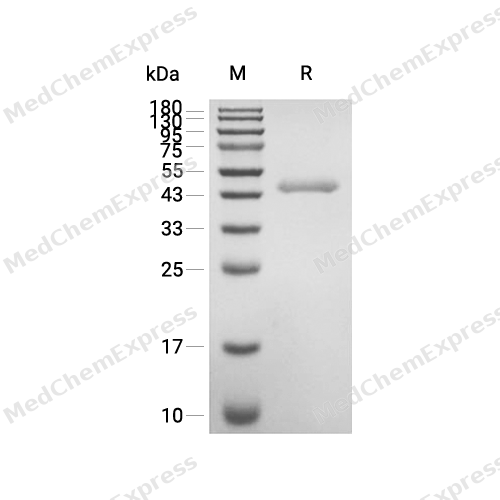
Purity - SDS-PAGE


Publications (1)
-
Journal Impact Factor
-
Most Recent
-
J Ovarian Res
Identification of exosome-related SERPINB1 as a novel predictor for tumor immune microenvironment and clinical outcomes in ovarian cancer. [Abstract]2025 Mar 28;18(1):65. PMID: 40155942


Technical Parameters
-
Species Human
-
Source HEK293
-
Tag C-6*His
-
Accession
P30740-1 (M1-P379)
-
Molecular Construction
-
N-term
-
Serpin B1 (M1-P379)
Accession # P30740 -
6*His
-
C-term
-
-
Protein Length
Full Length of Isoform-1
-
Synonyms
SERPINB1; Epididymis Secretory Protein Li 27; Prev. ELANH2; Peptidase Inhibitor 2; MNEI; HEL-S-27; PI2; M/NEI; LEI; PI-2; EI; Serpin Peptidase Inhibitor, Clade B (Ovalbumin), Member 1, Isoform CRA_a; Leukocyte Elastase Inhibitor; Protease Inhibitor 2 (Ant
-
AA Sequence
MEQLSSANTRFALDLFLALSENNPAGNIFISPFSISSAMAMVFLGTRGNTAAQLSKTFHFNTVEEVHSRFQSLNADINKRGASYILKLANRLYGEKTYNFLPEFLVSTQKTYGADLASVDFQHASEDARKTINQWVKGQTEGKIPELLASGMVDNMTKLVLVNAIYFKGNWKDKFMKEATTNAPFRLNKKDRKTVKMMYQKKKFAYGYIEDLKCRVLELPYQGEELSMVILLPDDIEDESTGLKKIEEQLTLEKLHEWTKPENLDFIEVNVSLPRFKLEESYTLNSDLARLGVQDLFNSSKADLSGMSGARDIFISKIVHKSFVEVNEEGTEAAAATAGIATFCMLMPEENFTADHPFLFFIRHNSSGSILFLGRFSSP
-
Molecular Weight
Approximately 40-56 kDa, based on SDS-PAGE under reducing conditions.
-
Purity
≥ 95%, as determined by reducing SDS-PAGE.


Product Properties
Lyophilized powder
Lyophilized from a 0.22 μm filtered solution of 20 mM PB, 150 mM NaCl, pH 7.4 or PBS, pH 7.4, 8% trehalose.
<1 EU/μg, determined by LAL method.
It is not recommended to reconstitute to a concentration less than 100 μg/mL in ddH2O. For long term storage it is recommended to add a carrier protein (0.1% BSA, 5% HSA, 10% FBS or 5% Trehalose).
Stored at -20°C for 2 years from date of receipt. After reconstitution, it is stable at 4°C for 1 week or -20°C for longer (with carrier protein). It is recommended to freeze aliquots at -20°C or -80°C for extended storage.
Room temperature in continental US; may vary elsewhere.


Documentation
-
Data Sheet (262 KB)
-
SDS (252 KB)
- English - EN (252 KB)
- Français - FR (252 KB)
- Deutsch - DE (252 KB)
- Norwegian - NO (252 KB)
- Español - ES (252 KB)
- Swedish - SV (252 KB)
- Italian - IT (252 KB)
- Korean - KR (252 KB)
- Portuguese - PT (252 KB)
-
Handling Instructions (2659 KB)

Calculators
Concentration (start) × Volume (start) = Concentration (final) × Volume (final)


 Powered by Bioz

