



SREC-I/SCARF1 Protein, Human (HEK293, His)
Based on 1 Customer Validation
SREC-I/SCARF1 Protein acts as a multifunctional mediator, facilitating Ac-LDL binding and degradation, suggesting a role in lipid metabolism and adhesion. Involved in neurite-like outgrowth, it interacts with SREC2 and AVIL, forming a complex molecular network. The protein's diverse roles underscore its significance in various cellular processes beyond lipid metabolism. SREC-I/SCARF1 Protein, Human (HEK293, His) is the recombinant human-derived SREC-I/SCARF1 protein, expressed by HEK293 , with C-6*His labeled tag.
- Species: Human
- Source: HEK293
-
Storage:Stored at -20°C for 2 years from date of receipt. After reconstitution, it is stable at 4°C for 1 week or -20°C for longer (with carrier protein). It is recommended to freeze aliquots at -20°C or -80°C for extended storage.



To place orders, for customer services and technical support, please contact: MedChemExpress USA
Tel: 609-228-6898 E-mail: [email protected] [email protected]


-
 Biological Activity
-
Technical Parameters
-
Product Properties
- Documentation
- Help & FAQs




Biological Activity
Description
SREC-I/SCARF1 Protein acts as a multifunctional mediator, facilitating Ac-LDL binding and degradation, suggesting a role in lipid metabolism and adhesion. Involved in neurite-like outgrowth, it interacts with SREC2 and AVIL, forming a complex molecular network. The protein's diverse roles underscore its significance in various cellular processes beyond lipid metabolism. SREC-I/SCARF1 Protein, Human (HEK293, His) is the recombinant human-derived SREC-I/SCARF1 protein, expressed by HEK293 , with C-6*His labeled tag.
Background
SREC-I/SCARF1 Protein serves as a multifunctional mediator in cellular processes, primarily facilitating the binding and degradation of acetylated low-density lipoprotein (Ac-LDL). Beyond its role in lipid metabolism, the protein is implicated in heterophilic interactions, suggesting its function as an adhesion protein. Additionally, SREC-I/SCARF1 is involved in the regulation of neurite-like outgrowth, further emphasizing its diverse roles in cellular dynamics. The protein engages in heterophilic interactions with SREC2 via its extracellular domain, with this interaction being suppressed in the presence of ligands such as Ac-LDL. Notably, SREC-I/SCARF1 also interacts with AVIL, contributing to its intricate network of molecular associations and highlighting its involvement in various cellular processes.
Verified Bioactivity
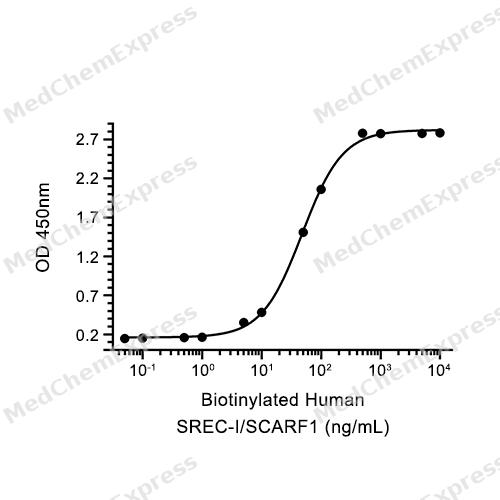
Measured by its binding ability in a functional ELISA. When Human AcLDL is immobilized at 10 µg/mL (100 µL/well) can bind Human SREC-I/SCARF1. The ED50 for this effect is 48.05 ng/mL.
MCE Validation Data
-
Purity - SDS-PAGE
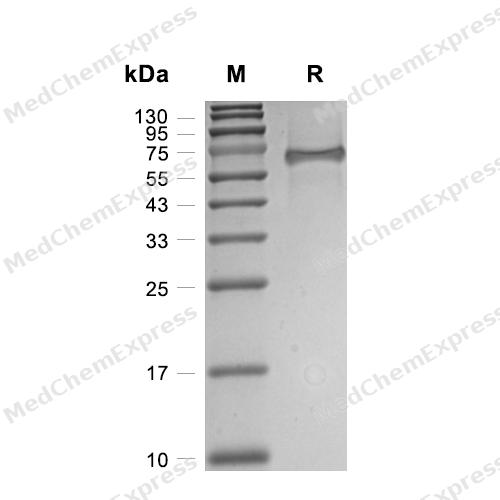
Purity - SDS-PAGE
-
Bioactivity - ELISA
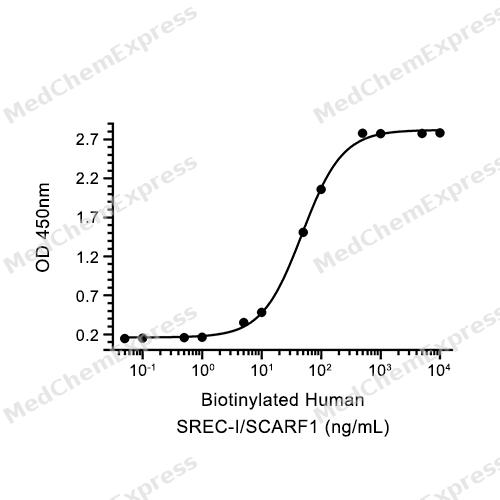
Bioactivity - ELISA


Technical Parameters
-
Species Human
-
Source HEK293
-
Tag C-6*His
-
Accession
Q14162 (S20-T421)
-
Gene ID8578
-
Molecular Construction
-
N-term
-
SREC-I (S20-T421)
Accession # Q14162 -
6*His
-
C-term
-
-
Protein Length
Extracellular Domain
-
Synonyms
SCARF1; Scavenger Receptor Expressed By Endothelial Cells 1; Scavenger Receptor Class F Member 1; SREC-I; Acetyl LDL Receptor; Scavenger Receptor Expressed By Endothelial Cells; SREC; Scavenger Receptor Class F, Member 1; KIAA0149; Alternative Protein SCA
-
AA Sequence
SELDPKGQHVCVASSPSAELQCCAGWRQKDQECTIPICEGPDACQKDEVCVKPGLCRCKPGFFGAHCSSRCPGQYWGPDCRESCPCHPHGQCEPATGACQCQADRWGARCEFPCACGPHGRCDPATGVCHCEPGWWSSTCRRPCQCNTAAARCEQATGACVCKPGWWGRRCSFRCNCHGSPCEQDSGRCACRPGWWGPECQQQCECVRGRCSAASGECTCPPGFRGARCELPCPAGSHGVQCAHSCGRCKHNEPCSPDTGSCESCEPGWNGTQCQQPCLPGTFGESCEQQCPHCRHGEACEPDTGHCQRCDPGWLGPRCEDPCPTGTFGEDCGSTCPTCVQGSCDTVTGDCVCSAGYWGPSCNASCPAGFHGNNCSVPCECPEGLCHPVSGSCQPGSGSRDT
-
Predicted Molecular Mass
42.5 kDa
-
Molecular Weight
Approximately 58-70 kDa, based on SDS-PAGE under reducing conditions, due to the glycosylation.
-
Purity
≥ 95%, as determined by reducing SDS-PAGE.


Product Properties
Lyophilized powder.
Lyophilized from a 0.22 μm filtered solution of PBS, pH 7.4, 8% trehalose.
<0.1 EU/μg, determined by LAL method.
It is not recommended to reconstitute to a concentration less than 100 μg/mL in PBS.
Stored at -20°C for 2 years from date of receipt. After reconstitution, it is stable at 4°C for 1 week or -20°C for longer (with carrier protein). It is recommended to freeze aliquots at -20°C or -80°C for extended storage.
Room temperature in continental US; may vary elsewhere.


Documentation
-
Data Sheet (238 KB)
-
SDS (251 KB)
- English - EN (251 KB)
- Français - FR (251 KB)
- Deutsch - DE (251 KB)
- Norwegian - NO (251 KB)
- Español - ES (251 KB)
- Swedish - SV (251 KB)
- Italian - IT (251 KB)
- Korean - KR (251 KB)
- Portuguese - PT (251 KB)
-
Handling Instructions (2659 KB)

Calculators
Concentration (start) × Volume (start) = Concentration (final) × Volume (final)


 Powered by Bioz

