



SULT1E1 Protein, Human (N-His)

Based on 1 Customer Validation
The SULT1E1 protein is a sulfotransferase that critically regulates estrogen homeostasis by sulfating estradiol and estrone, resulting in hormone inactivation. Its versatility extends to sulfated DHEA, pregnenolone, and xenobiotics such as ethinyl estradiol. SULT1E1 Protein, Human (N-His) is the recombinant human-derived SULT1E1 protein, expressed by E. coli , with N-His labeled tag.
- Species: Human
- Source: E. coli
-
Storage:Stored at -20°C for 2 years from date of receipt. After reconstitution, it is stable at 4°C for 1 week or -20°C for longer (with carrier protein). It is recommended to freeze aliquots at -20°C or -80°C for extended storage.


To place orders, for customer services and technical support, please contact: MedChemExpress USA
Tel: 609-228-6898 E-mail: [email protected] [email protected]


-
 Biological Activity
-
Technical Parameters
-
Product Properties
- Documentation
- Help & FAQs




Biological Activity
Description
The SULT1E1 protein is a sulfotransferase that critically regulates estrogen homeostasis by sulfating estradiol and estrone, resulting in hormone inactivation. Its versatility extends to sulfated DHEA, pregnenolone, and xenobiotics such as ethinyl estradiol. SULT1E1 Protein, Human (N-His) is the recombinant human-derived SULT1E1 protein, expressed by E. coli , with N-His labeled tag.
Background
SULT1E1 protein, a sulfotransferase utilizing 3'-phospho-5'-adenylyl sulfate (PAPS) as a sulfonate donor, plays a pivotal role in estrogen homeostasis by catalyzing the sulfate conjugation of estradiol and estrone, contributing to the inactivation of these hormones. Beyond its primary function in estrogen metabolism, SULT1E1 demonstrates versatility by sulfating dehydroepiandrosterone (DHEA), pregnenolone, (24S)-hydroxycholesterol, and various xenobiotic compounds such as ethinylestradiol, equalenin, diethyl stilbesterol, and 1-naphthol, albeit with lower efficiency. Notably, SULT1E1 does not sulfonate cortisol, testosterone, and dopamine. Moreover, this sulfotransferase may be implicated in gut microbiota-host metabolic interactions, as it O-sulfonates 4-ethylphenol (4-EP), a tyrosine-derived metabolite produced by gut bacteria. The resulting product, 4-EPS, crosses the blood-brain barrier and potentially exerts regulatory effects on oligodendrocyte maturation and myelination, influencing the functional connectivity of brain regions associated with the limbic system. The diverse substrate specificity of SULT1E1 highlights its crucial role in hormonal regulation and suggests its involvement in broader physiological processes, including gut-brain interactions with potential implications for neurological functions.
Verified Bioactivity
Measured by its ability to transfer sulfate from PAPS to 1-Napthol. The specific activity is 74.44 pmol/min/μg that incubate at 37 ºC for 20 minutes.
MCE Validation Data
-
Purity - SDS-PAGE
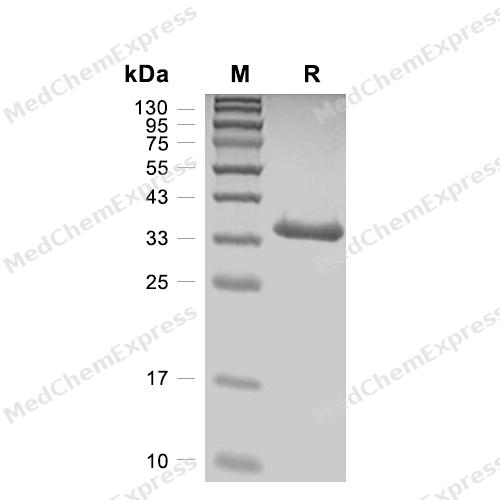
Purity - SDS-PAGE


Technical Parameters
-
Species Human
-
Source E. coli
-
Tag N-6*His
-
Accession
P49888 (N2-I294)
-
Gene ID6783
-
Molecular Construction
-
N-term
-
His
-
SULT1E1 (N2-I294)
Accession # P49888 -
C-term
-
-
Protein Length
Full Length
-
Synonyms
SULT1E1; Estrogen Sulfotransferase; Prev. STE; EST-1; Sulfotransferase, Estrogen-Preferring; ST1E1; EST; Estrone Sulfotransferase; Sulfotransferase Family 1E, Estrogen-Preferring, Member 1; Sulfotransferase; Sulfotransferase Family 1E Member 1; Sulfotrans
-
AA Sequence
NSELDYYEKFEEVHGILMYKDFVKYWDNVEAFQARPDDLVIATYPKSGTTWVSEIVYMIYKEGDVEKCKEDVIFNRIPFLECRKENLMNGVKQLDEMNSPRIVKTHLPPELLPASFWEKDCKIIYLCRNAKDVAVSFYYFFLMVAGHPNPGSFPEFVEKFMQGQVPYGSWYKHVKSWWEKGKSPRVLFLFYEDLKEDIRKEVIKLIHFLERKPSEELVDRIIHHTSFQEMKNNPSTNYTTLPDEIMNQKLSPFMRKGITGDWKNHFTVALNEKFDKHYEQQMKESTLKFRTEI
-
Predicted Molecular Mass
35 kDa
-
Molecular Weight
Approximately 36 kDa, based on SDS-PAGE under reducing conditions.
-
Purity
≥ 90%, as determined by reducing SDS-PAGE.


Product Properties
Lyophilized powder.
Lyophilized from a 0.22 μm filtered solution of 50 mM Tris-HCl, 200 mM NaCl, pH 7.4, 8% trehalose.
Note: For SPR assay, please replace the buffer. Primary amine components (e.g., Tris, imidazole) can affect protein-coupled chips.
<1 EU/μg, determined by LAL method.
It is not recommended to reconstitute to a concentration less than 100 μg/mL in ddH2O.
Stored at -20°C for 2 years from date of receipt. After reconstitution, it is stable at 4°C for 1 week or -20°C for longer (with carrier protein). It is recommended to freeze aliquots at -20°C or -80°C for extended storage.
Room temperature in continental US; may vary elsewhere.


Documentation
-
Data Sheet (237 KB)
-
SDS (251 KB)
- English - EN (251 KB)
- Français - FR (251 KB)
- Deutsch - DE (251 KB)
- Norwegian - NO (251 KB)
- Español - ES (251 KB)
- Swedish - SV (251 KB)
- Italian - IT (251 KB)
- Korean - KR (251 KB)
- Portuguese - PT (251 KB)
-
Handling Instructions (2659 KB)

Calculators
Concentration (start) × Volume (start) = Concentration (final) × Volume (final)


 Powered by Bioz

