



TFRC Protein, Mouse (HEK293, His)

Based on 1 Customer Validation
TFRC is a key protein in cellular iron uptake, coordinating receptor-mediated endocytosis of the ligand transferrin into specialized endosomes, where endosomal acidification triggers iron release.TFRC actively regulates T and B cell proliferation through iron uptake.TFRC Protein, Mouse (HEK293, His) is the recombinant mouse-derived TFRC protein, expressed by HEK293 , with N-8*His labeled tag.
- Species: Mouse
- Source: HEK293
-
Storage:Stored at -20°C for 2 years from date of receipt. After reconstitution, it is stable at 4°C for 1 week or -20°C for longer (with carrier protein). It is recommended to freeze aliquots at -20°C or -80°C for extended storage.


To place orders, for customer services and technical support, please contact: MedChemExpress USA
Tel: 609-228-6898 E-mail: [email protected] [email protected]


-
 Biological Activity
-
Technical Parameters
-
Product Properties
- Documentation
- Help & FAQs




Biological Activity
Description
TFRC is a key protein in cellular iron uptake, coordinating receptor-mediated endocytosis of the ligand transferrin into specialized endosomes, where endosomal acidification triggers iron release.TFRC actively regulates T and B cell proliferation through iron uptake.TFRC Protein, Mouse (HEK293, His) is the recombinant mouse-derived TFRC protein, expressed by HEK293 , with N-8*His labeled tag.
Background
TFRC, a pivotal protein in cellular iron uptake, orchestrates receptor-mediated endocytosis of ligand-occupied transferrin into specialized endosomes, where endosomal acidification triggers iron release. The apotransferrin-receptor complex undergoes recycling to the cell surface while a return to neutral pH, leading to the loss of apotransferrin affinity for its receptor. Essential for erythrocyte and nervous system development, TFRC positively regulates T and B cell proliferation through iron uptake. Acting as a lipid sensor, TFRC modulates mitochondrial fusion by regulating the JNK pathway. Low dietary stearate levels induce JNK pathway activation, resulting in HUWE1-mediated ubiquitination and degradation of mitofusin MFN2, inhibiting mitochondrial fusion. Conversely, high stearate levels stearoylate TFRC, suppressing JNK pathway activation and preventing MFN2 degradation. TFRC also can function as a homodimer with disulfide linkage, binding one transferrin molecule per subunit, and interacts with SH3BP4 and STEAP3, the latter facilitating TFRC endocytosis in erythroid precursor cells.
MCE Validation Data
-
Bioactivity - SPR
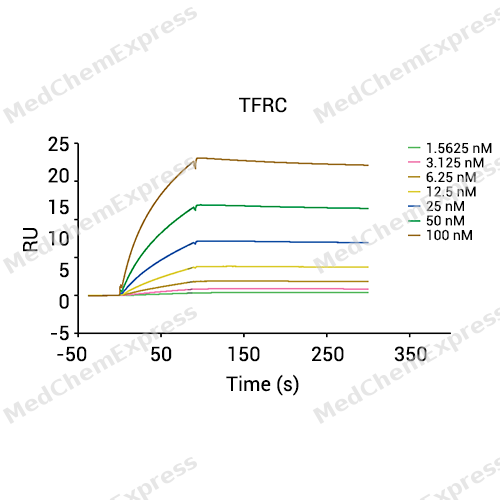
Bioactivity - SPR


Technical Parameters
-
Species Mouse
-
Source HEK293
-
Tag N-8*His
-
Accession
Q62351 (C89-F763)
-
Molecular Construction
-
N-term
-
8*His
-
TFRC (C89-F763)
Accession # Q62351 -
C-term
-
-
Protein Length
Extracellular Domain
-
Synonyms
TFRC; Transferrin Receptor (P90, CD71); Transferrin Receptor; CD71 Antigen; P90; IMD46; Transferrin Receptor Protein 1; TRFR; CD71; Trfr; TFR1; TfR1; Transferrin Receptor 1; TFR; T9; TfR; TR
-
AA Sequence
CKRVEQKEECVKLAETEETDKSETMETEDVPTSSRLYWADLKTLLSEKLNSIEFADTIKQLSQNTYTPREAGSQKDESLAYYIENQFHEFKFSKVWRDEHYVKIQVKSSIGQNMVTIVQSNGNLDPVESPEGYVAFSKPTEVSGKLVHANFGTKKDFEELSYSVNGSLVIVRAGEITFAEKVANAQSFNAIGVLIYMDKNKFPVVEADLALFGHAHLGTGDPYTPGFPSFNHTQFPPSQSSGLPNIPVQTISRAAAEKLFGKMEGSCPARWNIDSSCKLELSQNQNVKLIVKNVLKERRILNIFGVIKGYEEPDRYVVVGAQRDALGAGVAAKSSVGTGLLLKLAQVFSDMISKDGFRPSRSIIFASWTAGDFGAVGATEWLEGYLSSLHLKAFTYINLDKVVLGTSNFKVSASPLLYTLMGKIMQDVKHPVDGKSLYRDSNWISKVEKLSFDNAAYPFLAYSGIPAVSFCFCEDADYPYLGTRLDTYEALTQKVPQLNQMVRTAAEVAGQLIIKLTHDVELNLDYEMYNSKLLSFMKDLNQFKTDIRDMGLSLQWLYSARGDYFRATSRLTTDFHNAEKTNRFVMREINDRIMKVEYHFLSPYVSPRESPFRHIFWGSGSHTLSALVENLKLRQKNITAFNETLFRNQLALATWTIQGVANALSGDIWNIDNEF
-
Predicted Molecular Mass
77 kDa
-
Molecular Weight
Approximately 78-90 kDa, based on SDS-PAGE under reducing conditions, due to the glycosylation.
-
Glycosylation
Yes
-
Purity
≥ 95%, as determined by reducing SDS-PAGE.


Product Properties
Lyophilized powder
1.Lyophilized from a 0.22 μm filtered solution of PBS, pH 7.4.
2.Lyophilized from a 0.22 μm filtered solution of 20 mM Tris-HCl, 150 mM NaCl, 5% trehalose, 5% mannitol, 0.01% Tween 80, pH 7.4.
Please refer to the lot-specific COA for specific buffer information.
Note: For SPR assay, please replace the buffer. Primary amine components (e.g., Tris, imidazole) can affect protein-coupled chips.
<1 EU/μg, determined by LAL method.
It is not recommended to reconstitute to a concentration less than 100 μg/mL in ddH2O. For long term storage it is recommended to add a carrier protein (0.1% BSA, 5% HSA, 10% FBS or 5% Trehalose).
Stored at -20°C for 2 years from date of receipt. After reconstitution, it is stable at 4°C for 1 week or -20°C for longer (with carrier protein). It is recommended to freeze aliquots at -20°C or -80°C for extended storage.
Room temperature in continental US; may vary elsewhere.


Documentation
-
Data Sheet (240 KB)
-
SDS (251 KB)
- English - EN (251 KB)
- Français - FR (251 KB)
- Deutsch - DE (251 KB)
- Norwegian - NO (251 KB)
- Español - ES (251 KB)
- Swedish - SV (251 KB)
- Italian - IT (251 KB)
- Korean - KR (251 KB)
- Portuguese - PT (251 KB)
-
Handling Instructions (2659 KB)

Calculators
Concentration (start) × Volume (start) = Concentration (final) × Volume (final)


 Powered by Bioz

