



TIM-3/HAVCR2 Protein, Human (HEK293, Fc)

Based on 1 Customer Validation
TIM3 Protein, Human (HEK293, Fc) is a type I transmembrane glycoprotein belonging to T Cell Immunoglobulin Mucin (TIM) family, and is involved in regulating innate and adaptive immunity.
- Species: Human
- Source: HEK293
-
Storage:Stored at -20°C for 2 years from date of receipt. After reconstitution, it is stable at 4°C for 1 week or -20°C for longer (with carrier protein). It is recommended to freeze aliquots at -20°C or -80°C for extended storage.


To place orders, for customer services and technical support, please contact: MedChemExpress USA
Tel: 609-228-6898 E-mail: [email protected] [email protected]


-
 Biological Activity
-
Technical Parameters
-
Product Properties
- Documentation
- References
- Help & FAQs




Biological Activity
Description
TIM3 Protein, Human (HEK293, Fc) is a type I transmembrane glycoprotein belonging to T Cell Immunoglobulin Mucin (TIM) family, and is involved in regulating innate and adaptive immunity.
Background
T Cell Immunoglobulin Mucin 3 (TIM-3), also known as Hepatitis A virus cellular receptor 2 (HAVCR2), is an immunomodulatory molecule and upregulated in T cells by several cytokines. TIM-3 also influences mast cell function but its transcriptional regulation in mast cells has not been clarified. Human TIM-3 consists of a membrane distal variable immunoglobulin (IgV)-like domain involved in ligand interactions, a membrane proximal mucin domain and a transmembrane domain that is connected to an intracellular cytoplasmic tail involved in phosphotyrosine-dependent signaling[1][2][3].
Verified Bioactivity
1.Immobilized TIM-3, hFc, Human at 0.5 μg/mL, the concentration of Anti-TIM3 mouse antibody (Genscript) that produces 50% optimal binding response is found to be approximately 5.0 ng/mL.
2.Immobilized Galectin-9, His, Human at 0.5 μg/mL (100 µL/well) can bind TIM-3, hFc, Human with a linear range of 0.78-6.25 μg/mL.
MCE Validation Data
-
Purity - SDS-PAGE
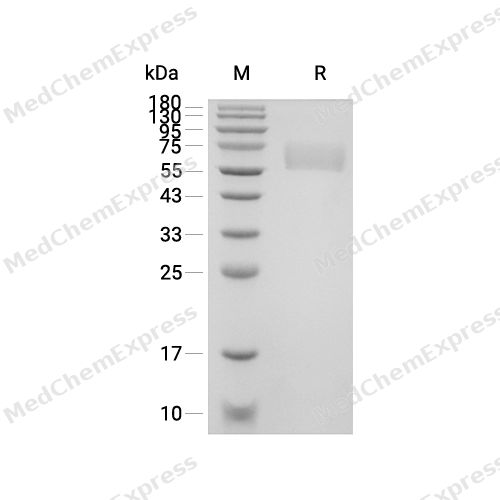
Purity - SDS-PAGE


Technical Parameters
-
Species Human
-
Source HEK293
-
Tag C-hFc
-
Accession
Q8TDQ0-1 (S22-R200)
-
Molecular Construction
-
N-term
-
TIM-3 (S22-R200)
Accession # Q8TDQ0-1 -
hFc
-
C-term
-
-
Protein Length
Extracellular Domain
-
Synonyms
HAVCR2; FLJ14428; Hepatitis A Virus Cellular Receptor 2; HAVcr-2; TIMD3; TIMD-3; TIM3; T-Cell Immunoglobulin And Mucin Domain 3; Tim-3; T Cell Immunoglobulin Mucin 3; CD366; Kidney Injury Molecule-3; T-Cell Immunoglobulin And Mucin Domain-Containing Prote
-
AA Sequence
SEVEYRAEVGQNAYLPCFYTPAAPGNLVPVCWGKGACPVFECGNVVLRTDERDVNYWTSRYWLNGDFRKGDVSLTIENVTLADSGIYCCRIQIPGIMNDEKFNLKLVIKPAKVTPAPTRQRDFTAAFPRMLTTRGHGPAETQTLGSLPDINLTQISTLANELRDSRLANDLRDSGATIR
-
Predicted Molecular Mass
46.5 kDa
-
Molecular Weight
Approximately 60-80 kDa, based on SDS-PAGE under reducing conditions, due to the glycosylation.
-
Glycosylation
Yes
-
Purity
≥ 95%, as determined by reducing SDS-PAGE.


Product Properties
Lyophilized powder.
Lyophilized from a 0.22 μm filtered solution of PBS.
<0.2 EU/μg, determined by LAL method.
It is not recommended to reconstitute to a concentration less than 100 μg/mL in ddH2O. For long term storage it is recommended to add a carrier protein (0.1% BSA, 5% HSA, 10% FBS or 5% Trehalose).
Stored at -20°C for 2 years from date of receipt. After reconstitution, it is stable at 4°C for 1 week or -20°C for longer (with carrier protein). It is recommended to freeze aliquots at -20°C or -80°C for extended storage.
Room temperature in continental US; may vary elsewhere.


Documentation
-
Data Sheet (263 KB)
-
SDS (251 KB)
- English - EN (251 KB)
- Français - FR (251 KB)
- Deutsch - DE (251 KB)
- Norwegian - NO (251 KB)
- Español - ES (251 KB)
- Swedish - SV (251 KB)
- Italian - IT (251 KB)
- Korean - KR (251 KB)
- Portuguese - PT (251 KB)
-
Handling Instructions (2659 KB)


References
[1]. Homayouni V, et al. Stimulation of Camel Polyclonal Antibody against Human T cell Immunoglobulin and Mucin 3. Iran J Biotechnol. 2017 Sep 27;15(3):166-171 [Content Brief]
[2]. Kim JS, et al. T Cell Immunoglobulin Mucin Domain (TIM)-3 Promoter Activity in a Human Mast Cell Line. Immune Netw. 2012 Oct;12(5):207-12. [Content Brief]
[3]. Gandhi AK, et al. High resolution X-ray and NMR structural study of human T-cell immunoglobulin and mucindomain containing protein-3. Sci Rep. 2018 Nov 30;8(1):17512. [Content Brief]

Calculators
Concentration (start) × Volume (start) = Concentration (final) × Volume (final)


 Powered by Bioz

