



TNF RI/TNFRSF1A Protein, Human (His)
Based on 1 Customer Validation
TNFRSF1A (TNF RI) protein has a high ability to bind with tumor necrosis factor-alpha (TNF-α). TNFRSF1A is a STAT3 target gene that regulates the NF-κB pathway. TNFRSF1A activate NF-κB, mediate apoptosis, and function as a regulator of inflammation. TNF RI/TNFRSF1A Protein, Human (His) is expressed by E. coli with a 6*His tag at the N-terminus.
- Species: Human
- Source: E. coli
-
Storage:Stored at -20°C for 2 years from date of receipt. After reconstitution, it is stable at 4°C for 1 week or -20°C for longer (with carrier protein). It is recommended to freeze aliquots at -20°C or -80°C for extended storage.


To place orders, for customer services and technical support, please contact: MedChemExpress USA
Tel: 609-228-6898 E-mail: [email protected] [email protected]


-
 Biological Activity
-
Technical Parameters
-
Product Properties
- Documentation
- References
- Help & FAQs




Biological Activity
Description
TNFRSF1A (TNF RI) protein has a high ability to bind with tumor necrosis factor-alpha (TNF-α). TNFRSF1A is a STAT3 target gene that regulates the NF-κB pathway. TNFRSF1A activate NF-κB, mediate apoptosis, and function as a regulator of inflammation. TNF RI/TNFRSF1A Protein, Human (His) is expressed by E. coli with a 6*His tag at the N-terminus[1].
Background
TNFRSF1A (TNF RI) protein is a single-pass type I membrane protein belonging to the tumor necrosis factor (TNF) family. TNFRSF1A is the major signaling receptor for TNF-α. TNFRSF1A protein is a multifunctional cytokine, which is synthesized by almost all cells[1][2].
The sequence of amino acids in TNFRSF1A from different species is very different (less than 85% similarity among human, rat and mouse).
TNFRSF1A contains a protein-protein interaction domain, called death domain (DD), can recruit other DD-containing proteins and couples the death receptors to caspase activation and apoptosis. Both soluble and membrane-bound forms of the cytokine can activate TNFRSF1A. TNFRSF1A induces cellular inflammatory damage and apoptosis by participating in mTOR, JNK, IKK, caspase 3, MAPK, and NF-κB pathways[1][3][4].
Verified Bioactivity
1.Measured by its ability to inhibit the TNF-alpha mediated cytotoxicity in the L-929 mouse fibroblast cells in the presence of the metabolic inhibitoractinomycin D.The ED50 for this effect is 0.03-0.09 μg/mL in the presence of 0.25 ng/mL of recombinant human TNF-alpha.
2.Loaded Atrosab (HY-P990008) on AHC2 biosensor, can bind TNFRSF1A Protein, Human (His) with an affinity constant of 1.151E-08 M as determined in BLI assay.
MCE Validation Data
-
Purity - SDS-PAGE
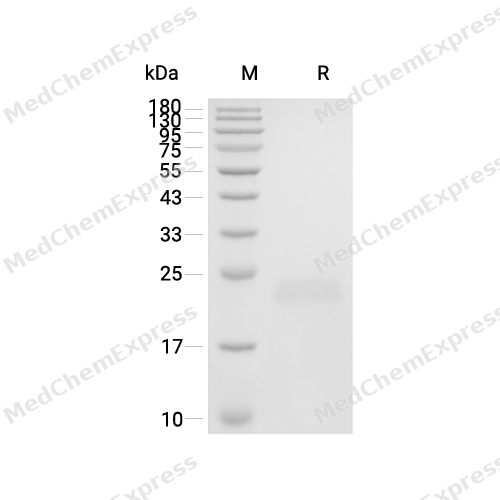
Purity - SDS-PAGE
-
Bioactivity - Cell-Based Assay
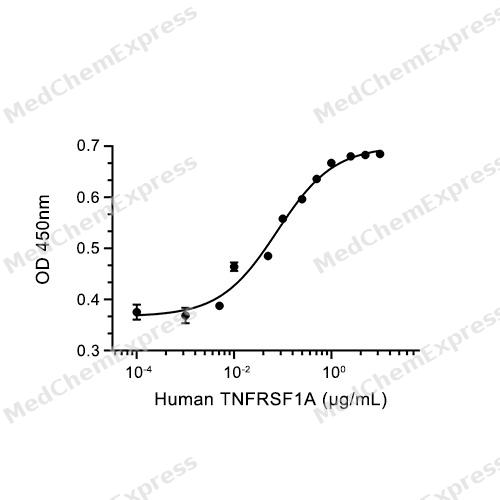
Bioactivity - Cell-Based Assay
-
Bioactivity - BLI
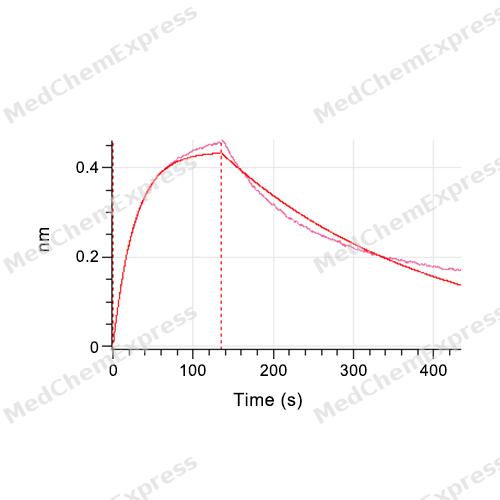
Bioactivity - BLI


Technical Parameters
-
Species Human
-
Source E. coli
-
Tag N-6*His
-
Accession
P19438-1 (I22-T211)
-
Molecular Construction
-
N-term
-
6*His
-
TNFRSF1A (I22-T211)
Accession # P19438-1 -
C-term
-
-
Protein Length
Partial Extracellular Domain
-
Synonyms
TNFRSF1A; Tumor Necrosis Factor Receptor 1; Prev. TNFR1; TNF-RI; TNFAR; TNFR-I; Tumor Necrosis Factor Receptor Superfamily Member 1A; Tumor Necrosis Factor Receptor Superfamily, Member 1A; TNF-R-I; Tumor Necrosis Factor Binding Protein 1; TNF-R55; Tumor N
-
AA Sequence
IYPSGVIGLVPHLGDREKRDSVCPQGKYIHPQNNSICCTKCHKGTYLYNDCPGPGQDTDCRECESGSFTASENHLRHCLSCSKCRKEMGQVEISSCTVDRDTVCGCRKNQYRHYWSENLFQCFNCSLCLNGTVHLSCQEKQNTVCTCHAGFFLRENECVSCSNCKKSLECTKLCLPQIENVKGTEDSGTT
-
Predicted Molecular Mass
22.1 kDa
-
Molecular Weight
Approximately 23 kDa, based on SDS-PAGE under reducing conditions.
-
Purity
≥ 95%, as determined by reducing SDS-PAGE.


Product Properties
Lyophilized powder
1.Lyophilized from a 0.22 μm filtered solution of PBS, pH 7.4.
2.Lyophilized from a 0.22 μm filtered solution of PBS, pH 7.4, 8% trehalose.
Please refer to the lot-specific COA for specific buffer information.
<1 EU/μg, determined by LAL method.
It is not recommended to reconstitute to a concentration less than 100 μg/mL in ddH2O. For long term storage it is recommended to add a carrier protein (0.1% BSA, 5% HSA, 10% FBS or 5% Trehalose).
Stored at -20°C for 2 years from date of receipt. After reconstitution, it is stable at 4°C for 1 week or -20°C for longer (with carrier protein). It is recommended to freeze aliquots at -20°C or -80°C for extended storage.
Room temperature in continental US; may vary elsewhere.


Documentation
-
Data Sheet (264 KB)
-
SDS (252 KB)
- English - EN (252 KB)
- Français - FR (252 KB)
- Deutsch - DE (252 KB)
- Norwegian - NO (252 KB)
- Español - ES (252 KB)
- Swedish - SV (252 KB)
- Italian - IT (252 KB)
- Korean - KR (252 KB)
- Portuguese - PT (252 KB)
-
Handling Instructions (2659 KB)


References
[1]. Wajant H, et, al. Tumor necrosis factor signaling. Cell Death Differ. 2003 Jan;10(1):45-65. [Content Brief]
[2]. Fu Q, et, al. miR-29a up-regulation in AR42J cells contributes to apoptosis via targeting TNFRSF1A gene. World J Gastroenterol. 2016 May 28;22(20):4881-90. [Content Brief]
[3]. Zhou S, et, al. Bioinformatics Analysis Identifies TNFRSF1A as a Biomarker of Liver Injury in Sepsis TNFRSF1A is a Biomarker for Septic Liver Injury. Genet Res (Camb). 2022 Oct 15;2022:1493744. [Content Brief]
[4]. Egusquiaguirre SP, et, al. The STAT3 Target Gene TNFRSF1A Modulates the NF-κB Pathway in Breast Cancer Cells. Neoplasia. 2018 May;20(5):489-498. [Content Brief]

Calculators
Concentration (start) × Volume (start) = Concentration (final) × Volume (final)


 Powered by Bioz

