



TOP1 Protein, Human (575a.a, sf9, His)

Based on 1 Customer Validation
The TOP1 protein is critical in cellular processes, mitigating DNA supercoiling and torsional tension during replication and transcription. It does this by transiently cutting and rejoining a DNA strand, introducing breaks through transesterification. TOP1 Protein, Human (575a.a, sf9, His) is the recombinant human-derived TOP1 protein, expressed by Sf9 insect cells , with N-His labeled tag.
- Species: Human
- Source: Sf9 insect cells
-
Storage:Stored at -80°C for 1 year from date of receipt. It is stable at -20°C for 3 months after opening. It is recommended to freeze aliquots at -80°C for extended storage. Avoid repeated freeze-thaw cycles.


To place orders, for customer services and technical support, please contact: MedChemExpress USA
Tel: 609-228-6898 E-mail: [email protected] [email protected]


-
 Biological Activity
-
Technical Parameters
-
Product Properties
- Documentation
- Help & FAQs




Biological Activity
Description
The TOP1 protein is critical in cellular processes, mitigating DNA supercoiling and torsional tension during replication and transcription. It does this by transiently cutting and rejoining a DNA strand, introducing breaks through transesterification. TOP1 Protein, Human (575a.a, sf9, His) is the recombinant human-derived TOP1 protein, expressed by Sf9 insect cells , with N-His labeled tag.
Background
TOP1 protein plays a pivotal role in cellular processes by alleviating the supercoiling and torsional tension of DNA generated during DNA replication and transcription. This is achieved through the transient cleavage and subsequent rejoining of one strand of the DNA duplex. The enzyme introduces a single-strand break via transesterification at a specific target site in duplex DNA, leading to the formation of a DNA-(3'-phosphotyrosyl)-enzyme intermediate. This intermediate expels a 5'-OH DNA strand, allowing the free DNA strand to rotate around the intact phosphodiester bond on the opposing strand, effectively removing DNA supercoils. In the final religation step, the DNA 5'-OH attacks the covalent intermediate, leading to the expulsion of the active-site tyrosine and restoration of the DNA phosphodiester backbone. Beyond its role in DNA topology maintenance, TOP1 is involved in the regulation of alternative splicing, exemplified by its impact on tissue factor (F3) pre-mRNA in endothelial cells. Additionally, it contributes to the circadian transcription of the core circadian clock component BMAL1 by modifying the chromatin structure surrounding the ROR response elements (ROREs) on the BMAL1 promoter.
MCE Validation Data
-
Purity - SDS-PAGE
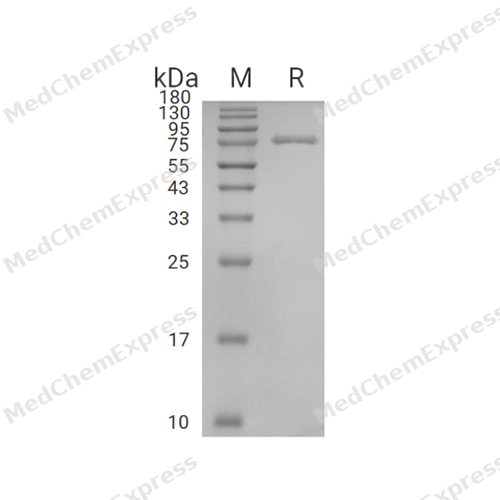
Purity - SDS-PAGE


Technical Parameters
-
Species Human
-
Source Sf9 insect cells
-
Tag N-His
-
Accession
P11387 (K191-F765)
-
Molecular Construction
-
N-term
-
His
-
TOP1 (K191-F765)
Accession # P11387 -
C-term
-
-
Protein Length
Partial
-
Synonyms
TOP1; Scl-70 Antigen; DNA Topoisomerase I; Type I DNA Topoisomerase; DNA Topoisomerase 1; TOP1 Protein; Topoisomerase (DNA) I; TOPI
-
AA Sequence
KKKKPKKEEEQKWKWWEEERYPEGIKWKFLEHKGPVFAPPYEPLPENVKFYYDGKVMKLSPKAEEVATFFAKMLDHEYTTKEIFRKNFFKDWRKEMTNEEKNIITNLSKCDFTQMSQYFKAQTEARKQMSKEEKLKIKEENEKLLKEYGFCIMDNHKERIANFKIEPPGLFRGRGNHPKMGMLKRRIMPEDIIINCSKDAKVPSPPPGHKWKEVRHDNKVTWLVSWTENIQGSIKYIMLNPSSRIKGEKDWQKYETARRLKKCVDKIRNQYREDWKSKEMKVRQRAVALYFIDKLALRAGNEKEEGETADTVGCCSLRVEHINLHPELDGQEYVVEFDFLGKDSIRYYNKVPVEKRVFKNLQLFMENKQPEDDLFDRLNTGILNKHLQDLMEGLTAKVFRTYNASITLQQQLKELTAPDENIPAKILSYNRANRAVAILCNHQRAPPKTFEKSMMNLQTKIDAKKEQLADARRDLKSAKADAKVMKDAKTKKVVESKKKAVQRLEEQLMKLEVQATDREENKQIALGTSKLNYLDPRITVAWCKKWGVPIEKIYNKTQREKFAWAIDMADEDYEF
-
Predicted Molecular Mass
70.4 kDa
-
Molecular Weight
Approximately 60-70 kDa, based on SDS-PAGE under reducing conditions.
-
Purity
≥ 90%, as determined by reducing SDS-PAGE.


Product Properties
Solution
Supplied as a 0.22 μm filtered solution of 20 mM Tris, 200 mM NaCl, 20% glycerol, pH 7.5.
Note: For SPR assay, please replace the buffer. Primary amine components (e.g., Tris, imidazole) can affect protein-coupled chips.
<1 EU/μg, determined by LAL method.
Stored at -80°C for 1 year from date of receipt. It is stable at -20°C for 3 months after opening. It is recommended to freeze aliquots at -80°C for extended storage. Avoid repeated freeze-thaw cycles.
Shipping with dry ice.


Documentation
-
Data Sheet (239 KB)
-
SDS (251 KB)
- English - EN (251 KB)
- Français - FR (251 KB)
- Deutsch - DE (251 KB)
- Norwegian - NO (251 KB)
- Español - ES (251 KB)
- Swedish - SV (251 KB)
- Italian - IT (251 KB)
- Korean - KR (251 KB)
- Portuguese - PT (251 KB)
-
Handling Instructions (2659 KB)

Calculators
Concentration (start) × Volume (start) = Concentration (final) × Volume (final)


 Powered by Bioz

