



Toxin B/TcdB Protein, C. difficile (His)
Based on 2 publication(s) in Google Scholar
Toxin B/TcdB protein is the precursor of the cytotoxin TcdB, which can strategically destroy the colon epithelium and cause host inflammatory response and diarrhea in Clostridium difficile infection. Compared with TcdA, TcdB has higher virulence and is essential for eliciting host responses. Toxin B/TcdB Protein, C. difficile (His) is the recombinant Toxin B/TcdB protein, expressed by E. coli , with C-6*His labeled tag.
- Species: Others
- Source: E. coli
-
Storage:Stored at -80°C for 1 year from date of receipt. It is stable at -20°C for 3 months after opening. It is recommended to freeze aliquots at -80°C for extended storage. Avoid repeated freeze-thaw cycles.


To place orders, for customer services and technical support, please contact: MedChemExpress USA
Tel: 609-228-6898 E-mail: [email protected] [email protected]


-
 Biological Activity
-
Technical Parameters
-
Product Properties
- Documentation
- Help & FAQs




Biological Activity
Description
Toxin B/TcdB protein is the precursor of the cytotoxin TcdB, which can strategically destroy the colon epithelium and cause host inflammatory response and diarrhea in Clostridium difficile infection. Compared with TcdA, TcdB has higher virulence and is essential for eliciting host responses. Toxin B/TcdB Protein, C. difficile (His) is the recombinant Toxin B/TcdB protein, expressed by E. coli , with C-6*His labeled tag.
Background
Toxin B/TcdB Protein serves as the precursor of a cytotoxin that strategically targets and disrupts the colonic epithelium, thereby instigating host inflammatory and innate immune responses that manifest as diarrhea and pseudomembranous colitis. This cytotoxin, TcdB, plays a central role in the pathology of C. difficile infection, an opportunistic pathogen that takes hold in the colon when the normal gut microbiome is disrupted. In comparison to TcdA, TcdB demonstrates heightened virulence and is particularly instrumental in eliciting host inflammatory and innate immune responses. Functioning as the precursor of the toxin, Toxin B enters host cells and undergoes autoprocessing, leading to the release of the active toxin, Glucosyltransferase TcdB, into the host cytosol. The toxin targets colonic epithelia by binding to frizzled receptors such as FZD1, FZD2, and FZD7, entering host cells through clathrin-mediated endocytosis. While frizzled receptors are primary in the colonic epithelium, additional receptors like CSPG4 or NECTIN3/PVRL3 have been identified. Carbohydrate and sulfated glycosaminoglycan binding on the host cell surface also contributes to cellular entry. Once inside host cells, acidification in the endosome triggers membrane insertion of the translocation region and pore formation, facilitating translocation of the GT44 and peptidase C80 domains across the endosomal membrane. This initiates the activation of the peptidase C80 domain through autocatalytic processing, releasing the N-terminal part (Glucosyltransferase TcdB) as the active toxin in the cytosol. The active form of the toxin, through monoglucosylation, inactivates small GTPases of the Rho family (Rac1, RhoA, RhoB, RhoC, RhoG, and Cdc42) in host cells, preventing downstream effector recognition, thereby disrupting the actin cytoskeleton and inducing cell death. This sequence of events results in the loss of colonic epithelial barrier function, contributing to the severe manifestations of C. difficile infection.
Verified Bioactivity
Measured by its ability to hydrolyze UDP-Glucose. The specific activity is ≥33.1357 pmol/min/μg, as measured under the described conditions.
MCE Validation Data
-
Purity - SDS-PAGE
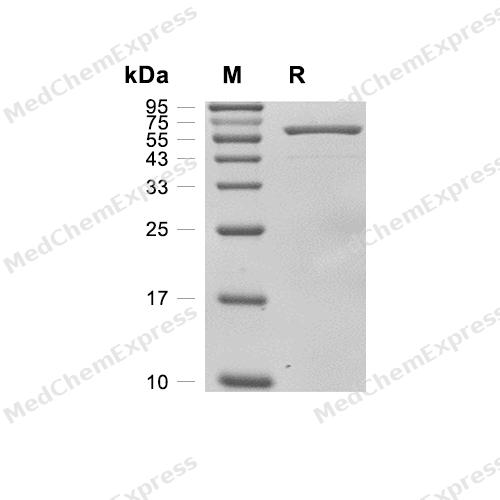
Purity - SDS-PAGE


Publications (2)
-
Journal Impact Factor
-
Most Recent
-
Pharmacol Res
ZBTB16 controls the onset of Clostridium difficile colitis through the Pyrin inflammasome. [Abstract]2026 Mar:225:108133. PMID: 41666999 -
Cell Rep
The Hippo pathway kinase MST1 mediates a feedback loop to maintain NLRP3 inflammasome homeostasis. [Abstract]2025 Jul 26;44(8):116076. PMID: 40716062


Technical Parameters
-
Species Others
-
Source E. coli
-
Tag C-6*His
-
Accession
P18177 (M1-L543)
-
Gene ID4914074
-
Molecular Construction
-
N-term
-
TcdB (M1-L543)
Accession # P18177 -
6*His
-
C-term
-
-
Protein Length
Full Length of Glucosyltransferase TcdB Chain
-
Synonyms
Toxin B; EC:3.4.22.-; Glucosyltransferase TcdB; EC:2.4.1.-; tcdB; toxB
-
AA Sequence
MSLVNRKQLEKMANVRFRTQEDEYVAILDALEEYHNMSENTVVEKYLKLKDINSLTDIYIDTYKKSGRNKALKKFKEYLVTEVLELKNNNLTPVEKNLHFVWIGGQINDTAINYINQWKDVNSDYNVNVFYDSNAFLINTLKKTVVESAINDTLESFRENLNDPRFDYNKFFRKRMEIIYDKQKNFINYYKAQREENPELIIDDIVKTYLSNEYSKEIDELNTYIEESLNKITQNSGNDVRNFEEFKNGESFNLYEQELVERWNLAAASDILRISALKEIGGMYLDVDMLPGIQPDLFESIEKPSSVTVDFWEMTKLEAIMKYKEYIPEYTSEHFDMLDEEVQSSFESVLASKSDKSEIFSSLGDMEASPLEVKIAFNSKGIINQGLISVKDSYCSNLIVKQIENRYKILNNSLNPAISEDNDFNTTTNTFIDSIMAEANADNGRFMMELGKYLRVGFFPDVKTTINLSGPEAYAAAYQDLLMFKEGSMNIHLIEADLRNFEISKTNISQSTEQEMASLWSFDDARAKAQFEEYKRNYFEGSL
-
Predicted Molecular Mass
63.1 kDa
-
Molecular Weight
65-68 kDa
-
Purity
≥ 95%, as determined by reducing SDS-PAGE.


Product Properties
Solution
Supplied as a 0.22 μm filtered solution of 50 mM Tris-HCl, 300 mM NaCL, pH 8.0.
Note: For SPR assay, please replace the buffer. Primary amine components (e.g., Tris, imidazole) can affect protein-coupled chips.
<1 EU/μg, determined by LAL method.
Stored at -80°C for 1 year from date of receipt. It is stable at -20°C for 3 months after opening. It is recommended to freeze aliquots at -80°C for extended storage. Avoid repeated freeze-thaw cycles.
Shipping with dry ice.


Documentation
-
Data Sheet (239 KB)
-
SDS (252 KB)
- English - EN (252 KB)
- Français - FR (252 KB)
- Deutsch - DE (252 KB)
- Norwegian - NO (252 KB)
- Español - ES (252 KB)
- Swedish - SV (252 KB)
- Italian - IT (252 KB)
- Korean - KR (252 KB)
- Portuguese - PT (252 KB)
-
Handling Instructions (2659 KB)

Calculators
Concentration (start) × Volume (start) = Concentration (final) × Volume (final)


 Powered by Bioz

