



TRIM5 Protein, Human (N-His)

Based on 1 Customer Validation
The TRIM5 protein is a capsid-specific restriction factor that prevents non-host adapted retroviral infection. TRIM5 acts as a pattern recognition receptor that activates innate immune signaling by triggering E3 ubiquitin ligase activity upon binding to viral capsids. TRIM5 restricts various retroviruses and regulates autophagy. TRIM5 Protein, Human (N-His) is the recombinant human-derived TRIM5 protein, expressed by E. coli , with N-6*His labeled tag.
- Species: Human
- Source: E. coli
-
Storage:Stored at -20°C for 2 years from date of receipt. After reconstitution, it is stable at 4°C for 1 week or -20°C for longer (with carrier protein). It is recommended to freeze aliquots at -20°C or -80°C for extended storage.


To place orders, for customer services and technical support, please contact: MedChemExpress USA
Tel: 609-228-6898 E-mail: [email protected] [email protected]


-
 Biological Activity
-
Technical Parameters
-
Product Properties
- Documentation
- Help & FAQs




Biological Activity
Description
The TRIM5 protein is a capsid-specific restriction factor that prevents non-host adapted retroviral infection. TRIM5 acts as a pattern recognition receptor that activates innate immune signaling by triggering E3 ubiquitin ligase activity upon binding to viral capsids. TRIM5 restricts various retroviruses and regulates autophagy. TRIM5 Protein, Human (N-His) is the recombinant human-derived TRIM5 protein, expressed by E. coli , with N-6*His labeled tag.
Background
TRIM5 is a capsid-specific restriction factor that effectively prevents infection by non-host-adapted retroviruses. Its antiviral activity occurs early in the viral life cycle, specifically after viral entry but before reverse transcription. In addition to its role as a capsid-specific restriction factor, TRIM5 acts as a pattern recognition receptor, activating innate immune signaling in response to the retroviral capsid lattice. Upon binding to the viral capsid, TRIM5 triggers its E3 ubiquitin ligase activity. Teaming up with the UBE2V1-UBE2N complex, it generates 'Lys-63'-linked polyubiquitin chains, facilitating the autophosphorylation of the MAP3K7/TAK1 complex. The activated MAP3K7/TAK1 complex induces NF-kappa-B and MAPK-responsive inflammatory genes, instigating an innate immune response in the infected cell. TRIM5's versatility extends to restricting infections by various retroviruses, including N-tropic murine leukemia virus, equine infectious anemia virus, simian immunodeficiency virus of macaques, feline immunodeficiency virus, and bovine immunodeficiency virus. Moreover, TRIM5 plays a crucial role in regulating autophagy by activating autophagy regulator BECN1 and acting as a selective autophagy receptor, targeting HIV-1 capsid protein p24 for autophagic degradation.
Verified Bioactivity
The enzyme activity of this recombinant protein is testing in progress, we cannot offer a guarantee yet.
MCE Validation Data
-
Purity - SDS-PAGE
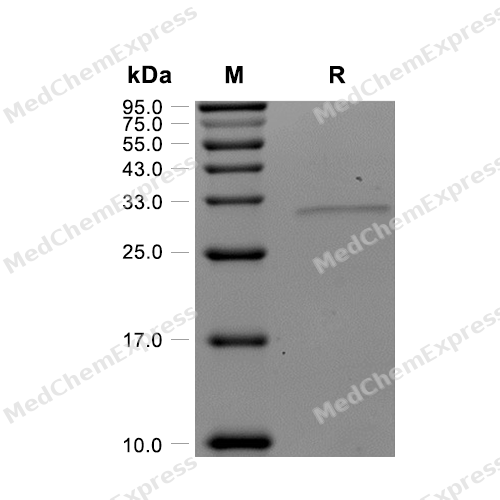
Purity - SDS-PAGE


Technical Parameters
-
Species Human
-
Source E. coli
-
Tag N-6*His
-
Accession
Q9C035-1 (M1-Q248)
-
Molecular Construction
-
N-term
-
6*His
-
TRIM5 (M1-Q248)
Accession # Q9C035-1 -
C-term
-
-
Protein Length
Partial
-
Synonyms
TRIM5; RNF88; Tripartite motif-containing protein 5; EC 2.3.2.27; RING finger protein 88; RING-type E3 ubiquitin transferase TRIM5; Tripartite Motif Protein TRIM5; Tripartite Motif-Containing 5; Tripartite Motif Protein TRIM; TRIM5alpha; RING-Type E3 Ubiq
-
AA Sequence
MASGILVNVKEEVTCPICLELLTQPLSLDCGHSFCQACLTANHKKSMLDKGESSCPVCRISYQPENIRPNRHVANIVEKLREVKLSPEGQKVDHCARHGEKLLLFCQEDGKVICWLCERSQEHRGHHTFLTEEVAREYQVKLQAALEMLRQKQQEAEELEADIREEKASWKTQIQYDKTNVLADFEQLRDILDWEESNELQNLEKEEEDILKSLTNSETEMVQQTQSLRELISDLEHRLQGSVMELLQ
-
Predicted Molecular Mass
28.7 kDa
-
Molecular Weight
Approximately 30 kDa, based on SDS-PAGE under reducing conditions.
-
Purity
≥ 95%, as determined by reducing SDS-PAGE.


Product Properties
Lyophilized powder.
Lyophilized from a 0.22 μm filtered solution of 50 mM Tris-HCl, 300 mM NaCl, 200 mM arginine, pH 8.0.
Note: For SPR assay, please replace the buffer. Primary amine components (e.g., Tris, imidazole) can affect protein-coupled chips.
<1 EU/μg, determined by LAL method.
It is not recommended to reconstitute to a concentration less than 100 μg/mL in ddH2O. For long term storage it is recommended to add a carrier protein (0.1% BSA, 5% HSA, 10% FBS or 5% Trehalose).
Stored at -20°C for 2 years from date of receipt. After reconstitution, it is stable at 4°C for 1 week or -20°C for longer (with carrier protein). It is recommended to freeze aliquots at -20°C or -80°C for extended storage.
Room temperature in continental US; may vary elsewhere.


Documentation
-
Data Sheet (237 KB)
-
SDS (251 KB)
- English - EN (251 KB)
- Français - FR (251 KB)
- Deutsch - DE (251 KB)
- Norwegian - NO (251 KB)
- Español - ES (251 KB)
- Swedish - SV (251 KB)
- Italian - IT (251 KB)
- Korean - KR (251 KB)
- Portuguese - PT (251 KB)
-
Handling Instructions (2659 KB)

Calculators
Concentration (start) × Volume (start) = Concentration (final) × Volume (final)


 Powered by Bioz

