



TrkA Protein, Rabbit (HEK293, His)

Based on 1 Customer Validation
TrkA Protein, Rabbit (HEK293, His) is a nerve growth factor (NGF) receptor that belongs to the tyrosine kinase receptor family. TRKA (NTRK1) gene encodes the high affinity receptor for a neurotrophin nerve growth factor (NGF). It is critical for the correct development of many types of neurons including pain-mediating sensory neurons and also controls proliferation, differentiation and survival of many neuronal and non-neuronal cells. TrkA Protein, Rabbit (HEK293, His) is the recombinant Rabbit-derived TrkA protein, expressed by HEK293 , with C-His labeled tag.
- Species: Rabbit
- Source: HEK293
-
Storage:Stored at -20°C for 2 years from date of receipt. After reconstitution, it is stable at 4°C for 1 week or -20°C for longer (with carrier protein). It is recommended to freeze aliquots at -20°C or -80°C for extended storage.


To place orders, for customer services and technical support, please contact: MedChemExpress USA
Tel: 609-228-6898 E-mail: [email protected] [email protected]


-
 Biological Activity
-
Technical Parameters
-
Product Properties
- Documentation
- Help & FAQs




Biological Activity
Description
TrkA Protein, Rabbit (HEK293, His) is a nerve growth factor (NGF) receptor that belongs to the tyrosine kinase receptor family. TRKA (NTRK1) gene encodes the high affinity receptor for a neurotrophin nerve growth factor (NGF). It is critical for the correct development of many types of neurons including pain-mediating sensory neurons and also controls proliferation, differentiation and survival of many neuronal and non-neuronal cells[1][2]. TrkA Protein, Rabbit (HEK293, His) is the recombinant Rabbit-derived TrkA protein, expressed by HEK293 , with C-His labeled tag.
Background
TRKA with the highly similar receptors TRKB and TRKC belongs to the group of tyrosine kinase receptors. TRKB binds neurotrophins brain-derived neurotrophic factor (BDNF) and neurotrophin-4 (NT-4) while TRKC is the predominant receptor for neurotrophin NT-3, although TRKA and TRKB can also be activated by NT-3. Signaling initiated by the NGF-TRKA complex is crucial for the development of pain-mediating sensory neurons, postganglionic sympathetic neurons and basal forebrain cholinergic neurons[1].
TRKA (also known as NTRK1) gene is a target of alternative splicing which can result in several different protein isoforms. TRKA is encoded by the NTRK1 gene located on chromosome 1q21-q22. Presently, three human isoforms (TRKAI, TRKAII and TRKAIII) and two rat isoforms (TRKA L0 and TRKA L1) have been described. Human TRKA gene is overlapped by two genes and spans 67 kb. TrkA genes in rat and mouse appear to be considerably shorter, are not overlapped by other genes. Human TRKA gene is located on chromosome 1 and has been described to span 23 kb. Seventeen exons, that are relatively well conserved in rat and mouse as compared to human TRKA gene, [the basic local alignment search tool (BLAST) algorithm gives 85 % of similarity in both cases] have been characterized[1][2].
Verified Bioactivity
1.This product does not contain protein kinase domain.
2.Measured by its ability to inhibit NGF-induced proliferation of TF-1 human erythroleukemic cells. The ED50 for this effect is 0.9070 μg/mL in the presence of 10 ng/mL of NGF, corresponding to a specific activity is 1.103×10³ U/mg
MCE Validation Data
-
Purity - SDS-PAGE
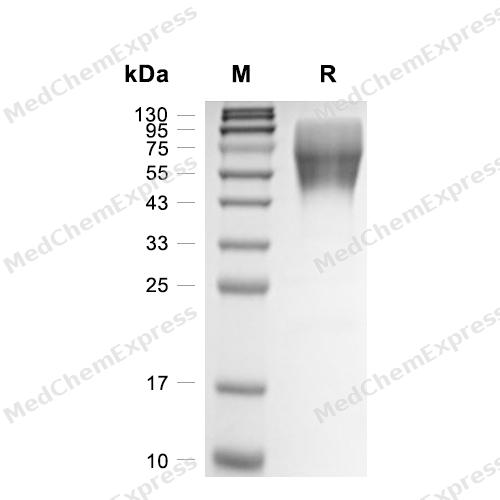
Purity - SDS-PAGE
-
Bioactivity - Cell-Based Assay
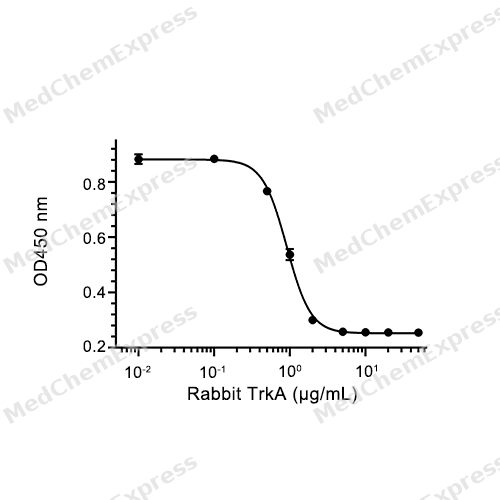
Bioactivity - Cell-Based Assay


Technical Parameters
-
Species Rabbit
-
Source HEK293
-
Tag C-6*His
-
Accession
XP_008262512 (A33-E414)
-
Molecular Construction
-
N-term
-
TrkA (A33-E414)
Accession # XP_008262512 -
His
-
C-term
-
-
Protein Length
Partial
-
Synonyms
NTRK1; Tyrosine Kinase Receptor A; Neurotrophic Receptor Tyrosine Kinase 1; P140-TrkA; TRKA; Gp140trk; TRK; Trk-A; MTC; Neurotrophic Tyrosine Kinase Receptor Type 1; High Affinity Nerve Growth Factor Receptor; Tyrosine-Protein Kinase Receptor; Neurotrophi
-
AA Sequence
AALCPDVCCPRGPSGLLCTRPGALDRLRHLPGIENLTELYLENQNLQHLTLGDLRGLRELRNLAIVNSGLQSVATDAFRFTPRLSHLNLSFNALESLSWKTVQGLPLQELVLSGNSLRCSCALRWLQRWEEEGLAGVREQKLRCSESEPLALMPNASCGMPTLKVQMPNGSVDVGDSVFLQCQVEGQGLEKAGWSLTELEELATVMIQKSEDLPTLRLTLANVTSDLNRKNVTCWAENDVGRTEVSVQVNVSFPASVQLHTAVEMHHWCIPFSVDGQPAPSLHWLFNGSVLNETSFIFTEFLEPAANETMRHGCLRLNQPTHVNNGNYTLLATNPSGQAAASIMAAFMDNPFEFNPEDPIPVSFSPVDANSTSGDPVEKKDE
-
Molecular Weight
Approximately 45-100 kDa due to the glycosylation.
-
Purity
≥ 95%, as determined by reducing SDS-PAGE.


Product Properties
Lyophilized powder.
Lyophilized from a 0.22 μm filtered solution of PBS, pH 7.4.
<1 EU/μg, determined by LAL method.
It is not recommended to reconstitute to a concentration less than 100 μg/mL in ddH2O. For long term storage it is recommended to add a carrier protein (0.1% BSA, 5% HSA, 10% FBS or 5% Trehalose).
Stored at -20°C for 2 years from date of receipt. After reconstitution, it is stable at 4°C for 1 week or -20°C for longer (with carrier protein). It is recommended to freeze aliquots at -20°C or -80°C for extended storage.
Room temperature in continental US; may vary elsewhere.


Documentation
-
Data Sheet (238 KB)
-
SDS (251 KB)
- English - EN (251 KB)
- Français - FR (251 KB)
- Deutsch - DE (251 KB)
- Norwegian - NO (251 KB)
- Español - ES (251 KB)
- Swedish - SV (251 KB)
- Italian - IT (251 KB)
- Korean - KR (251 KB)
- Portuguese - PT (251 KB)
-
Handling Instructions (2659 KB)

Calculators
Concentration (start) × Volume (start) = Concentration (final) × Volume (final)


 Powered by Bioz

