



TWEAK/TNFSF12 Protein, Mouse (HEK293, rFc)

Based on 1 Customer Validation
TWEAK Protein refers to the cytokine tumor necrosis factor-like weak inducer of apoptosis, belongs to tumor necrosis factor (TNF) superfamily. TWEAK protein binds to FN14 and TNRFSF12/APO3, is a weak inducer of apoptosis. TWEAK does have pro-apoptotic activity for tumor cell, mediates NF-kappa-B activation, promotes angiogenesis and the proliferation of endothelial cells (ECs). TWEAK also increases IL-6 and IL-8 secretion, and could potentiate the pro-inflammatory activities of TNF and IL-1. Mouse TWEAK protein is a type II transmembrane protein (M1-H249) with a transmembrane domain (25-45 a.a.). TWEAK/TNFSF12 Protein, Mouse (HEK293, rFc) is the extracellular part (R105-H249) of TWEAK protein, produced by HEK293 cells (R105-H249) with N-terminal rFc-tag.
- Species: Mouse
- Source: HEK293
-
Storage:Stored at -20°C for 2 years from date of receipt. After reconstitution, it is stable at 4°C for 1 week or -20°C for longer (with carrier protein). It is recommended to freeze aliquots at -20°C or -80°C for extended storage.


To place orders, for customer services and technical support, please contact: MedChemExpress USA
Tel: 609-228-6898 E-mail: [email protected] [email protected]


-
 Biological Activity
-
Technical Parameters
-
Product Properties
- Documentation
- References
- Help & FAQs




Biological Activity
Description
TWEAK Protein refers to the cytokine tumor necrosis factor-like weak inducer of apoptosis, belongs to tumor necrosis factor (TNF) superfamily. TWEAK protein binds to FN14 and TNRFSF12/APO3, is a weak inducer of apoptosis[1]. TWEAK does have pro-apoptotic activity for tumor cell, mediates NF-kappa-B activation, promotes angiogenesis and the proliferation of endothelial cells (ECs)[2]. TWEAK also increases IL-6 and IL-8 secretion, and could potentiate the pro-inflammatory activities of TNF and IL-1[3]. Mouse TWEAK protein is a type II transmembrane protein (M1-H249) with a transmembrane domain (25-45 a.a.). TWEAK/TNFSF12 Protein, Mouse (HEK293, rFc) is the extracellular part (R105-H249) of TWEAK protein, produced by HEK293 cells (R105-H249) with N-terminal rFc-tag.
Background
TWEAK Protein refers to the cytokine tumor necrosis factor-like weak inducer of apoptosis. It is a multifunctional cytokine belonging to tumor necrosis factor (TNF) superfamily, acts function by binding TweakR/Fn14 receptor. TWEAK is a cell surface-associated type II transmembrane protein with 2 types protein chain: the membrane form and the secreted or soluble form. The soluble form derives from the membrane form by proteolytic processing. The protein sequences in human and mouse is very different with similarity of 24.79%[1].
TWEAK binds to FN14 and possibly also to TNRFSF12/APO3, is a weak inducer of apoptosis in some cell types. TWEAK mediates NF-kappa-B activation, promotes angiogenesis and the proliferation of endothelial cells[2].
TWEAK has multiple biological activities, many of which are associated with immune system development and function[1].
TWEAK does have pro-apoptotic activity on a select group of human tumor cell lines and on monocytes, while it promotes cell proliferation in human vascular EC and SMC. Furthermore, FGF-2 co-treatment can potentiate TWEAK-stimulated HUVEC proliferation, an effect that may be due to the ability of FGF-2 to up-regulate TweakR/Fn14 gene expression. At the meanwhile TWEAK-TweakR/Fn14 autocrine signaling promotes human microvascular renal EC (HMREC) migration[1].
TWEAK also plays key role in inflammatory response. TWEAK, stimulates interleukin (IL)-8 secretion in human tumor cell lines, WI-38 fibroblasts and astrocytes. TWEAK also increases IL-6 secretion and ICAM-1 expression in astrocyte cell. Moreover, TWEAK co-incubation could potentiate the pro-inflammatory activities of TNF and IL-1, and concluded that TWEAK could be involved in the pathogenesis of chronic inflammatory diseases[3].
Above all, TWEAK involves in stimulation of cell growth and angiogenesis, induction of inflammatory cytokines, and under some experimental conditions, stimulation of apoptosis[1].
In Vitro
TWEAK (1 ng/mL; 3 and 6 h) activates NFκB and reduces Klotho expression in murine proximal tubular epithelial (MCT) cells[4].
In Vivo
Fc-TWEAK (murine; 2 μg/mouse; i.v.; single dose, sacrificed at 16 h) up-regulates kidney CCL2/MCP-1 and CXCL1/IP-1 gene expression by Fn14 mediation in C57BL/6-SCID mice[5].
Verified Bioactivity
Measured in a cell proliferation assay using HUVEC cells. The ED50 for this effect is 36.42 ng/mL, corresponding to a specific activity is 2.746×10^4 U/mg.
MCE Validation Data
-
Purity - SDS-PAGE
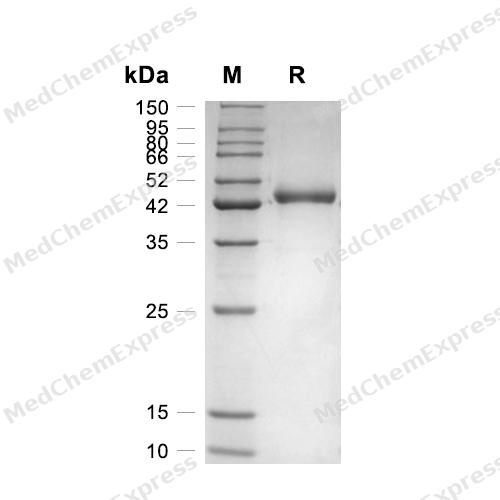
Purity - SDS-PAGE
-
Bioactivity - Cell-Based Assay
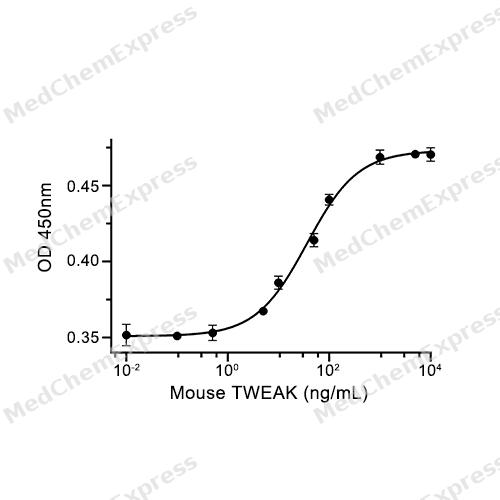
Bioactivity - Cell-Based Assay


Technical Parameters
-
Species Mouse
-
Source HEK293
-
Tag N-rFc
-
Accession
NP_035744.1 (R105-H249)
-
Molecular Construction
-
N-term
-
rFc
-
TWEAK (R105-H249)
Accession # NP_035744.1 -
C-term
-
-
Protein Length
Full Length of THD Domain
-
Synonyms
TNFSF12; TNLG4A; TNF Superfamily Member 12; TNF12; TWEAK; Tumor Necrosis Factor Superfamily Member 12; DR3LG; TNF-Related WEAK Inducer Of Apoptosis; APO3L; Tumor Necrosis Factor Ligand 4A; Tumor Necrosis Factor Ligand Superfamily Member 12; HCG1991317, Is
-
AA Sequence
RAIAAHYEVHPRPGQDGAQAGVDGTVSGWEETKINSSSPLRYDRQIGEFTVIRAGLYYLYCQVHFDEGKAVYLKLDLLVNGVLALRCLEEFSATAASSPGPQLRLCQVSGLLPLRPGSSLRIRTLPWAHLKAAPFLTYFGLFQVH
-
Predicted Molecular Mass
43.5 kDa
-
Molecular Weight
Approximately 43-47 kDa, based on SDS-PAGE under reducing conditions, due to the glycosylation.
-
Glycosylation
Yes
-
Purity
≥ 95%, as determined by reducing SDS-PAGE.


Product Properties
Lyophilized powder
Lyophilized from a 0.2 μm filtered solution of PB, 150 mM NaCl, pH 7.4.
<1 EU/μg, determined by LAL method.
It is not recommended to reconstitute to a concentration less than 100 μg/mL in ddH2O. For long term storage it is recommended to add a carrier protein (0.1% BSA, 5% HSA, 10% FBS or 5% Trehalose).
Stored at -20°C for 2 years from date of receipt. After reconstitution, it is stable at 4°C for 1 week or -20°C for longer (with carrier protein). It is recommended to freeze aliquots at -20°C or -80°C for extended storage.
Room temperature in continental US; may vary elsewhere.


Documentation
-
Data Sheet (265 KB)
-
SDS (252 KB)
- English - EN (252 KB)
- Français - FR (252 KB)
- Deutsch - DE (252 KB)
- Norwegian - NO (252 KB)
- Español - ES (252 KB)
- Swedish - SV (252 KB)
- Italian - IT (252 KB)
- Korean - KR (252 KB)
- Portuguese - PT (252 KB)
-
Handling Instructions (2659 KB)


References
[1]. Wiley SR, et al. TWEAK, a member of the TNF superfamily, is a multifunctional cytokine that binds the TweakR/Fn14 receptor. Cytokine Growth Factor Rev. 2003 Jun-Aug;14(3-4):241-9. [Content Brief]
[2]. Lammens A, et al. Crystal structure of human TWEAK in complex with the Fab fragment of a neutralizing antibody reveals insights into receptor binding. PLoS One. 2013 May 8;8(5):e62697. [Content Brief]
[3]. Lynch CN, et al. TWEAK induces angiogenesis and proliferation of endothelial cells. J Biol Chem. 1999 Mar 26;274(13):8455-9. [Content Brief]
[4]. Moreno JA, et al. The inflammatory cytokines TWEAK and TNFα reduce renal klotho expression through NFκB. J Am Soc Nephrol. 2011 Jul;22(7):1315-25. [Content Brief]
[5]. Harada N, et al. Pro-inflammatory effect of TWEAK/Fn14 interaction on human umbilical vein endothelial cells. Biochem Biophys Res Commun. 2002 Dec 6;299(3):488-93. [Content Brief]

Calculators
Concentration (start) × Volume (start) = Concentration (final) × Volume (final)


 Powered by Bioz

