



vacA Protein, Helicobacter pylori (His)

Based on 1 Customer Validation
The VacA protein takes center stage, demonstrating its unique ability to induce vacuole formation in eukaryotic cells, affecting cell morphology. This process involves the formation of vacuoles, highlighting the role of VacA as a key regulator of cell structure. vacA Protein, Helicobacter pylori (His) is the recombinant vacA protein, expressed by E. coli , with N-6*His labeled tag.
- Species: Others
- Source: E. coli
-
Storage:Stored at -20°C for 2 years from date of receipt. After reconstitution, it is stable at 4°C for 1 week or -20°C for longer (with carrier protein). It is recommended to freeze aliquots at -20°C or -80°C for extended storage.


To place orders, for customer services and technical support, please contact: MedChemExpress USA
Tel: 609-228-6898 E-mail: [email protected] [email protected]


-
 Biological Activity
-
Technical Parameters
-
Product Properties
- Documentation
- Help & FAQs




Biological Activity
Description
The VacA protein takes center stage, demonstrating its unique ability to induce vacuole formation in eukaryotic cells, affecting cell morphology. This process involves the formation of vacuoles, highlighting the role of VacA as a key regulator of cell structure. vacA Protein, Helicobacter pylori (His) is the recombinant vacA protein, expressed by E. coli , with N-6*His labeled tag.
Background
VacA protein takes center stage with its distinctive ability to induce vacuolation in eukaryotic cells, showcasing its potent impact on cellular morphology. This process, characterized by the formation of vacuoles within the cells, reflects VacA's role as a key modulator of cellular architecture. Beyond its influence on cell morphology, VacA is implicated in causing ulceration and gastric lesions, underscoring its significant role in the pathogenesis of gastric disorders. The dual effects of vacuolation induction and the promotion of gastric lesions position VacA as a critical virulence factor, shedding light on its role in the complex interplay between bacterial pathogens and host cells in the context of gastric pathology.
Verified Bioactivity
Measured by its binding ability in a functional ELISA. When Recombinant Human vacA is immobilized at 2.5 µg/mL(100 µL/well) can bind Anti-vacA Antibody.The ED50 for this effect is <150 ng/mL.
MCE Validation Data
-
Purity - SDS-PAGE
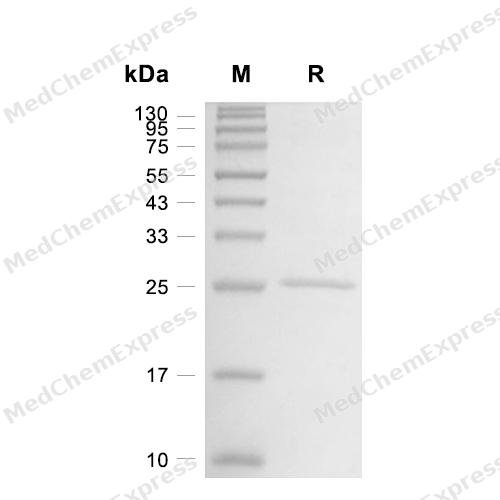
Purity - SDS-PAGE
-
Bioactivity - ELISA
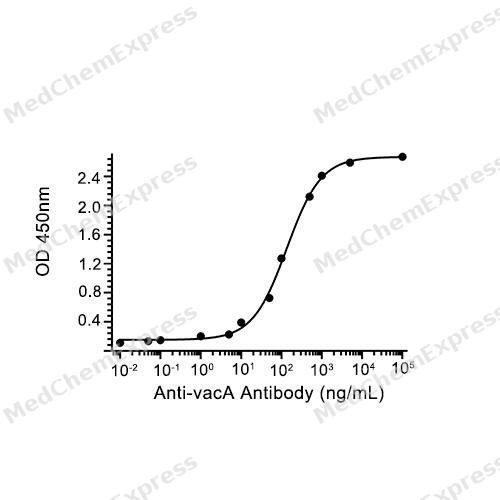
Bioactivity - ELISA


Technical Parameters
-
Species Others
-
Source E. coli
-
Tag N-6*His
-
Accession
P55981 (T37-N245)
-
Gene ID/
-
Molecular Construction
-
N-term
-
6*His
-
vacA (T37-N245)
Accession # P55981 -
C-term
-
-
Protein Length
Partial
-
Synonyms
vacA; HP_0887; Vacuolating cytotoxin autotransporter Cleaved into: Vacuolating cytotoxin; Vacuolating cytotoxin translocator
-
AA Sequence
TTVIIPAIVGGIATGAAVGTVSGLLGWGLKQAEEANKTPDKPDKVWRIQAGKGFNEFPNKEYDLYRSLLSSKIDGGWDWGNAATHYWVKGGQWNKLEVDMKDAVGTYNLSGLRNFTGGDLDVNMQKATLRLGQFNGNSFTSYKDSADRTTRVDFNAKNILIDNFLEINNRVGSGAGRKASSTVLTLQASEGITSSKNAEISLYDGATLN
-
Predicted Molecular Mass
22.6 kDa
-
Molecular Weight
Approximately 25 kDa, based on SDS-PAGE under reducing conditions.
-
Purity
≥ 90%, as determined by reducing SDS-PAGE.


Product Properties
Lyophilized powder
1.Lyophilized from a 0.22 μm filtered solution of 10 mM Tris-HCl, 1 mM EDTA, 6% trehalose.
2.Lyophilized from a 0.22 μm filtered solution of PBS, pH 7.0, 8% trehalose.
Please refer to the lot-specific COA for specific buffer information.
Note: For SPR assay, please replace the buffer. Primary amine components (e.g., Tris, imidazole) can affect protein-coupled chips.
<1 EU/μg, determined by LAL method.
It is not recommended to reconstitute to a concentration less than 100 μg/mL in ddH2O.
Stored at -20°C for 2 years from date of receipt. After reconstitution, it is stable at 4°C for 1 week or -20°C for longer (with carrier protein). It is recommended to freeze aliquots at -20°C or -80°C for extended storage.
Room temperature in continental US; may vary elsewhere.


Documentation
-
Data Sheet (236 KB)
-
SDS (252 KB)
- English - EN (252 KB)
- Français - FR (252 KB)
- Deutsch - DE (252 KB)
- Norwegian - NO (252 KB)
- Español - ES (252 KB)
- Swedish - SV (252 KB)
- Italian - IT (252 KB)
- Korean - KR (252 KB)
- Portuguese - PT (252 KB)
-
Handling Instructions (2659 KB)

Calculators
Concentration (start) × Volume (start) = Concentration (final) × Volume (final)


 Powered by Bioz

