



VEGF164 Protein, Canine (HEK293)
Based on 1 Customer Validation
VEGFA Protein is a vascular endothelial growth factor that is active in angiogenesis and endothelial cell growth. VEGFA Protein induces endothelial cell proliferation, promotes cell migration, inhibits cell apoptosis, and induces vascular permeability. VEGF164 Protein, Canine (HEK293) is the recombinant canine-derived VEGF164 protein, expressed by HEK293 , with tag free.
- Species: Canine
- Source: HEK293
-
Storage:Stored at -20°C for 2 years from date of receipt. After reconstitution, it is stable at 4°C for 1 week or -20°C for longer (with carrier protein). It is recommended to freeze aliquots at -20°C or -80°C for extended storage.


To place orders, for customer services and technical support, please contact: MedChemExpress USA
Tel: 609-228-6898 E-mail: [email protected] [email protected]


-
 Biological Activity
-
Technical Parameters
-
Product Properties
- Documentation
- Help & FAQs




Biological Activity
Description
VEGFA Protein is a vascular endothelial growth factor that is active in angiogenesis and endothelial cell growth. VEGFA Protein induces endothelial cell proliferation, promotes cell migration, inhibits cell apoptosis, and induces vascular permeability. VEGF164 Protein, Canine (HEK293) is the recombinant canine-derived VEGF164 protein, expressed by HEK293 , with tag free.
Background
VEGFA Protein has activity in angiogenesis and endothelial cell growth.
VEGFA Protein induces endothelial cell proliferation, promotes cell migration, inhibits cell apoptosis, and induces vascular permeability.
VEGFA Protein can bind to receptors such as FLT1/VEGFR1 and KDR/VEGFR2, receptors such as DEAR/FBXW7-AS1, and sulfated acetylheparins and heparins.
The binding of VEGFA protein to NRP1 receptor initiates the signaling pathways required for motor neuron axon guidance and cell body migration, including the migration of facial motor neurons from rhomboid 4 to the tail of rhomboid 6 during embryonic development.
VEGF-A Protein is involved in the progression and malignant transformation of canine mastocytoma (MCT)
Verified Bioactivity
1.Immobilized canine VEGF164/VEGFA at 10 μg/mL (100 μL/well) can bind human VEGFR2-Fc and the EC50 is 33.83-78.95 ng/mL.
2.Measured in a cell proliferation assay using human umbilical vein endothelial cells (HUVEC). The ED50 for this effect is typically 2-12 ng/mL.
MCE Validation Data
-
Purity - SDS-PAGE
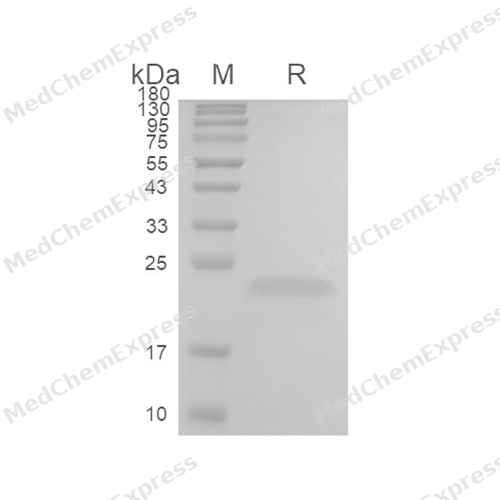
Purity - SDS-PAGE
-
Bioactivity - Cell-Based Assay
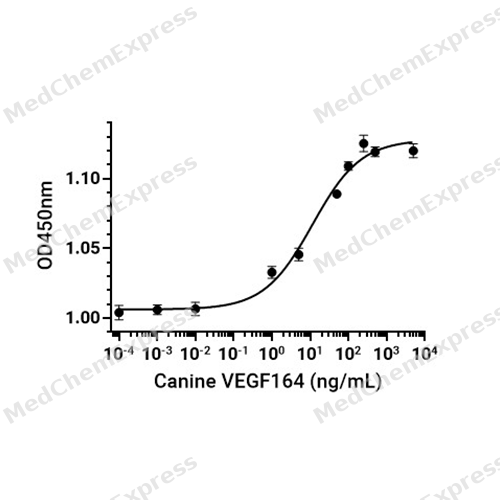
Bioactivity - Cell-Based Assay


Technical Parameters
-
Species Canine
-
Source HEK293
-
Tag Tag Free
-
Accession
Q9MYV3-3/NP_001103972.1 (A27-R190)
-
Molecular Construction
-
N-term
-
VEGF164 (A27-R190)
Accession # Q9MYV3-3/NP_001103972.1 -
C-term
-
-
Protein Length
Full Length of Isoform-3
-
Synonyms
VEGFA; Vascular Endothelial Growth Factor A; VEGF; VPF; Vascular Permeability Factor; Vascular Endothelial Growth Factor A, Long Form; VEGF-A; L-VEGF; Vascular Endothelial Growth Factor A121; Vascular Endothelial Growth Factor A165; Vascular Endothelial G
-
AA Sequence
APMAGGEHKPHEVVKFMDVYQRSYCRPIETLVDIFQEYPDEIEYIFKPSCVPLMRCGGCCNDEGLECVPTEEFNITMQIMRIKPHQGQHIGEMSFLQHSKCECRPKKDRARQENPCGPCSERRKHLFVQDPQTCKCSCKNTDSRCKARQLELNERTCRCDKPRR
-
Predicted Molecular Mass
19.1 kDa
-
Molecular Weight
Approximately 23 kDa, based on SDS-PAGE under reducing conditions, due to the glycosylation.
-
Glycosylation
Yes
-
Purity
≥ 90%, as determined by reducing SDS-PAGE.


Product Properties
Lyophilized powder
1.Lyophilized from a 0.22 μm filtered solution of PBS, pH 7.4, 5% trehalose, 5% mannitol and 0.01% Tween 80.
2.Lyophilized from a 0.22 μm filtered solution of PBS, pH 7.4, 8% trehalose.
Please refer to the lot-specific COA for specific buffer information.
<1 EU/μg, determined by LAL method.
It is not recommended to reconstitute to a concentration less than 100 μg/mL in ddH2O.
Stored at -20°C for 2 years from date of receipt. After reconstitution, it is stable at 4°C for 1 week or -20°C for longer (with carrier protein). It is recommended to freeze aliquots at -20°C or -80°C for extended storage.
Room temperature in continental US; may vary elsewhere.


Documentation
-
Data Sheet (236 KB)
-
SDS (251 KB)
- English - EN (251 KB)
- Français - FR (251 KB)
- Deutsch - DE (251 KB)
- Norwegian - NO (251 KB)
- Español - ES (251 KB)
- Swedish - SV (251 KB)
- Italian - IT (251 KB)
- Korean - KR (251 KB)
- Portuguese - PT (251 KB)
-
Handling Instructions (2659 KB)

Calculators
Concentration (start) × Volume (start) = Concentration (final) × Volume (final)


 Powered by Bioz

