31 Results for "

nerve terminals

" in MedChemExpress (MCE) Product Catalog:
Products (31)

31 Results for "nerve terminals" in MCE Product Catalog:

Cat. No.: HY-P5044
CAS No.: 2243206-98-4
Target:  

α-synuclein

Research Areas:  

Neurological Disease

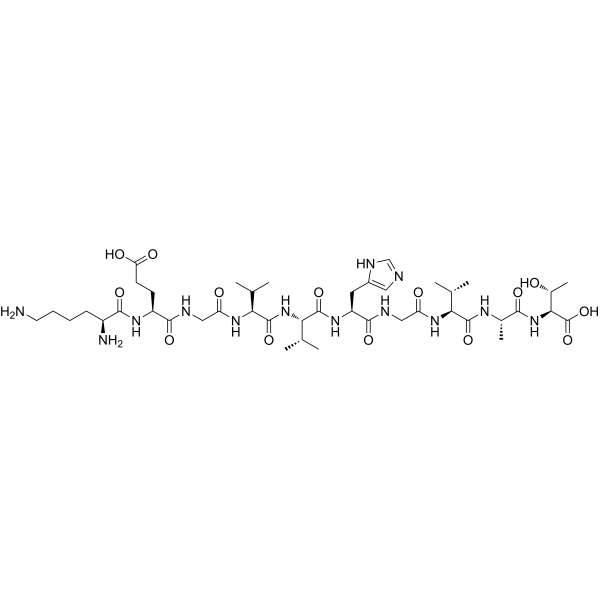
α-Synuclein (45-54) (human) is the 45-54 fragment of α-Synuclein. α-Synuclein is an abundant neuronal protein that is highly abundant in presynaptic nerve terminals. α-Synuclein is a biomarker for Parkinson's disease (PD) .
loading...
    loading...
Cat. No.: HY-P5046
CAS No.: 332867-16-0
Target:  

α-synuclein

Research Areas:  

Neurological Disease

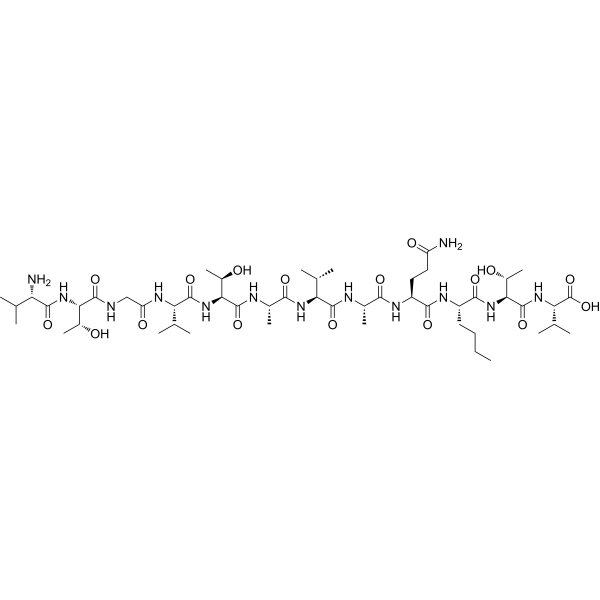
α-Synuclein (71-82) (human) is the 71-82 fragment of α-Synuclein. α-Synuclein is an abundant neuronal protein that is highly abundant in presynaptic nerve terminals. α-Synuclein is a biomarker for Parkinson's disease (PD) .
loading...
    loading...
Cat. No.: HY-B0800R
CAS No.: 645-43-2
Synonyms: Guanethidine monosulfate (Standard)
Guanethidine (sulfate) (Standard) is the analytical standard of Guanethidine (sulfate). This product is intended for research and analytical applications. Guanethidine sulfate (Guanethidine monosulfate), an antihypertensive agent, is an adrenergic neurone blocking agent. Guanethidine sulfate enters noradrenergic nerve terminals by the neuronal amine carrier .
loading...
    loading...
Cat. No.: HY-14608S12
CAS No.: 24016-48-6
Synonyms: L-Glutamic acid-14C
Research Areas:  

Neurological Disease

L-Glutamic acid-14C is L-Glutamic acid (HY-14608) labeled with the radioactive isotope carbon-14. L-Glutamic acid is an excitatory amino acid neurotransmitter and an agonist for all subtypes of glutamate receptors (metabotropic, NMDA, and AMPA). L-Glutamic acid acts as an agonist in the release of DA from dopaminergic nerve terminals and can be used in the study of neurological diseases .
loading...
    loading...
Cat. No.: HY-115364R
CAS No.: 14255-87-9
Synonyms: SKF 29044 (Standard)
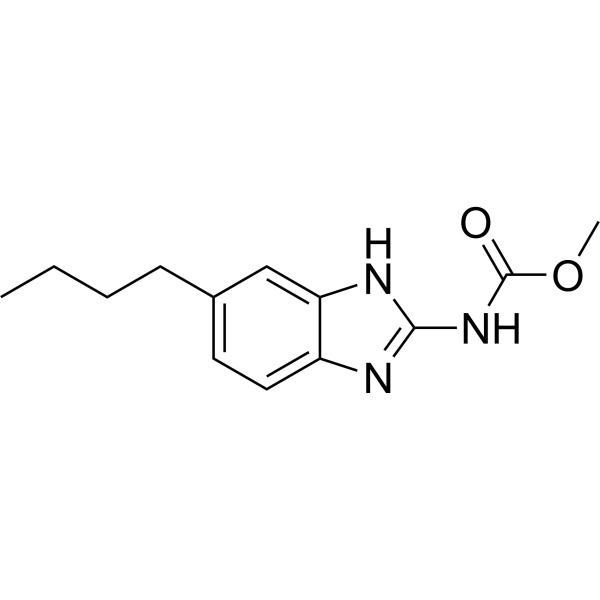
Parbendazole (Standard) (SKF 29044 (Standard)) is the analytical standard of Parbendazole (HY-115364). This product is intended for research and analytical applications. Parbendazole (SKF‑29044) is an orally active benzimidazole carbamate compound with multiple biological activities. Parbendazole binds to free tubulin and inhibits microtubule polymerization; it also activates the JNK/c‑Jun signaling axis and upregulates the expression of the downstream axonal repulsion factor Sema3A. Parbendazole upregulates KAL-1 mRNA expression, reduces nerve growth factor levels, and promotes the terminal differentiation of normal human epidermal keratinocytes. Parbendazole induces apoptosis in differentiated acute myeloid leukemia monocytes and exerts antileukemic activity in a mouse xenograft model of acute myeloid leukemia. Parbendazole exhibits broad-spectrum anthelmintic activity against various animal nematodes. Parbendazole is used in research related to acute myeloid leukemia and parasitic infections .
loading...
    loading...
Cat. No.: HY-115364S
CAS No.: 1613439-58-9
Synonyms: SKF 2904-d3
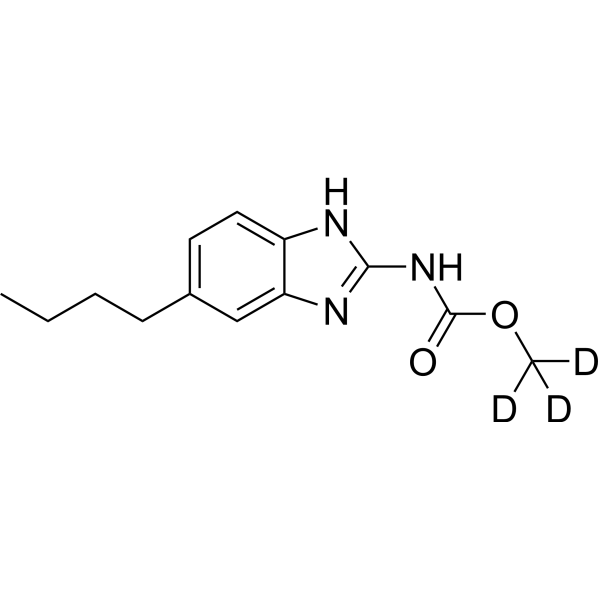
Parbendazole-d3 (SKF 2904-d3) is the deuterated-labeled Parbendazole (HY-115364). Parbendazole (SKF‑29044) is an orally active benzimidazole carbamate compound with multiple biological activities. Parbendazole binds to free tubulin and inhibits microtubule polymerization; it also activates the JNK/c‑Jun signaling axis and upregulates the expression of the downstream axonal repulsion factor Sema3A. Parbendazole upregulates KAL-1 mRNA expression, reduces nerve growth factor levels, and promotes the terminal differentiation of normal human epidermal keratinocytes. Parbendazole induces apoptosis in differentiated acute myeloid leukemia monocytes and exerts antileukemic activity in a mouse xenograft model of acute myeloid leukemia. Parbendazole exhibits broad-spectrum anthelmintic activity against various animal nematodes. Parbendazole is used in research related to acute myeloid leukemia and parasitic infections .
loading...
    loading...
Cat. No.: HY-183399
CAS No.: 95669-35-5
Wy 27127 is a potent and selective α2-adrenergic receptor antagonist. Wy 27127 competitively blocks α2-adrenergic receptors, interrupts the negative feedback loop of sympathetic nerve endings, enhances stimulus-evoked norepinephrine release, and blocks agonist-induced inhibition of vas deferens contraction. Wy 27127 shows weak antagonistic effects on α1 receptors, and exhibits no significant antagonistic activity against 5-hydroxytryptamine, muscarinic, presynaptic dopamine, histamine or β1-adrenergic receptors in vitro. Wy 27127 blocks saphenous vein contraction mediated by postsynaptic α2-adrenergic receptor agonists. Wy 27127 is applicable to studies related to sympathetic neurotransmission and vascular adrenergic responses .
loading...
    loading...
Cat. No.: HY-D3383
Target:  

Fluorescent Dye

Research Areas:  

Neurological Disease

AM4-64 is a fixable cationic styryl fluorescent dye for nerve terminals, which can be used for vesicle cycle evaluation, endocytic pathway tracing and endocytosis detection. AM4-64 inserts into the plasma membrane, is internalized via activity- or energy-dependent endocytosis, and accumulates in vesicles, endosomal compartments, vacuolar membranes, mitochondria and endolysosomal structures. The fluorescence of AM4-64 is enhanced in the membrane-bound state. AM4-64 is applicable to relevant studies on neurons, plant and fungal cells and tissues (Ex/Em = 510/750 nm) .
loading...
    loading...
Cat. No.: HY-110220R
CAS No.: 1031496-06-6
Research Areas:  

Neurological Disease

CIM0216 (Standard) is the analytical standard of CIM0216 (HY-110220). This product is intended for research and analytical applications. CIM0216, a synthetic TRPM3 ligand, acts as a potent and selective agonist of TRPM3. CIM0216 exhibits selectivity for TRPM3 over TRPM1, TRPM2 and TRPM4-8. CIM0216 acts in a TRPM3-dependent manner to induce pain and evoke neuropeptide release from sensory nerve terminals in vitro. CIM0216 is a powerful tool for studies of the physiological functions of TRPM3, and can be used for neurogenic inflammation research .
loading...
    loading...
Cat. No.: HY-115364A
CAS No.: 83601-81-4
Synonyms: SKF 29044 hydrochloride
Research Areas:  

Infection Cancer

Parbendazole hydrochloride (SKF‑29044 hydrochloride) is an orally active benzimidazole carbamate compound with multiple biological activities. Parbendazole hydrochloride binds to free tubulin and inhibits microtubule polymerization; it also activates the JNK/c‑Jun signaling axis and upregulates the expression of the downstream axonal repulsion factor Sema3A. Parbendazole hydrochloride upregulates KAL-1 mRNA expression, reduces nerve growth factor levels, and promotes the terminal differentiation of normal human epidermal keratinocytes. Parbendazole hydrochloride induces apoptosis in differentiated acute myeloid leukemia monocytes and exerts antileukemic activity in a mouse xenograft model of acute myeloid leukemia. Parbendazole hydrochloride exhibits broad-spectrum anthelmintic activity against various animal nematodes. Parbendazole hydrochloride is used in research related to acute myeloid leukemia and parasitic infections .
loading...
    loading...
Cat. No.: HY-187585
CAS No.: 104639-01-2
Fourphit is a dopamine transporter (DAT) inhibitor and phencyclidine (PCP) receptor binding agent. Fourphit irreversibly acylates the DAT [ 3H]methylphenidate binding site, reversibly binds to the PCP receptor, and sensitizes neuronal L-type DHP calcium channels. Fourphit attenuates K +-stimulated 45Ca 2+ uptake at high concentrations, and after its pretreatment, Nifedipine (HY-B0284) effectively inhibits this uptake without affecting resting calcium uptake. Fourphit reduces cocaine-induced hyperactivity, decreases cocaine-induced rearing frequency, enhances cocaine-induced thigmotaxis, elicits an acute increase in locomotor activity, and suppresses dark-cycle activity. Fourphit is used in research related to cocaine abuse and addiction .
loading...
    loading...

