93 Results for "

conduction

" in MedChemExpress (MCE) Product Catalog:
Products (93)

93 Results for "conduction" in MCE Product Catalog:

Cat. No.: HY-B0563R
CAS No.: 84057-95-4
Ropivacaine (Standard) is the analytical standard of Ropivacaine. This product is intended for research and analytical applications. Ropivacain is a potent sodium channel blocker. Ropivacain blocks impulse conduction via reversible inhibition of sodium ion influx in nerve fibrese . Ropivacaine is also an inhibitor of K2P (two-pore domain potassium channel) TREK-1 with an IC50 of 402.7 μM in COS-7 cell's membrane . Ropivacaine is used for the research of neuropathic pain management .
loading...
    loading...
Cat. No.: HY-B0563BS
CAS No.: 1217667-10-1
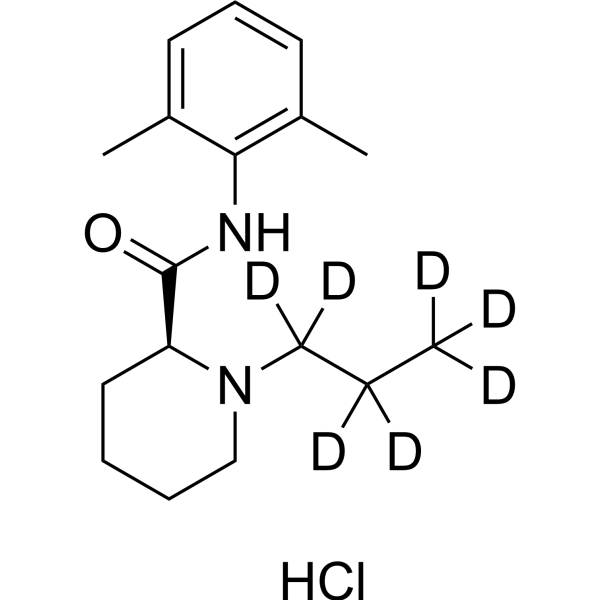
Ropivacaine-d7 hydrochloride is a deuterium labeled Ropivacaine (hydrochloride) (HY-B0563B) . Ropivacaine hydrochloride is a potent sodium channel blocker and blocks impulse conduction via reversible inhibition of sodium ion influx in nerve fibrese . Ropivacaine is also an inhibitor of K2P (two-pore domain potassium channel) TREK-1 with an IC50 of 402.7 μM in COS-7 cell's membrane . Ropivacaine is widely used for neuropathic pain management in vivo .
loading...
    loading...
Cat. No.: HY-119883
CAS No.: 750531-54-5
Target:  

Adrenergic Receptor

Research Areas:  

Neurological Disease

A-61603 free base is a potent adrenergic receptor agonist. A-61603 free base reduces carotid artery conductance in anesthetized pigs mediated by α1 and α2 adrenergic receptors (pEC50=7.25). A-61603 free base can be used as a probe to study adrenergic function .
loading...
    loading...
Cat. No.: HY-113841
CAS No.: 107707-38-0
RS-87337 is an orally active piperazine-amidine hybrid class Ia (inhibiting Vmax, IC50 = 17 μM)/class III (prolonging ADP90, EC15 = 2 μM) antiarrhythmic agent with selectivity for ventricular conduction . RS-87337 inhibits cardiac sodium channel, thereby reducing the maximum depolarization rate of action potential, with moderate onset and recovery kinetics. RS-87337 reduces cardiac outward potassium conductance (I_K), thus prolonging action potential duration. RS-87337 is applicable to research related to arrhythmia, ventricular arrhythmia, ventricular fibrillation, and myocardial ischemia-reperfusion injury .
loading...
    loading...
Cat. No.: HY-W783157
CAS No.: 40626-35-5
Synonyms: Heterofos
Research Areas:  

Infection

Heterophos (Heterofos) is an organophosphorus insecticide and an AChE inhibitor. Heterophos inhibits AChE's function of decomposing acetylcholine, causing disorder of insect nerve conduction and exerting insecticidal effects .
loading...
    loading...
Cat. No.: HY-117765
CAS No.: 129173-57-5
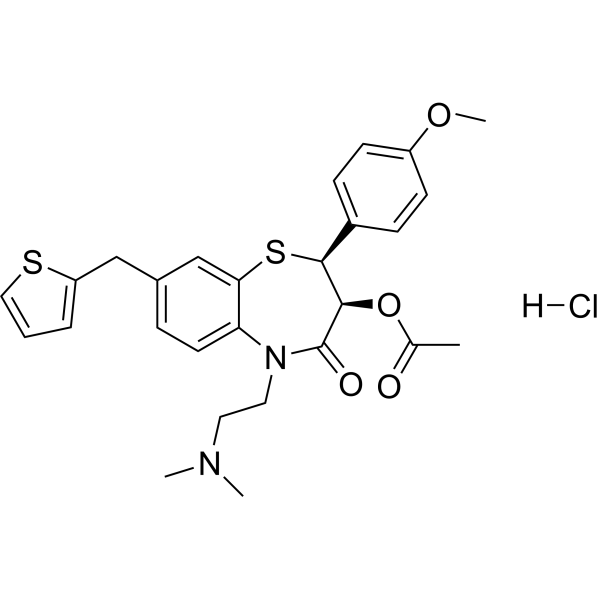
RS-5773 is a calcium channel inhibitor and a diltiazem congener. RS-5773 has antianginal effect and does not cause excessive hypotension or depression of atrioventricular conduction .
loading...
    loading...
Cat. No.: HY-105581
CAS No.: 1776-83-6
Synonyms: Oxinothiofos
Target:  

Cholinesterase (ChE)

Research Areas:  

Others

Quintiofos (Oxinothiofos) is an insecticide. Quintiofos inhibits the activity of acetylcholinesterase in insects, causing nerve conduction disorders, thereby achieving an insecticidal effect. Quintiofos can be used to control a variety of pests, such as aphids, whiteflies, and stem borers .
loading...
    loading...
Cat. No.: HY-W243879
CAS No.: 175606-05-0
Synonyms: DBP
Tetraphenyldibenzoperiflanthene (DBP) is an organic semiconductor material with excellent electronic conduction activity. Tetraphenyldibenzoperiflanthene exhibits high mobility in organic field effect transistors (OFETs), improving device performance. Tetraphenyldibenzoperiflanthene is widely used in organic photovoltaic (OPV) materials to enhance photoelectric conversion efficiency.
loading...
    loading...
Cat. No.: HY-W803860
CAS No.: 86383-21-3
Research Areas:  

Cardiovascular Disease

N-Depropylpropafenone is an active metabolite of Propafenone (HY-B0432), generated through the CYP450 enzyme system (mainly CYP2D6). It functions by blocking sodium ion channels, slowing myocardial conduction and exhibiting certain antiarrhythmic effects .
loading...
    loading...
Cat. No.: HY-17611A1
CAS No.: 2560549-35-9
Synonyms: MSP-2017 hydrochloride; (-)-MSP-2017 hydrochloride
Target:  

Calcium Channel

Research Areas:  

Neurological Disease

Etripamil (MSP-2017) hydrochloride is a short-acting, L-type calcium channel antagonist that can be used in the study of paroxysmal supraventricular tachycardia (PSVT). Etripamil hydrochloride inhibits calcium influx through slow calcium channels, thereby slowing atrioventricular node conduction and prolonging the atrioventricular node refractory period.
loading...
    loading...
Cat. No.: HY-135121R
CAS No.: 57530-40-2
Synonyms: Ethacizin (Standard); NIK-244 (Standard)
Ethacizine (hydrochloride) (Standard) is the analytical standard of Ethacizine (hydrochloride). This product is intended for research and analytical applications. Ethacizine hydrochloride (Ethacizin; NIK-244) is a longer-lasting Class Ic antiarrhythmic agent than Flecainide . Ethacizine hydrochloride (Ethacizin; NIK-244) inhibits the depolarizing current responsible for the intraatrial and His-Purkinje-ventricular conduction .
loading...
    loading...
Cat. No.: HY-66012R
CAS No.: 5875-06-9
Synonyms: Proxymetacaine hydrochloride (Standard)
Research Areas:  

Neurological Disease

Proparacaine (Hydrochloride) (Standard) is the analytical standard of Proparacaine (Hydrochloride). This product is intended for research and analytical applications. Proparacaine hydrochloride is a local anesthetic. Proparacaine hydrochloride blocks voltage-gated sodium channels on neuronal cell membranes, thereby inhibiting signal conduction and nociceptive signal transmission. Proparacaine hydrochloride blocks nociceptive signals in the eye and induces ocular muscle relaxation to reduce eye movement during surgery. Proparacaine hydrochloride is used in research related to cataracts.
loading...
    loading...
Cat. No.: HY-105093
CAS No.: 141696-90-4
Target:  

Adenosine Receptor

Research Areas:  

Inflammation/Immunology

N-0861 is a novel selective A1 adenosine receptor antagonist. In studies, it has been shown to be able to inhibit the negative conduction effects (prolonged AH interval) and chest pain caused by adenosine, while having no significant effect on the increase in coronary blood flow velocity caused by adenosine. This indicates that N-0861 has the property of selectively inhibiting A1 adenosine receptors .
loading...
    loading...
Cat. No.: HY-123196
CAS No.: 342419-09-4
Target:  

Adenosine Receptor

Research Areas:  

Cardiovascular Disease

CVT-2759 is a potent inhibitor of A1-ADOR, with the IC50 values of 0.18 μM and 9.5 μM to reduce the binding of [3H]CPX in the absence and presence of 1 mM GTP. CVT-2759 plays an important role in slowing AV nodal conduction and thereby ventricular rate without causing AV block, bradycardia, atrial arrhythmias, or vasodilation .
loading...
    loading...
Cat. No.: HY-B1343AS
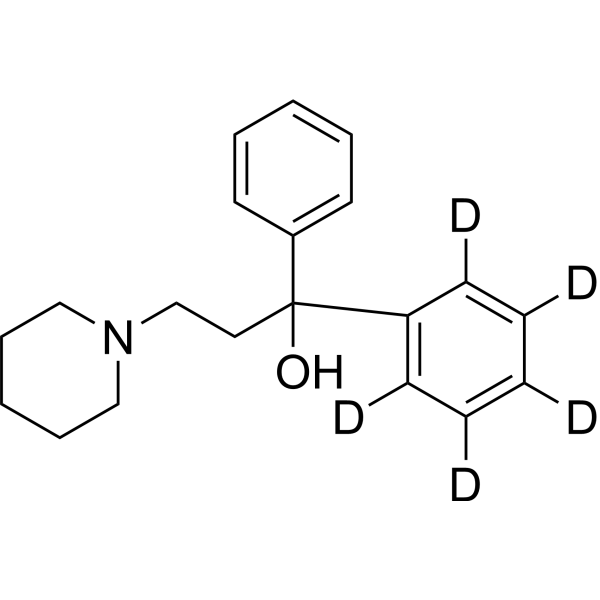
Pridinol-d5 is deuterium labeled Pridinol (HY-B1343A) . Pridinol is an orally active, blood-brain permeable, muscarinic acetylcholine receptor (mAChR)-directed muscle relaxant. Pridinol reduces the conduction of impulses to spinal motor neurons and exerts muscle relaxant activity. Pridinol inhibits skeletal muscle contractures in diseases of both central and peripheral origin and can be used in research in the field of musculoskeletal diseases .
loading...
    loading...
Cat. No.: HY-167645
CAS No.: 140-65-8
Synonyms: Pramoxine
Target:  

Sodium Channel

Research Areas:  

Neurological Disease

Pramocaine (Pramoxine) is a topical surface anesthetic and antipruritic agent. Pramocaine reversibly inhibits voltage-gated sodium channel, reduces transmembrane permeability of sodium ions, stabilizes cell membranes, prevents depolarization, blocks action potential conduction, and inhibits peripheral slow C-fiber pathways associated with pain, pruritus and thermoception. Pramocaine can be used in research related to chronic pruritus, renal pruritus, atopic dermatitis, xerotic pruritus, uremic pruritus, and cutaneous hyperalgesia/pain .
loading...
    loading...
Cat. No.: HY-178082
CAS No.: 36386-71-7
Target:  

Others

Research Areas:  

Cardiovascular Disease

MK-251 is an orally active anti-arrhythmic agent. MK-251 prevents or modifies ventricular arrhythmias induced in dogs and baboons by tetrafluorethylbutylamine. MK-251 antagonizes the arrhythmias caused by Digoxin (HY-B1049) in cats. MK-251 at effective doses has little effect on basic cardiovascular parameters such as blood pressure, cardiac output, myocardial contractility and ventricular conduction, thus demonstrating its unique advantages .
loading...
    loading...
Cat. No.: HY-167689
CAS No.: 136-46-9
Target:  

Adrenergic Receptor

Research Areas:  

Neurological Disease

Parethoxycaine hydrochloride is an anesthetic with nerve conduction blocking activity. Parethoxycaine hydrochloride exhibits non-selective inhibitory effects on responses to various stimulants in rat vas deferens and guinea pig ileum muscles. Parethoxycaine hydrochloride has an enhanced effect on the action of norepinephrine, and its methyl bromide derivative also exhibits the same properties on the action of norepinephrine and potassium ions. Derivatives of parethoxycaine hydrochloride have significant effects on calcium dose-response curves, displaying different tissue and stimulant selectivities. The mechanism of action of Parethoxycaine hydrochloride involves the regulation of calcium transport processes .
loading...
    loading...
Cat. No.: HY-P4742A
Synonyms: 6-FAM-AEEAC-SHK TFA
6-FAM-AEEAc-Stichodactyla helianthus Neurotoxin (ShK) TFA (6-FAM-AEEAC-SHK TFA) is a peptide neurotoxin conjugated with a fluorescent marker. 6-FAM-AEEAc-Stichodactyla helianthus Neurotoxin (ShK) TFA can block voltage-gated potassium channels (kv1.1 and kv1.2) to prolong the duration of action potentials, thereby affecting the conduction of neural signals. 6-FAM-AEEAc-Stichodactyla helianthus Neurotoxin (ShK) TFA can be used in neuroscience research .
loading...
    loading...
Cat. No.: HY-108998
CAS No.: 96480-44-3
Research Areas:  

Cardiovascular Disease

Bisaramil hydrochloride is an antiarrhythmic compound with activity in inhibiting free radical generation. Bisaramil hydrochloride directly blocks sodium currents and exhibits enhanced sodium channel blocking ability. Bisaramil hydrochloride inhibits isoproterenol-induced slow calcium action potentials in cardiomyocytes. Bisaramil hydrochloride reduces heart rate and prolongs the PR, QRS, and QT intervals in the electrocardiogram, showing blocking effects on sodium and potassium channels. Bisaramil hydrochloride reduces cardiac conduction velocity, increases the threshold current for capture and atrial fibrillation, and prolongs the effective refractory period. Bisaramil hydrochloride reduces ventricular arrhythmias and eliminates mortality caused by ventricular fibrillation in ischemic rat hearts .
loading...
    loading...

