



Ropivacaine (Standard)
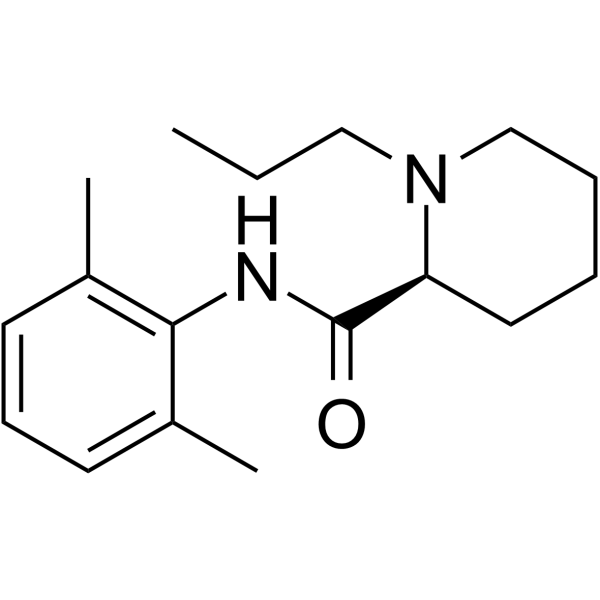
Ropivacaine (Standard) is the analytical standard of Ropivacaine. This product is intended for research and analytical applications. Ropivacain is a potent sodium channel blocker. Ropivacain blocks impulse conduction via reversible inhibition of sodium ion influx in nerve fibrese. Ropivacaine is also an inhibitor of K2P (two-pore domain potassium channel) TREK-1 with an IC50 of 402.7 μM in COS-7 cell's membrane. Ropivacaine is used for the research of neuropathic pain management.
For research use only. We do not sell to patients.
- Purity : 98%
- CAS No.: 84057-95-4
- Formula: C₁₇H₂₆N₂O
- Molecular Weight:274.40
-
Storage:
Please store the product under the recommended conditions in the Certificate of Analysis.


To place orders, for customer services and technical support, please contact: MedChemExpress USA
Tel: 609-228-6898 E-mail: [email protected] [email protected]


-
 Product Information
-
Chemical Information
- Purity & Documentation
-
 Help & FAQs




Product Information
Information
Application
The compound is the grade of analytical standard, which is the reference standard supplied assay. It is commonly used in qualitative, quantitative and methodological research experiments in HPLC, GC and MS.


Chemical Information
-
CAS No. 84057-95-4
-
Molecular Weight 274.40
-
Formula C₁₇H₂₆N₂O
-
SMILES
O=C([C@H]1N(CCC)CCCC1)NC2=C(C)C=CC=C2C
-
Shipping
Room temperature in continental US; may vary elsewhere.
-
Storage
Please store the product under the recommended conditions in the Certificate of Analysis.


Purity & Documentation
References
[1]. Dene Simpson, et al. Ropivacaine: a review of its use in regional anaesthesia and acute pain management. Drugs. 2005;65(18):2675-717. [Content Brief]
[2]. Li TF, et al. Epidural sustained release ropivacaine prolongs anti-allodynia and anti-hyperalgesia in developing and established neuropathic pain. PLoS One. 2015 Jan 24;10(1):e0117321. [Content Brief]
[3]. Hye Won Shin, et al. The inhibitory effects of bupivacaine, levobupivacaine, and ropivacaine on K2P (two-pore domain potassium) channel TREK-1. J Anesth [Content Brief]
[4]. Milan Patel, et al. Ropivacaine Inhibits Pressure-Induced Lung Endothelial Hyperpermeability in Models of Acute Hypertension. Life Sci. 2019 Apr 1;222:22-28. [Content Brief]

Calculators
Concentration (start) × Volume (start) = Concentration (final) × Volume (final)


Ropivacaine (Standard) Related Classifications
HY-B0563R Related Classifications
 Powered by Bioz