129 Results for "

complication

" in MedChemExpress (MCE) Product Catalog:
Products (129)

129 Results for "complication" in MCE Product Catalog:

Cat. No.: HY-N11875S
6-Sulfatoxymelatonin-d4 ammonium hydrate is the deuterated-labeled 6-Sulfatoxymelatonin ammonium hydrate. 6-Sulfatoxymelatonin ammonium hydrate is a metabolite of Melatonin (HY-B0075) and serves as a detection marker for Melatonin. 6-Sulfatoxymelatonin ammonium hydrate shows a decreasing trend with increasing age, and its urinary excretion is closely correlated with plasma Melatonin levels, which can reflect changes in the secretion phase of melatonin. 6-Sulfatoxymelatonin ammonium hydrate is associated with reduced risks of diabetic retinopathy and coronary heart disease, and can act as a biomarker for microvascular and macrovascular complications of type 2 diabetes mellitus. 6-Sulfatoxymelatonin ammonium hydrate can be used in studies related to type 2 diabetes mellitus and coronary heart disease .
loading...
    loading...
Cat. No.: HY-107207R
CAS No.: 32602-81-6
Synonyms: Kaempferol 3-O-neohesperidoside (Standard)
Kaempferol 3-neohesperidoside (Kaempferol 3-O-neohesperidoside) Standard is the analytical standard of Kaempferol 3-neohesperidoside (HY-107207). This product is intended for research and analytical applications. Kaempferol 3-neohesperidoside (Kaempferol 3-O-neohesperidoside) is a flavonoid. Kaempferol 3-neohesperidoside mimics insulin action via the PI3K/PKC pathway, significantly promoting glucose uptake and increasing muscle glycogen content in rat soleus muscles. Kaempferol 3-neohesperidoside also exhibits anti-glycation activity. Kaempferol 3-neohesperidoside binds to albumin through hydrogen bonding and hydrophobic interactions, and inhibits the formation of advanced glycation end products. Kaempferol 3-neohesperidoside can be used in studies of diabetes and its related complications .
loading...
    loading...
Cat. No.: HY-125863C
CAS No.: 9001-40-5
Synonyms: G6PD, Bacillus sp.
Research Areas:  

Metabolic Disease

Glucose-6-phosphate dehydrogenase, Bacillus sp. (G6PD, Bacillus sp.) (EC 1.1.1.49) is an NADP-dependent antioxidant metabolic enzyme. Glucose-6-phosphate dehydrogenase, Bacillus sp. is induced by sublethal doses of Menadione (HY-B0332) and increasing concentrations of NaCl in Bacillus sp. F26. Glucose-6-phosphate dehydrogenase, Bacillus sp. catalyzes the oxidation of glucose-6-phosphate (G6P) to 6-phosphoglucono-δ-lactone, while reducing NADP + to NADPH, providing reducing power for the antioxidant defense system and cellular redox balance of Bacillus sp. F26. Glucose-6-phosphate dehydrogenase, Bacillus sp. is used in research related to diabetic complications .
loading...
    loading...
Cat. No.: HY-L127
39 compounds

Orthopoxvirus is a genus of viruses in the family Poxviridae and subfamily Chordopoxvirinae. The orthopoxvirus genus consists of 12 viruses including variola virus, vaccinia virus (VV), cowpox viruses (CV), monkeypox virus, and camelpox virus. Smallpox has been eradicated worldwide in 1980, but some other orthopoxvirus, such as monkeypox virus, are still threats to human health.

There are not many drugs available for orthopoxvirus treatment. The only product currently available for treatment of complications of Orthopoxvirus infection is vaccinia immunoglobulin (VIG). In 2021, brincidofovir was approved by FDA for the treatment of smallpox and tecovirimat was approved by EMA for the treatment of monkeypox in 2022. A few active compounds including interferon and interferon inducers, and a variety of nucleosides or nucleotides have been reported to have activity against orthopoxvirus.

MCE carefully prepared a unique collection of 39 compounds reported with the anti- orthopoxvirus activity which can be used for drug screening and other research about orthopoxvirus.

Cat. No.: HY-P1615
CAS No.: 1006388-38-0
Synonyms: UPARANT
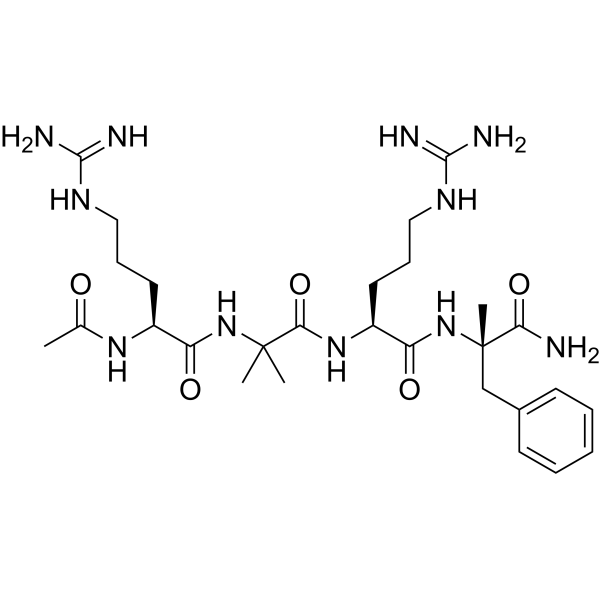
Cenupatide (UPARANT) is a uPAR and FPR antagonist with anti-angiogenic, anti-inflammatory, and vascular barrier regulatory activities, as well as high stability and resistance to enzymatic degradation in blood/plasma. Cenupatide blocks the uPAR-FPR interaction, reduces VEGF-induced phosphorylation levels of AKT, VEGFR-2, STAT3, JNK, p38 MAPK, ERK1/2, and NF-κB p65, and inhibits αvβ3 integrin activation. Cenupatide suppresses endothelial cell migration, invasion, tube formation, and angiogenic signaling pathways, restores tight junctions and blood-retinal barrier integrity, reduces pro-inflammatory marker levels, and inhibits apoptosis. Cenupatide reduces retinal neovascularization, renal fibrosis, and vascular leakage, and restores visual function in preclinical models. Cenupatide is applicable to research related to retinopathy, diabetic complications, ocular diseases, cancer, and inflammatory diseases .
loading...
    loading...
Cat. No.: HY-127167
CAS No.: 4143-64-0
Purity:  98.61%
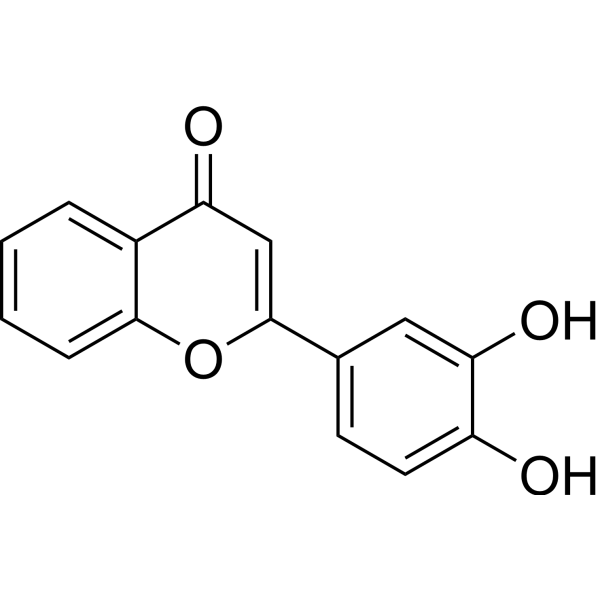
3',4'-Dihydroxyflavone is an orally active antioxidant. 3',4'-Dihydroxyflavone inhibits the NF-κB, JAK1/STAT1, AP-1, IRF3, and MAPK/MEK/ERK pathways, while activating Nrf2 and reducing Keap1, thereby exerting anti-inflammatory and antioxidant effects. 3',4'-Dihydroxyflavone inhibits NO, PGE2, pro-inflammatory cytokines, and ROS production, upregulates GSH, and activates KATP channels, adenosine A3 receptors, and GABAA receptors. 3',4'-Dihydroxyflavone inhibits PPARγ expression and adipogenic differentiation, induces osteogenic differentiation; it also inhibits 5-lipoxygenase and xanthine oxidase, weakly inhibits PARP1, and scavenges DPPH and superoxide radicals. 3',4'-Dihydroxyflavone can be used for research on peripheral nerve injury, septic shock, obesity, influenza A virus infection, infertility, and diabetic complications .
loading...
    loading...
Cat. No.: HY-N16527
CAS No.: 233690-85-2
7-O-Galloyl-D-sedoheptulose is an orally effective polyphenolic compound. 7-O-Galloyl-D-sedoheptulose lowers the serum levels of glucose, leptin, insulin, C-peptide, resistin, TNF-α, IL-6, and increases the serum level of adiponectin. 7-O-Galloyl-D-sedoheptulose significantly reduces the levels of ROS and lipid peroxidation products (TBARS) by down-regulating the protein expression of NADPH oxidase subunit Nox-4 and p22phox. 7-O-Galloyl-D-sedoheptulose down-regulates NF-κB and related pro-inflammatory factors (COX-2, iNOS), inhibits the phosphorylation of JNK and the activity of its downstream AP-1. 7-O-Galloyl-D-sedoheptulose reduces the expression of TGF-β1 and fibronectin, indicating its potential in anti-tissue fibrosis. 7-O-Galloyl-D-sedoheptulose can be used for the study of type 2 diabetes and its hepatic and pancreatic complications .
loading...
    loading...
Cat. No.: HY-175862
CAS No.: 2135481-84-2
ALR2-IN-9 is a potent ALR2 inhibitor (IC50 = 21.8 nM) with excellent antioxidant activity (EC50 for DPPH radical scavenging = 2.8 μM). ALR2-IN-9 interacts directly with Reactive Oxygen Species (ROS)/Reactive Nitrogen Species (RNS) and interrupts the free radical chain reactions, and as an endogenous enzymatic antioxidant regulator, which regulates enzyme functions of CAT and SOD. ALR2-IN-9 regulates PI3K/Akt/Nrf2 pathway to attenuate hyperglycemia-mediated mitochondrial superoxide overproduction in vitro, and ameliorates CuSO4- and H2O2-induced oxidative stress in vivo. ALR2-IN-9 prolongs lifespan of C. elegans via the regulation of stress response genes such as PMK-1. ALR2-IN-9 is a promising anti-aging drug candidate. ALR2-IN-9 can be used for diabetic complication research .
loading...
    loading...
Cat. No.: HY-L073
394 compounds

Hepatitis C virus (HCV) is a hepatotropic enveloped positive- strand RNA virus (family Flaviviridae) that infects the parenchymal cells of the liver. HCV infection is a significant public health burden. Globally, an estimated 71 million people have chronic hepatitis C virus infection. A significant number of those who are chronically infected will develop cirrhosis or liver cancer. To date, there is no vaccine against HCV, and combination pegylated alpha interferon (pIFN-) and ribavirin, the main standard-of-care treatment for HCV, is effective in only a subset of patients and is associated with a wide spectrum of toxic side effects and complications. More recently, new therapeutic approaches that target essential components of the HCV life cycle have been developed, including direct-acting antiviral (DAA) that specifically block a viral enzyme or functional protein and host-targeted agents (HTA) that block interactions between host proteins and viral components that are essential to the viral life cycle. However, the genetic diversity of HCV viruses and the stage of liver disease (i.e., cirrhosis) are revealing themselves as obstacles for effective, pan-genotypic treatments. There still exists a need for the discovery and development of new HCV inhibitors. In particular, since the future of HCV therapy will likely consist of a cocktail approach using multiple inhibitors that target different steps of infection, new antivirals targeting all steps of the viral infection cycle.

MCE offers a unique collection of 394 compounds with identified and potential anti-HCV activity. MCE Anti- Hepatitis C Virus Compound Library is a useful tool for discovery new anti-HCV drugs and other anti-infection research.

