179 Results for "

hematologic malignancy

" in MedChemExpress (MCE) Product Catalog:
Products (179)

179 Results for "hematologic malignancy" in MCE Product Catalog:

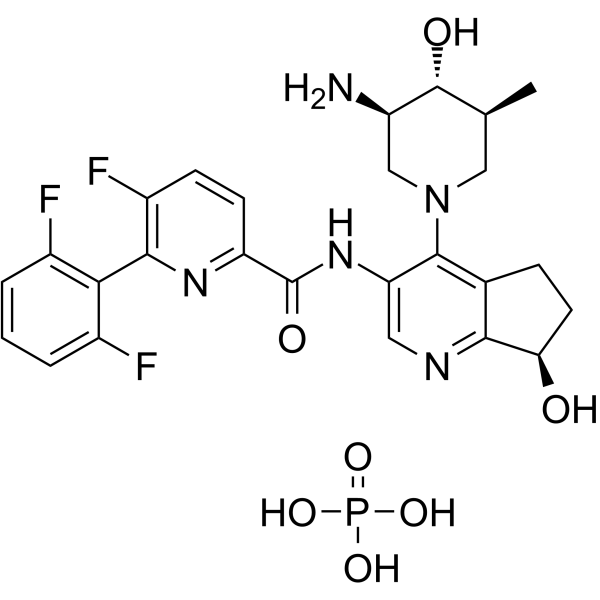
Cat. No.: HY-101870B
CAS No.: 2088852-47-3
Purity:  99.39%
Synonyms: INCB053914 phosphate
Target:  

Pim

Research Areas:  

Cancer

Uzansertib (INCB053914) phosphate is an orally active, ATP-competitive pan-PIM kinase inhibitor with IC50s of 0.24 nM, 30 nM, 0.12 nM for PIM1, PIM2, PIM3, respectively. Uzansertib phosphate has broad anti-proliferative activity against a variety of hematologic tumor cell lines .
loading...
    loading...
Cat. No.: HY-101870BR
CAS No.: 2088852-47-3
Synonyms: INCB053914 phosphate (Standard)
Target:  

Reference Standards Pim

Research Areas:  

Cancer

Uzansertib phosphate (Standard) is the analytical standard of Uzansertib phosphate (HY-101870B). This product is intended for research and analytical applications. Uzansertib (INCB053914) phosphate is an orally active, ATP-competitive pan-PIM kinase inhibitor with IC50s of 0.24 nM, 30 nM, 0.12 nM for PIM1, PIM2, PIM3, respectively. Uzansertib phosphate has broad anti-proliferative activity against a variety of hematologic tumor cell lines .
loading...
    loading...
Cat. No.: HY-181023
Target:  

PROTACs HDAC

Research Areas:  

Cancer

PROTAC HDAC8 Degrader-3 (Compound BP1) is an efficient and selective HDAC8 PROTAC degrader with a DC50 of 20 nM. PROTAC HDAC8 Degrader-3 exhibits IC50 for HDAC8 and CRBN of 0.46 and 7.5 μM, respectively. PROTAC HDAC8 Degrader-3 exhibits potent anti-proliferative activity against MM.1S and HL-60 cells. PROTAC HDAC8 Degrader-3 can be used for research on multiple myeloma and acute myeloid leukemia .
loading...
    loading...
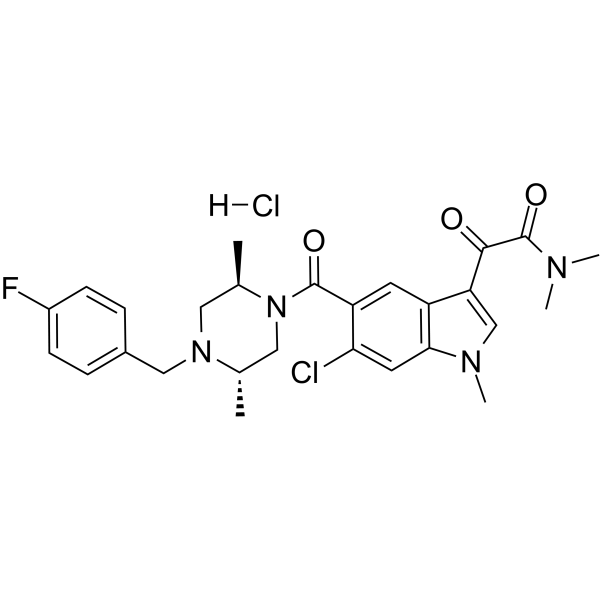
Cat. No.: HY-10406A
CAS No.: 2387505-88-4
Synonyms: SCIO-469 hydrochloride
Talmapimod (SCIO-469) hydrochloride is an orally active and selective inhibitor of p38α MAPK with an IC50 of 9 nM. Talmapimod hydrochloride inhibits the secretion of inflammatory factors (such as TNFα, IL-1β, IL-6, and VEGF) by suppressing the p38α MAPK pathway, and it also inhibits angiogenesis and osteoclast activation. Talmapimod hydrochloride inhibits the growth of multiple myeloma cells and induces apoptosis. Talmapimod hydrochloride can be used to study various hematological malignancies (such as multiple myeloma, myelodysplastic syndrome) .
loading...
    loading...
Cat. No.: HY-13328A
CAS No.: 1422006-47-0
Synonyms: INK-128 phosphate; MLN0128 phosphate; TAK-228 phosphate
Sapanisertib (INK-128; MLN0128; TAK-228) phosphate is an orally active dual mTORC1/mTORC2 inhibitor. Sapanisertib phosphate directly and simultaneously inhibits mTORC1/2 activity through competitive binding with ATP, thereby comprehensively blocking downstream processes such as protein and lipid synthesis and cytoskeletal reorganization, consequently suppressing tumor cell proliferation and promoting apoptosis. Sapanisertib phosphate is applicable to research on melanoma, ovarian cancer, pulmonary fibrosis, and hematological malignancies .
loading...
    loading...
Cat. No.: HY-178490
CAS No.: 2468046-72-0
Target:  

SWI/SNF Complex

Research Areas:  

Cancer

BRM/BRG1 ATP-IN-8 (Compound Cpd14) is an orally active BRG1/BRM ATPase domain inhibitor. BRM/BRG1 ATP-IN-8 exerts antitumor effects by disrupting aberrant chromatin remodeling in cancer cells, inducing apoptosis and growth arrest. BRM/BRG1 ATP-IN-8 is promising for research of BRG1/BRM-dependent malignancies, including hematological cancers, prostate cancer, breast cancer, and Ewing's sarcoma .
loading...
    loading...
Cat. No.: HY-10406B
CAS No.: 879132-01-1
Synonyms: rel-SCIO-469 hydrochloride
rel-Talmapimod (rel-SCIO-469) hydrochloride is an orally active and selective inhibitor of p38α MAPK with an IC50 of 9 nM. rel-Talmapimod hydrochloride inhibits the secretion of inflammatory factors (such as TNFα, IL-1β, IL-6, and VEGF) by suppressing the p38α MAPK pathway, and it also inhibits angiogenesis and osteoclast activation. rel-Talmapimod hydrochloride inhibits the growth of multiple myeloma cells and induces apoptosis. rel-Talmapimod hydrochloride can be used to study various hematological malignancies (such as multiple myeloma, myelodysplastic syndrome) .
loading...
    loading...
Cat. No.: HY-156730
CAS No.: 2502186-79-8
Purity:  96.17%
Target:  

Molecular Glues STAT

Research Areas:  

Cancer

KT-333 is a molecular glues that degrades STAT3 protein. KT-333 mediates the selective degradation of STAT3 through the ubiquitin-proteasome system by binding to STAT3 protein and E3 ubiquitin ligase von Hippel-Lindau protein (VHL). KT-333 has strong selectivity for STAT3 protein degradation and good antitumor activity. KT-333 can be used in the study of hematologic malignancies such as large granular lymphocytic leukemia (LGL-L), peripheral T-cell lymphoma (PTCL), and cutaneous T-cell lymphoma (CTCL) .
loading...
    loading...
Cat. No.: HY-172615
CAS No.: 3033019-04-1
Research Areas:  

Cancer

AMPTX-1 is a selective, orally active, covalent reversible BRD9 molecular glue degrader with a DC50 of 0.05 nM. AMPTX-1 selectively recruits BRD9 to the E3 ligase DCAF16. AMPTX-1 forms a ternary complex with BRD9 and a reversible covalent adduct with Cys58 on the surface of DCAF16. AMPTX-1 mediates BRD9 degradation via the proteasome and Cullin RING E3 ligase pathways. AMPTX-1 can be used in the research of solid tumors and hematological malignancies .
loading...
    loading...
Cat. No.: HY-10252R
CAS No.: 475488-23-4
Synonyms: ADW742 (Standard); GSK 552602A (Standard); ADW (Standard)
NVP-ADW742 (Standard) is the analytical standard of NVP-ADW742 (HY-10252). This product is intended for research and analytical applications. NVP-ADW742 (ADW742) is an orally active, selective IGF-1R tyrosine kinase inhibitor with an IC50 of 0.17 μM. NVP-ADW742 inhibits insulin receptor (InsR) with an IC50 of 2.8 μM. NVP-ADW742 induces pleiotropic antiproliferative/proapoptotic biologic sequelae in tumor cells .
loading...
    loading...
Cat. No.: HY-103019A
CAS No.: 1610358-53-6
Purity:  99.87%
Synonyms: (±)-BAY-1251152; (±)-VIP152
Research Areas:  

Cancer

(±)-Enitociclib ((±)-BAY-1251152) is the racemic mixture of Enitociclib (HY-103019E). Enitociclib is a selective CDK9 inhibitor and apoptosis inducer. Enitociclib inhibits CDK9 activity and reduces the phosphorylation of Ser2 in the carboxyl-terminal domain (CTD) of RNA polymerase Pol II, thereby downregulating the transcription of key oncogenes such as MYC and MCL1. Enitociclib has anti-proliferative activity targeting MYC + lymphoma and multiple myeloma (MM) cells, and has synergistic effects with Bortezomib (HY-10227) and Lenalidomide (HY-A0003), and can be used in the research of hematological malignancies .
loading...
    loading...
Cat. No.: HY-13599S1
Synonyms: 2-Chloro-2′-deoxyadenosine-13C5,15N2; CldAdo-13C5,15N2; 2CdA-13C5,15N2
Cladribine- 13C5, 15N2 (2-Chloro-2′-deoxyadenosine- 13C5, 15N2) is 13C and 15N labeled Cladribine. Cladribine (2-Chloro-2′-deoxyadenosine), a purine nucleoside analog, is an orally active adenosine deaminase inhibitor. Cladribine functions as an inhibitor of DNA synthesis to block the repair of the damaged DNA. Cladribine can inhibit DNA methylation. Cladribine has anti-lymphoma activity. Cladribine can be used for the research of several hematologic malignancies and multiple sclerosis .
loading...
    loading...
Cat. No.: HY-13599S4
Synonyms: 2-Chloro-2′-deoxyadenosine-13C,15N2; CldAdo-13C,15N2; 2CdA-13C,15N2
Cladribine- 13C, 15N2 (2-Chloro-2′-deoxyadenosine- 13C, 15N2) is the 13C- and 15N-labeled Cladribine (HY-13599). Cladribine (2-Chloro-2′-deoxyadenosine), a purine nucleoside analog, is an orally active?adenosine deaminase?inhibitor. Cladribine functions as an inhibitor of?DNA synthesis?to block the repair of the damaged DNA. Cladribine can inhibit DNA methylation. Cladribine has anti-lymphoma activity. Cladribine can be used for the research of several hematologic malignancies and multiple sclerosis.
loading...
    loading...
Cat. No.: HY-156730B
CAS No.: 2502186-80-1
Target:  

Molecular Glues STAT

Research Areas:  

Cancer

KT-333 diammonium is a molecular glues that degrades STAT3 protein. KT-333 diammonium mediates the selective degradation of STAT3 through the ubiquitin-proteasome system by binding to STAT3 protein and E3 ubiquitin ligase von Hippel-Lindau protein (VHL). KT-333 diammonium has strong selectivity for STAT3 protein degradation and good antitumor activity. KT-333 diammonium can be used in the study of hematologic malignancies such as large granular lymphocytic leukemia (LGL-L), peripheral T-cell lymphoma (PTCL), and cutaneous T-cell lymphoma (CTCL) .
loading...
    loading...
Cat. No.: HY-161670
Research Areas:  

Cancer

NSD2-PWWP1 ligand 1 (compound 34) is a small molecule ligand targeting the NSD2-PWWP1 domain (pIC50: 8.2). NSD2 is a large multidomain protein with histone writer and histone reader functions. Dysregulation of the levels of histone methyltransferase nuclear receptor binding SET domain 2 (NSD2) may lead to a variety of hematological and solid malignancies. NSD2-PWWP1 ligand 1 binds to NSD2, reducing its enzymatic activity and inhibiting tumorigenesis .
loading...
    loading...
Cat. No.: HY-168878
CAS No.: 3050819-22-9
Target:  

METTL3

Research Areas:  

Cancer

EP652 is a METTL3 inhibitor and antitumor agent with IC50 values of 2 nM, <10 nM, and 37 nM in SPA, intracellular, and ATPlite assays, respectively. EP652 exhibits high selectivity against 40 other methyltransferases and FTO, and possesses favorable pharmacokinetic parameters. EP652 reduces intracellular N 6-methyladenosine (m 6A) levels in mRNA. EP652 inhibits tumor growth and progression of both hematologic malignancies and solid tumors. EP652 can be used for the research of acute myeloid leukemia, ovarian cancer, non-small cell lung cancer, and hypopharyngeal squamous cell carcinoma .
loading...
    loading...
Cat. No.: HY-169076
Target:  

FLT3 HDAC Apoptosis

Research Areas:  

Cancer

FLT3/HDAC-IN-1 is a dual inhibitor of FLT3/HDAC, with IC50 values of 30.4, 52.4, and 14.7 nM for FLT3, HDAC1, and HDAC3, respectively. FLT3/HDAC-IN-1 can induce apoptosis in MV-4-11 cells and has anti-proliferative effects on FLT3 mutant-transformed BaF3 cells. FLT3/HDAC-IN-1 is being researched for its potential in treating hard-to-treat solid tumors and hematological malignancies .
loading...
    loading...
Cat. No.: HY-176244
CAS No.: 1351116-34-1
Research Areas:  

Cancer

KI-TOX-A3 is a TOX protein-protein interaction inhibitor that blocks the TOX-KAT7 protein-protein interaction with an IC50 of 0.51 μM. KI-TOX-A3 induces proteasomal degradation of TOX, restores KAT7-mediated H3K14 acetylation, reverses exhaustion of CD8 + T cells, and inhibits the proliferation of T cell acute lymphoblastic leukemia (T-ALL) cells. KI-TOX-A3 shows promise for use in studies of hematological malignancies such as T-ALL .
loading...
    loading...
Cat. No.: HY-178683
CAS No.: 2438125-72-3
Target:  

BCL6

Research Areas:  

Cancer

ALV-05-077-01 is a BCL6/BCL6B degrader. ALV-05-077-01 binds to CRBN and recruits specific zinc finger proteins as neo-substrates for ubiquitination and proteasomal degradation. ALV-05-077-01 induces the degradation of full-length endogenous BCL6 zinc finger protein. ALV-05-077-01 induces the degradation of full-length endogenous BCL6B zinc finger protein. ALV-05-077-01 can be used in the research of hematological malignancies .
loading...
    loading...
Cat. No.: HY-10406R
CAS No.: 309913-83-5
Synonyms: SCIO-469 (Standard)
Talmapimod (Standard) is the analytical standard of Talmapimod (HY-10406). This product is intended for research and analytical applications. Talmapimod (SCIO-469) is an orally active and selective inhibitor of p38α MAPK with an IC50 of 9 nM. Talmapimod inhibits the secretion of inflammatory factors (such as TNFα, IL-1β, IL-6, and VEGF) by suppressing the p38α MAPK pathway, and it also inhibits angiogenesis and osteoclast activation. Talmapimod inhibits the growth of multiple myeloma cells and induces apoptosis. Talmapimod can be used to study various hematological malignancies (such as multiple myeloma, myelodysplastic syndrome) .
loading...
    loading...

