11 Results for "

β-cell dysfunction

" in MedChemExpress (MCE) Product Catalog:
Products (11)

11 Results for "β-cell dysfunction" in MCE Product Catalog:

1
1 Cited Publications
Art. -Nr.: HY-B1021
CAS. Nr.: 1617-90-9
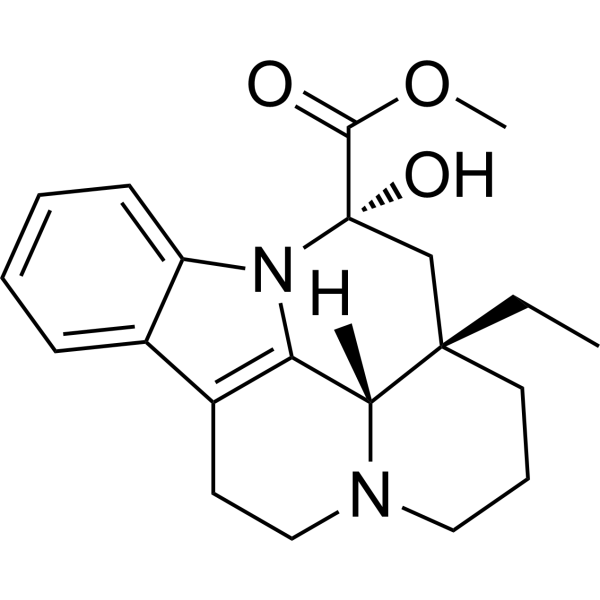
Vincamine is a monoterpenoid indole alkaloid extracted from the Madagascar periwinkle. Vincamine is a peripheral vasodilator and exerts a selective vasoregulator action on the brain microcapilar circulation . Vincamine is a GPR40 agonist and acts as a β-cell protector by ameliorating β-cell dysfunction and promoting glucose-stimulated insulin secretion (GSIS). Vincamine improves glucose homeostasis in vivo, and has the potential for the type 2 diabetes mellitus (T2DM) research .
loading...
    loading...
Art. -Nr.: HY-N10587
CAS. Nr.: 65597-47-9
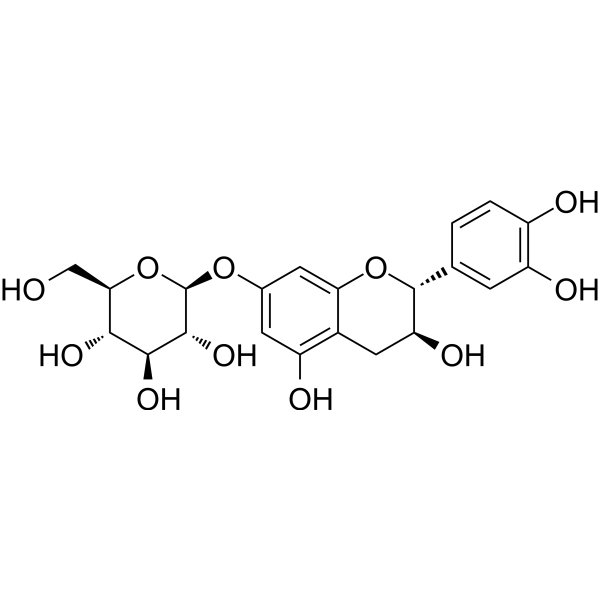
Catechin 7-O-beta-D-glucopyranoside is an orally active natural product found in Ulmus davidiana and Paeonia obovata. Catechin 7-O-β-D-glucopyranoside shows antioxidant and anti-inflammatory activities, and attenuates mitochondrial dysfunction. Catechin 7-O-beta-D-glucopyranoside can be used in intestinal inflammatory disease research .
loading...
    loading...
Art. -Nr.: HY-176745
CAS. Nr.: 292613-04-8
Target:  

VDAC

Forschungsgebiete:  

Metabolic Disease Endocrinology

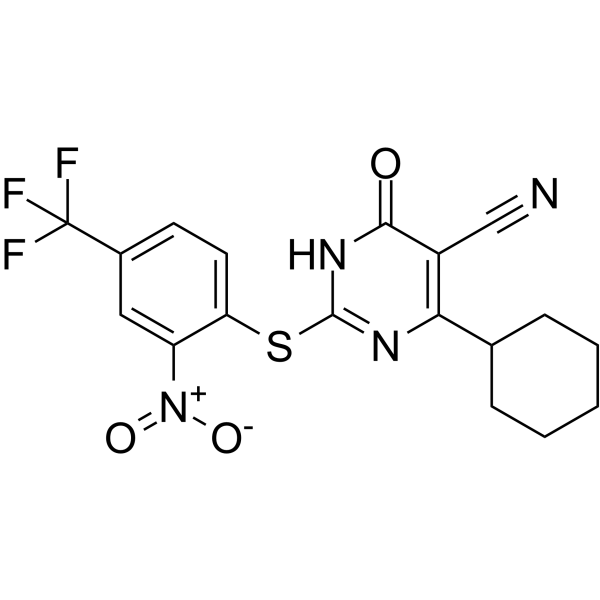
SW016789 is a hypersecretion-inducer targeting VDAC1. SW016789 can induce insulin hypersecretion and Ca 2+ influx in β-cells directly. SW016789 induces a transient endoplasmic reticulum stress response (ER stress), but does not cause beta cell death. SW016789 has reversible and non-apoptotic characteristics. SW016789 can be used for the study of Diabetes mellitus type 2 (T2DM) β-cell dysfunction .
loading...
    loading...
Art. -Nr.: HY-165035
CAS. Nr.: 85305-87-9
Synonyms: Glucocerebrosides; Gaucher cerebroside; GluCers (gaucher's spleen)
Glucosylceramide (Glucocerebrosides) (gaucher's spleen) is a glycosphingolipid and primary substrate of acid β-glycosidase, suppresses tyrosine phosphorylation of insulin receptor and IRS-1, disrupts insulin signaling cascade and triggers pancreatic β-cell dysfunction. Glucosylceramide (Gaucher's spleen) accumulates in rodents and induces obesity and insulin resistance, restores systemic glucose homeostasis and insulin sensitivity when synthesis is suppressed. Glucosylceramide (Gaucher's spleen) accumulates in the brain of chronic neuronopathic Gaucher disease mice with age and can be applied for research on insulin resistance, type 2 diabetes mellitus and chronic neuronopathic Gaucher disease .
loading...
    loading...
Art. -Nr.: HY-179041
CAS. Nr.: 924851-91-2
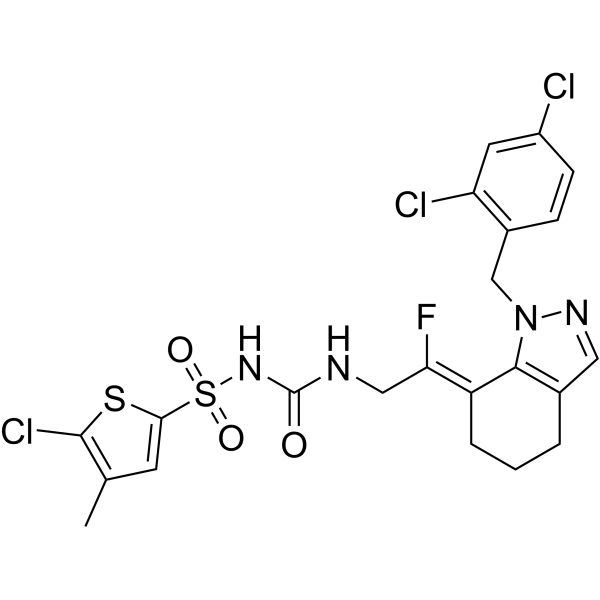
SZ0232 is a selective mPGES-2 inhibitor. SZ0232 binds to the active site of mPGES-2 via hydrogen bonds and π-π stacking, reduces the production of prostaglandin E2 (PGE2) and blocks the PGE2-EP3 pathway. SZ0232 regulates Ferroptosis by activating the heme-dependent p53/SLC7A11/GPX4 axis, inhibits lipid peroxidation, and protects renal tubules. SZ0232 enhances glucose-stimulated insulin secretion, inhibits β-cell senescence, and improves glucose homeostasis. SZ0232 reduces renal lipid accumulation, alleviates fibrosis, and ameliorates renal dysfunction in diabetic mice. SZ0232 inhibits renal cyst growth in polycystic kidney disease models. SZ0232 exhibits an insulinotropic effect that strengthens with the increase of animal age. SZ0232 can be used in studies related to type 2 diabetes, acute kidney injury, diabetic kidney disease, and autosomal dominant polycystic kidney disease .
loading...
    loading...
Art. -Nr.: HY-P990990
CAS. Nr.: 2803875-75-2
Synonyms: YN011; YN012; YN015

Target:  

GLP Receptor

Efsubaglutide alfa is a long-acting humanised GLP-1 receptor agonist . Efsubaglutide alfa binds specifically to the GLP-1 receptor, enhancing glucose-dependent insulin secretion, suppressing glucagon release, and promoting β-cell proliferation and increased β-cell mass. Efsubaglutide alfa improves glucose tolerance, increases pancreatic insulin content, and enhances β-cell secretory responses in isolated human islets. Efsubaglutide alfa reduces liver steatosis, lowers NAFLD Activity Scores, improves perisinusoidal collagen features, reduces serum ALT and AST levels, improves fasting glucose and triglyceride levels, and reduces body weight, liver weight and liver-to-body weight ratio. Efsubaglutide alfa can be used for the research of type 2 diabetes. Efsubaglutide alfa can be used for the research of metabolic dysfunction-associated steatohepatitis .
loading...
    loading...
Art. -Nr.: HY-124771
CAS. Nr.: 301177-36-6
Reinheit:  99.76%
Target:  

Apoptosis

Forschungsgebiete:  

Metabolic Disease

RH01386 is a small molecule that can prevent endoplasmic reticulum stress (ERS)-induced β cell dysfunction and death, and inhibits proapoptotic gene expression. RH01386 restores ERS-impaired glucose-stimulated insulin secretion responses. RH01386 has the potential for type 2 diabetes treatment .
loading...
    loading...
Art. -Nr.: HY-124483
CAS. Nr.: 432016-77-8
Target:  

Arrestin

Forschungsgebiete:  

Metabolic Disease

W2476 is a regulator of thioredocin-interacting protein signaling pathway. W2476 promotes competitive binding of forkhead box O1 transcription factor (FOXO1). W2476 can ameliorate β-cell dysfunction and enhance insulin secretion in diabetic mouse model .
loading...
    loading...
Art. -Nr.: HY-W742312
CAS. Nr.: 561-86-4
Synonyms: Ucedorm
Target:  

GABA Receptor

Forschungsgebiete:  

Metabolic Disease

Brallobarbitone is a positive allosteric modulator of GABAA receptor. Brallobarbitone can be used in the research of β-cell dysfunction .
loading...
    loading...
Art. -Nr.: HY-B1021R
CAS. Nr.: 1617-90-9
Vincamine (Standard) is the analytical standard of Vincamine. This product is intended for research and analytical applications. Vincamine is a monoterpenoid indole alkaloid extracted from the Madagascar periwinkle. Vincamine is a peripheral vasodilator and exerts a selective vasoregulator action on the brain microcapilar circulation . Vincamine is a GPR40 agonist and acts as a β-cell protector by ameliorating β-cell dysfunction and promoting glucose-stimulated insulin secretion (GSIS). Vincamine improves glucose homeostasis in vivo, and has the potential for the type 2 diabetes mellitus (T2DM) research .
loading...
    loading...
Art. -Nr.: HY-153256
CAS. Nr.: 2408297-80-1
Forschungsgebiete:  

Metabolic Disease

EP3 antagonist 4 (Compound 28) is an EP3 antagonist, with a Ki value of 2 nM for hEP. EP3 antagonist 4 shows low in vivo clearance, high oral AUC, and good bioavailability in the rat full PK studies. EP3 antagonist 4 can be used for research of beta cell dysfunction in diabetes .
loading...
    loading...
  • 1

