
17 Results for "

A. baumannii

" in MedChemExpress (MCE) Product Catalog:
Products (17)

17 Results for "A. baumannii" in MCE Product Catalog:

1
1 Cited Publications
Cat. No.: HY-116872
CAS No.: 4871-40-3
Purity:  99.33%
Target:  

Bacterial

Research Areas:  

Infection

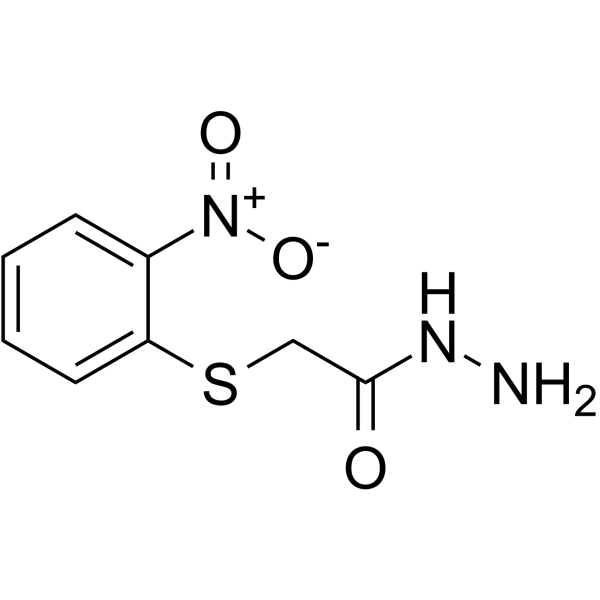
MAC13772 is a BioA inhibitor with an IC50 of 0.28 μM against E. coli and an IC50 of 0.269 μM against A. baumannii. MAC13772 inhibits bacterial growth by targeting the biotin biosynthesis pathway. MAC13772 can be used in studies related to bacterial infections .
loading...
    loading...
Cat. No.: HY-P2124
CAS No.: 20829-55-4
Target:  

Antibiotic Bacterial

Research Areas:  

Infection

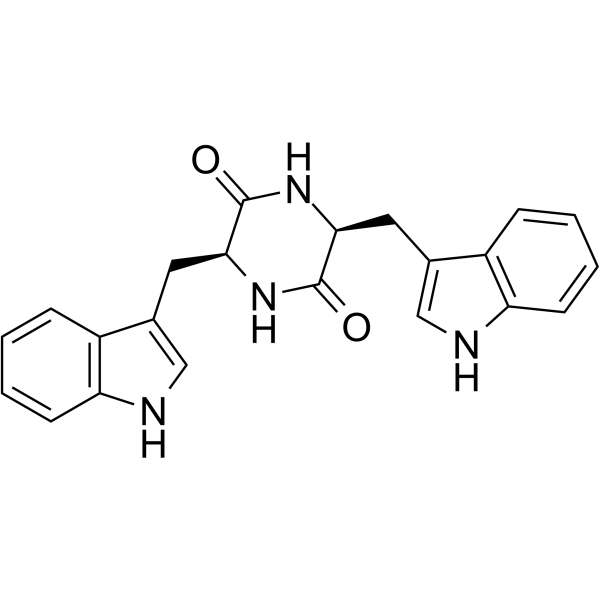
Cyclo(L-Trp-L-Trp) is an antibiotic, and shows antimicrobial activity. Cyclo(L-Trp-L-Trp) can inhibit A. baumannii, as well as Candida albicans, Bacillus subtilis, Micrococcus luteus, Saccharomyces cerevisiae, Aspergillus niger, Staphylococcus aureus. Cyclo(L-Trp-L-Trp) can be used in microbial infection research .
loading...
    loading...
Cat. No.: HY-162959
CAS No.: 2254567-00-3
Research Areas:  

Infection

BWC0977 acts as an inhibitor of bacterial Topoisomerase. BWC0977 stabilizes single-strand DNA breaks, inhibits DNA supercoiling and decatenation activities, binds to GyrA and ParC residues, and activates the SOS response. BWC0977 can be used in research related to multidrug-resistant bacterial infections .
loading...
    loading...
Cat. No.: HY-127041
CAS No.: 88909-96-0
Purity:  98.00%
Target:  

Bacterial

Research Areas:  

Infection

Virstatin inhibits the pili system synthesis and prevents A. baumannii biofilm formation. Virstatin also inhibits dimerization of the transcriptional activator ToxT .
loading...
    loading...
Cat. No.: HY-P10233
Target:  

Bacterial

Research Areas:  

Infection

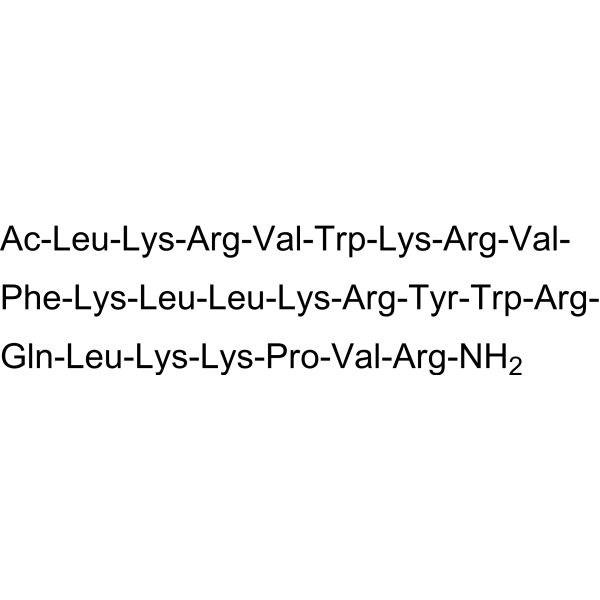
SAAP 148 is a synthetic antimicrobial peptide (bacteria) that interacts with and disrupts the lipid bilayer of bacterial cytoplasmic membranes, thereby inducing changes in membrane permeability and bacterial death. SAAP 148 kills drug-resistant, multidrug-resistant and persister bacterial strains, inhibits biofilm formation, eliminates established biofilms, and blocks bacterial colonization on implant surfaces. SAAP 148 retains its activity after modification or immobilization, exhibits variable cytotoxicity in different human cell models, and shows reduced efficacy in protein-rich environments. SAAP 148 can be used in infection-related research .
loading...
    loading...
Cat. No.: HY-P10389
Target:  

Bacterial

Research Areas:  

Infection

Globomycin derivative G2A (Compound G2A) is an inhibitor for lipoprotein signal peptidase II (LspA), with an IC50 of 604 nM. Globomycin derivative G2A inhibits E. coli, P. aeruginosa and A. baumannii, with MIC ranging from 12.5 to 32 μg/mL .
loading...
    loading...
Cat. No.: HY-173054
CAS No.: 3099249-36-9
Target:  

Bacterial

Research Areas:  

Infection

FtsZ-IN-12 (Compound 16e) is the inhibitor for filamentous temperature-sensitive mutant Z (FtsZ) that promotes the polymerization of FtsZ protein, inhibits its GTPase activity, thereby interfering with bacterial cell division process. FtsZ-IN-12 exhibits boardspectrum antibacterial activity that inhibits B. subtilis ATCC9372, B. pumilus CMCC63202, S. aureus ATCC25923, E. coli BW25113 and A. baumannii ATCC19606 with MIC of 0.062-1 μg/mL. FtsZ-IN-12 inhibits the formation of bacterial biofilms and exhibits a clearing effect on mature biofilms. FtsZ-IN-12 exhibits bactericidal activity without hemolytic toxicity to mammalian red blood cells (15 mg/kg) .
loading...
    loading...
Cat. No.: HY-P2365
CAS No.: 127637-03-0
Target:  

Fungal

Research Areas:  

Infection

Histatin-8 is a part of the Histatin-3 central sequence and is known as hemagglutination-inhibiting peptide. Histatin-8 is a potent anti-fungal peptide. Histatin-8 shows antimicrobial activity against yeast strains. Histatin-8 can be used for oral thrush research .
loading...
    loading...
Cat. No.: HY-162959A
CAS No.: 3027162-72-4
Research Areas:  

Infection

BWC0977 formic acts as an inhibitor of bacterial Topoisomerase. BWC0977 formic stabilizes single-strand DNA breaks, inhibits DNA supercoiling and decatenation activities, binds to GyrA and ParC residues, and activates the SOS response. BWC0977 formic can be used in research related to multidrug-resistant bacterial infections .
loading...
    loading...
Cat. No.: HY-149286
CAS No.: 3037009-24-5
Target:  

Bacterial

Research Areas:  

Infection

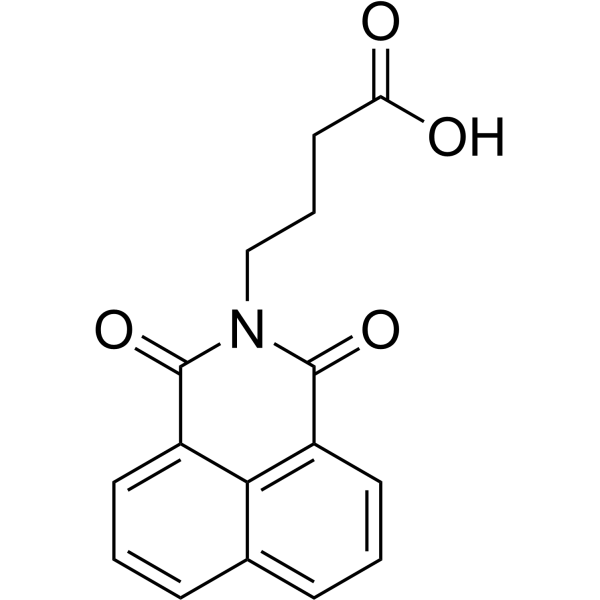
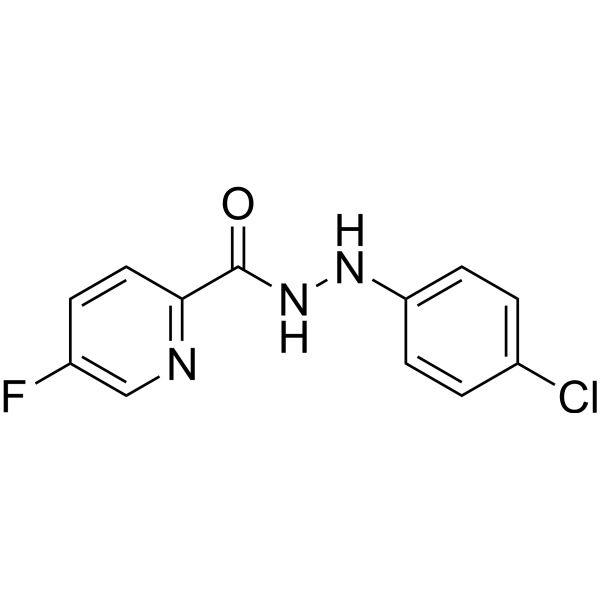
Antibacterial agent 142, an aromatic hydrazidesis, has antibacterial activity. Antibacterial agent 142 has bacteriostatic and inhibits biofilm formation .
loading...
    loading...
Cat. No.: HY-P2124R
CAS No.: 20829-55-4
Research Areas:  

Infection

L-Isoleucine (Standard) is the analytical standard of L-Isoleucine. This product is intended for research and analytical applications. L-Isoleucine is an orally active branched chain amino acid, which is the L-enantiomer of isoleucine. L-Isoleucine has a role as a Saccharomyces cerevisiae metabolite, an Escherichia coli metabolite, a plant metabolite, a human metabolite, an algal metabolite and a mouse metabolite. L-Isoleucine regulates the inflammatory response to protect against pathogens in vivo and in vitro .
loading...
    loading...
Cat. No.: HY-144255
Research Areas:  

Infection

Antibacterial agent 70 is an antibacterial agent that interacts with DNA, with a MIC value of 0.5 μg/mL against K. pneumonia and A. baumanii. Antibacterial agent 70 exhibits rapid bactericidal activity, low cytotoxicity to mammalian cells, and low tendency to induce drug resistance. Antibacterial agent 70 intercalates into DNA, disrupts bacterial membrane integrity, increases intracellular ROS production, reduces GSH activity, regulates membrane depolarization, enhances outer membrane permeability, and induces inner membrane damage. Antibacterial agent 70 can be used in studies related to multidrug-resistant bacterial infections and infections caused by drug-resistant Gram-negative pathogens .
loading...
    loading...
Cat. No.: HY-N17533
CAS No.: 1868129-15-0
Sargentodoside D is a phenolic glycoside. Sargentodoside D occurs in the stems of Sargentodoxa cuneata. Sargentodoside D is applicable to research on infections caused by Acinetobacter baumannii, Candida albicans and Staphylococcus aureus, as well as research on cervical cancer .
loading...
    loading...
Cat. No.: HY-P11940
Target:  

Bacterial

Research Areas:  

Infection

YB18 is an antimicrobial peptide targeting Gram-negative bacteria. YB18 exhibits low hemolytic activity, acceptable cytocompatibility at antibacterial-related concentrations, and membrane-associated bactericidal behavior. YB18 disrupts bacterial membrane permeability and membrane potential. In an in vivo wound model infected with Escherichia coli, topical administration of YB18 reduces bacterial load. YB18 can be used for research on Gram-negative bacterial infections .
loading...
    loading...
Cat. No.: HY-128526
CAS No.: 160472-93-5
Target:  

Endogenous Metabolite

Research Areas:  

Infection

Acinetobactin is a bifunctional siderophore secreted by Acinetobacter baumannii that competitively binds ferric iron ions. Acinetobactin supplies A. baumannii by sequestering host-sequestered Fe 3+, while competitively depriving skin and respiratory commensal bacteria of iron resources, thereby exerting growth-inhibitory effects on Staphylococcus epidermidis, Staphylococcus hominis, Staphylococcus haemolyticus, and Corynebacterium striatum. The synthesis and transport of Acinetobactin enhance the intracellular epithelial colonization ability of A. baumannii, induce apoptosis of host epithelial cells, and simultaneously improve the survival and invasion capabilities of the bacterium in Galleria mellonella and mouse sepsis models. Acinetobactin can be used in A. baumannii-related research .
loading...
    loading...
Cat. No.: HY-P11898
Target:  

Bacterial

Research Areas:  

Infection

RBWH15 is a synthetic broad-spectrum antimicrobial peptide. RBWH15 increases the permeability of bacterial outer and inner membranes, disrupts membrane integrity and induces bacterial death. RBWH15 exhibits biofilm eradication activity and can eliminate established bacterial biofilms. RBWH15 shows broad-spectrum antimicrobial activity against Gram-negative and Gram-positive ESKAPE pathogens, including multidrug-resistant strains. RBWH15 can be used in the research of multidrug-resistant bacterial infections .
loading...
    loading...
Cat. No.: HY-182315
Target:  

Bacterial

Research Areas:  

Infection

Antibacterial agent 334 is an antimicrobial peptide with in vitro activity against both Gram-negative and Gram-positive bacteria. Antibacterial agent 334 disrupts bacterial membrane integrity, induces membrane depolarization, impairs bacterial physiological processes without causing immediate bacterial lysis, and reduces the formation of Staphylococcus aureus biofilms. Antibacterial agent 334 can be used in studies related to Staphylococcus aureus infections .
loading...
    loading...
  • 1

