



Antibacterial agent 70
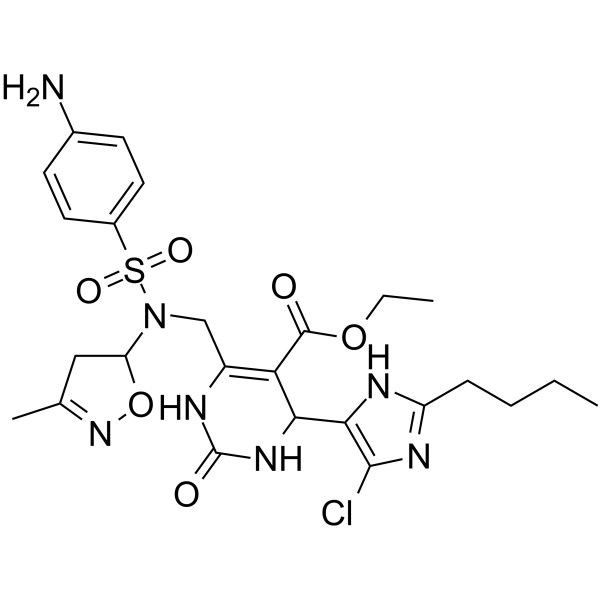
Antibacterial agent 70 is an antibacterial agent that interacts with DNA, with a MIC value of 0.5 μg/mL against K. pneumonia and A. baumanii. Antibacterial agent 70 exhibits rapid bactericidal activity, low cytotoxicity to mammalian cells, and low tendency to induce drug resistance. Antibacterial agent 70 intercalates into DNA, disrupts bacterial membrane integrity, increases intracellular ROS production, reduces GSH activity, regulates membrane depolarization, enhances outer membrane permeability, and induces inner membrane damage. Antibacterial agent 70 can be used in studies related to multidrug-resistant bacterial infections and infections caused by drug-resistant Gram-negative pathogens.
Nos produits utilisent uniquement pour la recherche. Nous ne vendons pas aux patients.
- Formule: C25H32ClN7O6S
- Masse moléculaire:594.08
-
Stockage:
Please store the product under the recommended conditions in the Certificate of Analysis.

To place orders, for customer services and technical support, please contact: MedChemExpress USA
Tel: 609-228-6898 E-mail: [email protected] [email protected]


-
 Activité biologique
-
Chemical Information
- Protocole
- Pureté et documentation
- Références
-
 Help & FAQs




Activité biologique
Description
Cellular Effect
|
Cell Line

|
Type | Value | Description | References |
|---|---|---|---|---|
| HepG2 | CC50 |
40 mg/mL
|
Cytotoxicity against human HepG2 hepatocellular carcinoma cells assessed as cell viability remaining above 50% at tested concentrations.
Cytotoxicity against human HepG2 hepatocellular carcinoma cells assessed as cell viability remaining above 50% at tested concentrations.
|
35168152 |
In Vitro
Antibacterial agent 70 (0.5-2 mg/mL; 1-6 h) exhibits rapid, dose-dependent bactericidal activity against K. pneumonia and A. baumanii[1].
Antibacterial agent 70 (0.25 mg/mL; 16 consecutive passages) shows a low tendency to induce drug resistance in A. baumanii and K. pneumonia[1].
Antibacterial agent 70 (0.5-3 mg/mL; 24 h) dose-dependently inhibits biofilm formation and disrupts preformed biofilms of A. baumanii and K. pneumonia[1].
Antibacterial agent 70 (0.25-2 mg/mL; 100 min) induces concentration-dependent and time-dependent cytoplasmic membrane depolarization and increases outer membrane permeability in A. baumanii and K. pneumonia[1].
Antibacterial agent 70 (0.25-2 mg/mL; 4-8 h) disrupts inner membrane integrity in K. pneumonia and A. baumanii, and induces cell lysis in K. pneumonia[1].
Antibacterial agent 70 (0.5-4 mg/mL; 6-8 h) promotes the accumulation of intracellular reactive oxygen species (ROS) and reduces the activity of intracellular glutathione (GSH) in K. pneumonia and A. baumanii[1].
Antibacterial agent 70 (10-100 μg/mL; 48 h) exhibits extremely low cytotoxicity in human hepatocellular carcinoma cells (HepG2) and endothelial cells (ECs)[1].
Antibacterial agent 70 (23.3-93.2 nM) binds to DNA in the calf thymus DNA system, and exerts the effect of competitively displacing acridine orange (AO) to intercalate into DNA in the AO (HY-101879)-DNA system[1].
MedChemExpress (MCE) has not independently confirmed the accuracy of these methods. They are for reference only.
-
Cell Line:HepG2 and ECs
-
Concentration:10, 20, 40, 80, 100 μg/mL
-
Incubation Time:48 h
-
Result:Demonstrated no obvious cytotoxicity, maintaining a relatively high cell viability rate near the highest tested concentrations.
Key Biological Information: 50% Cytotoxic Concentration (CC50) > 40 μg/mL.
- Research Protocol for Infectious Diseases
- Cell Cytotoxicity Assay
- Mammalian live/dead viability and cytotoxicity staining
- ROS/oxidative-stress fluorescent staining
- Fluorescent plasma-membrane potential dye assay
- Transepithelial/transendothelial electrical resistance assay
- Gram Staining of Tissue Sections
- Bacterial live/dead nucleic-acid viability staining
- Cell Viability Determination by MTT Colorimetric Assay


Chemical Information
-
Masse moléculaire 594.08
-
Formule C25H32ClN7O6S
-
SMILES
CCCCC1=NC(Cl)=C(N1)C2NC(NC(CN(S(=O)(C3=CC=C(C=C3)N)=O)C4CC(C)=NO4)=C2C(OCC)=O)=O
-
Livraison
Room temperature in continental US; may vary elsewhere.
-
Stockage
Please store the product under the recommended conditions in the Certificate of Analysis.


Pureté et documentation
Références

Calculators
Concentration (start) × Volume (start) = Concentration (final) × Volume (final)


Antibacterial agent 70 Related Classifications
HY-144255 Related Classifications
 Powered by Bioz