
1. Search Result
Search Result
Pathways Recommended: Antibody-drug Conjugate/ADC Related
Results for "

Antibody radiolabeling

" in MedChemExpress (MCE) Product Catalog:

15

Inhibitors & Agonists

2

Biochemical Assay Reagents

5

Inhibitory Antibodies

1

Click Chemistry

Cat. No. Product Name Target Research Areas Chemical Structure
  • HY-P99020
    Fresolimumab
    1 Publications Verification

    GC1008

    TGF-beta/Smad Metabolic Disease Inflammation/Immunology Cancer
    Fresolimumab (GC1008) is a human monoclonal antibody against TGF-β that neutralizes all mammalian active subtypes of TGF-β. The binding affinity of Fresolimumab to TGF-β2 is 1.8 nM. Fresolimumab improves Bleomycin (HY-108345)-induced acute lung injury. Fresolimumab radiolabeled with 89Zr can be used for PET analysis of TGF-β expression, antibody uptake and organ distribution. Fresolimumab can be used in the study of cancer, osteogenesis imperfecta, fibrosis and kidney disease .
    Fresolimumab
  • HY-134797
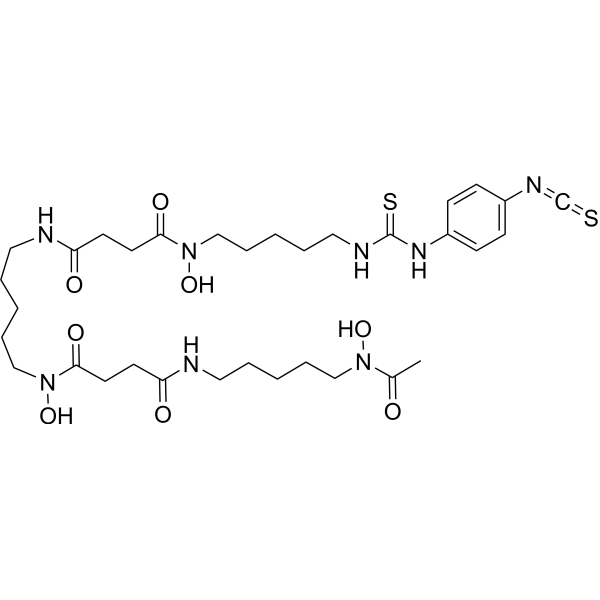
    p-SCN-Bn-deferoxamine
    1 Publications Verification

    Radionuclide-Drug Conjugates (RDCs) Cancer
    P-SCN-Bn-deferoxamine is a bifunctional chelating agent that can link radioactive metal nuclides (such as Zr-89) and biological targeting molecules (such as antibodies). P-SCN-Bn-deferoxamine can be used for the research of immune PET imaging .
    p-SCN-Bn-deferoxamine
  • HY-158067

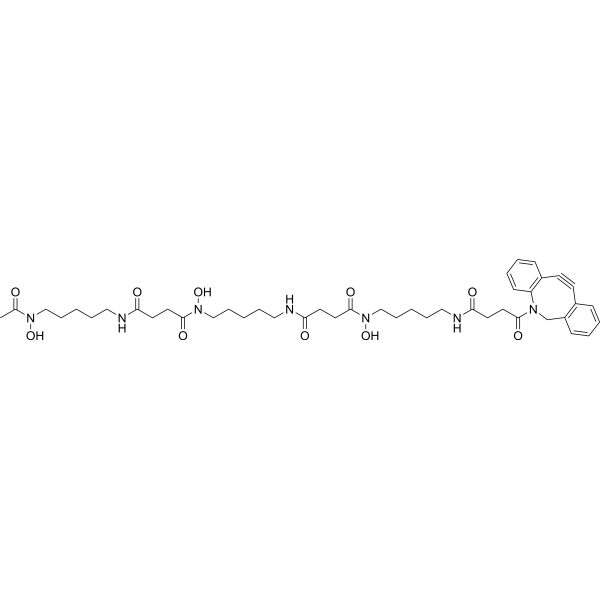
    DFO-DBCO

    Biochemical Assay Reagents Radionuclide-Drug Conjugates (RDCs) Cancer
    Deferoxamine-DBCO is a bifunctional chelating agent. Deferoxamine-DBCO efficiently chelates with radioactive metals (such as 89Zr) through the DFO structure to achieve radiolabeling. Deferoxamine-DBCO undergoes a metal-free Huisgen cycloaddition reaction with azide-containing biomolecules (such as siRNA, monoclonal antibodies) under bioorthogonal conditions through the DBCO structure to achieve targeted coupling. Deferoxamine-DBCO has efficient metal chelating ability and specific bioorthogonal reaction activity. Deferoxamine-DBCO can be used for targeted radioactive imaging studies of tumors .
    Deferoxamine-DBCO
  • HY-W539893

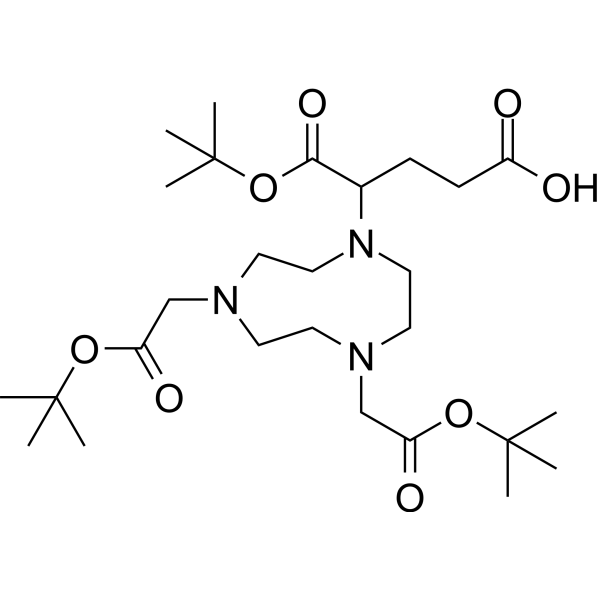
    NODAG

    Biochemical Assay Reagents Cancer
    NODAGA-tris(t-Bu ester) (NODAG) is a NODAGA derivative. NODAGA-tris(t-Bu ester) can be used to label peptides, antibodies, etc., and subsequently radiolabeled for PET imaging .
    NODAGA-tris(t-Bu ester)
  • HY-136952

    Biochemical Assay Reagents Radionuclide-Drug Conjugates (RDCs) Cancer
    p-SCN-Bn-HOPO is a bifunctional chelator that forms stable octadentate complexes with Zr (IV) and 89Zr 4+ via four 1,2-hydroxypyridone groups. p-SCN-Bn-HOPO conjugates with antibodies through the formation of thiourea bonds with lysine residues, and enables efficient 89Zr radiolabeling under mild conditions. p-SCN-Bn-HOPO inhibits bone uptake of free radiometals, stabilizes radiometal-antibody conjugates, and achieves PET imaging with low background and enhanced tumor-to-organ contrast. p-SCN-Bn-HOPO can be used in breast cancer-related research .
    p-SCN-Bn-HOPO
  • HY-122939

    Radionuclide-Drug Conjugates (RDCs) Cancer
    MAIPGG is a bifunctional chelator and an intermediate in the synthesis of radionuclide drug conjugates (RDCs). MAIPGG can be for the radiolabeling of a variety of monoclonal antibodies with 99mTc or 186Re, which then can be used for radioimmunodetection and radioimmunotherapy of cancer .
    MAIPGG
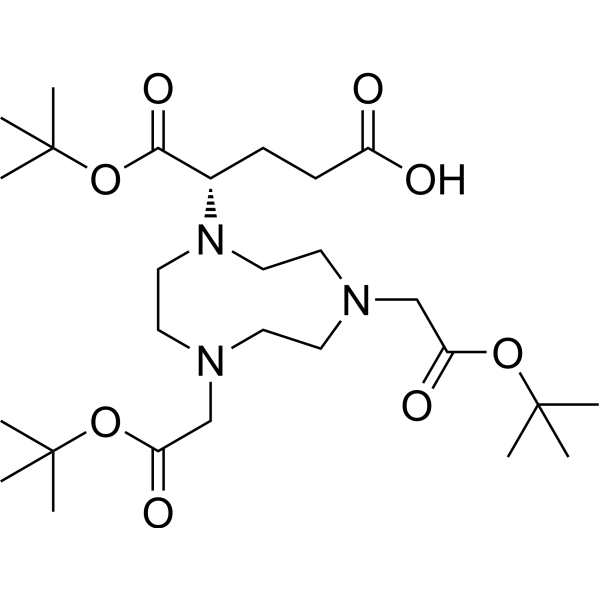
  • HY-W755222

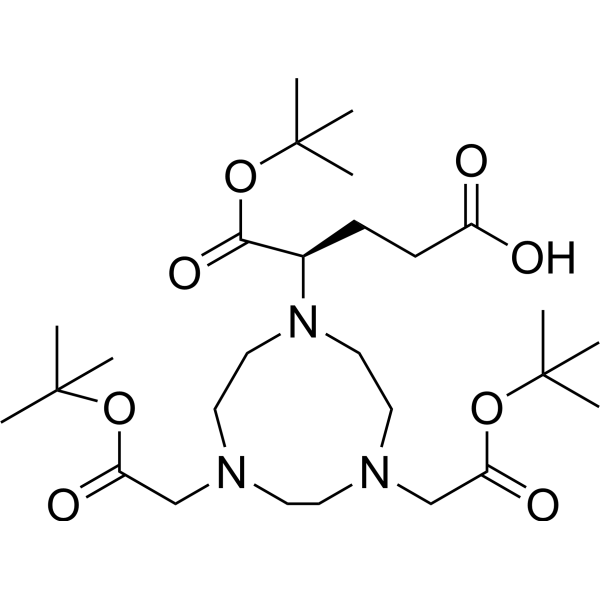
    (S)-NODAG

    Biochemical Assay Reagents Cancer
    (S)-NODAGA-tris(t-Bu ester) ((S)-NODAG) is a NODAGA derivative. (S)-NODAGA-tris(t-Bu ester) can be used to label peptides, antibodies, etc., and subsequently radiolabeled for PET imaging .
    (S)-NODAGA-tris(t-Bu ester)
  • HY-W591317

    (R)-NODAG

    Radionuclide-Drug Conjugates (RDCs) Cancer
    (R)-NODAGA-tris(t-Bu ester) ((R)-NODAG) is a NODAGA derivative. (R)-NODAGA-tris(t-Bu ester) can be used to label peptides, antibodies, etc., and subsequently radiolabeled for PET imaging .
    (R)-NODAGA-tris(t-Bu ester)
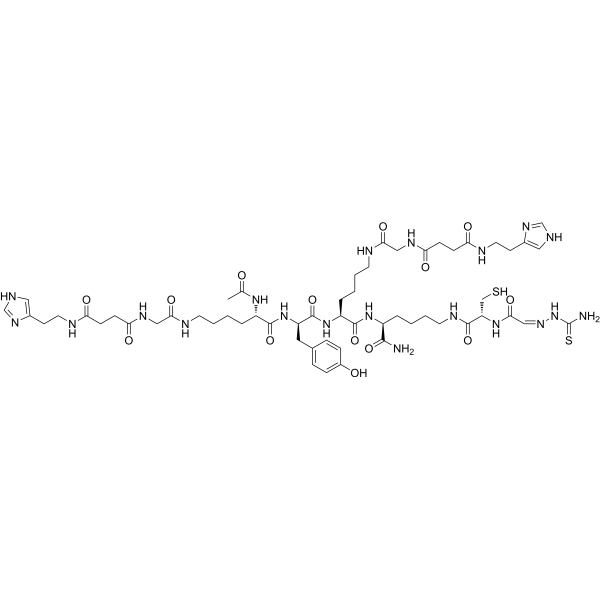
  • HY-155470

    Biochemical Assay Reagents Cancer
    IMP 243 is a symmetric di-HSG (histamine-succinyl-glycine) bivalent hapten containing a Tscg-Cys ligand and two HSG groups. IMP 243 can be radiolabeled with 99mTc-pertechnetate. IMP 243 can be conjugated to other peptides to design bispecific antibodies (bsMAbs) for cancer research .
    IMP 243
  • HY-183600

    Radionuclide-Drug Conjugates (RDCs) Biochemical Assay Reagents Cancer
    SCN-PYTA is a bifunctional chelator for trivalent radiometals. After conjugation with monoclonal antibodies, SCN-PYTA forms a stable complex with 225Ac to achieve efficient radiolabeling. SCN-PYTA can be used in cancer research .
    SCN-PYTA
  • HY-P992475

    Radionuclide-Drug Conjugates (RDCs) Cancer
    Tecnemab K1 is an anti-Melanoma monoclonal antibody. Tecnemab K1 accumulates in metastatic lesions of malignant melanoma and some benign lesions. When radiolabeled, Tecnemab K1 can serve as a radiotracer for malignant melanoma research. The isotype control is Mouse IgG1 kappa, Isotype Control (HY-P99977) .
    Tecnemab K1
  • HY-P991922

    Fc Receptor (FcR) Complement System Radionuclide-Drug Conjugates (RDCs) Cancer
    AKIR001 is a high-affinity human IgG1 antibody targeting CD44v6. AKIR001 carries LALA-silencing mutations in its FcγR-binding domain to reduce FcγR and C1q interactions, minimizing tissue interactions and limiting CDC and ADCC risks. [ 177Lu] radiolabeled AKIR001, namely [ 177Lu]Lu-AKIR001, has anticancer activity against epidermoid carcinoma .
    AKIR001
  • HY-P992367

    TROP2 Cancer
    hIMB1636 is a humanized monoclonal antibody targeting Trop2. By binding to the conformational Trop2 epitope, hIMB1636 regulates related signaling pathways, triggers lysosomal endocytosis, and further induces apoptosis, cell cycle arrest, and antibody-dependent cellular cytotoxicity. hIMB1636 effectively inhibits tumor cell proliferation, migration and in vivo tumor growth, and also exerts bystander killing effect and mediates long-term retention. hIMB1636 can be conjugated with NOTA/DOTA for radiolabeling to enable immuno-PET imaging, or prepared as hIMB1636-LDP-AE to significantly inhibit the growth of breast cancer and lung cancer xenografts .
    hIMB1636
  • HY-W1129940

    Radionuclide-Drug Conjugates (RDCs) Cancer
    p-SCN-Macropa is a bifunctional macrocyclic chelator featuring macrocyclic polyamine skeletons and thiocyanate (-SCN) reactive moieties. p-SCN-Macropa can conjugate with monoclonal antibodies including Nimotuzumab (HY-P9968), Rituximab (HY-P9913) and Trastuzumab (HY-P9907)-PEG6-DM1 for 225Ac radiolabeling to construct radioimmunoconjugates. p-SCN-Macropa is applicable for the research of colorectal cancer, HER2-positive breast cancer, TROP-2-positive cancers, and PSMA-positive cancers .
    p-SCN-Macropa
  • HY-P992340

    Radionuclide-Drug Conjugates (RDCs) TNF Receptor Cancer
    CTB006 is a monoclonal antibody targeting a humanized chimeric recombinant anti-DR5. CTB006 specifically binds to and activates DR5, thereby inducing tumor cell apoptosis, inhibiting tumor growth and reducing tumor drug resistance. 177Lu-radiolabeled CTB006 can deliver targeted radiotherapy to tumor cells; while 89Zr- or 177Lu-labeled CTB006 can serve as a PET/CT imaging agent for detecting DR5 expression levels in preclinical tumor models and screening cancers with DR5 overexpression. CTB006 can be applied to research related to gastrointestinal cancer, colorectal cancer and other solid tumors .
    CTB006

Inquiry Online

Your information is safe with us. * Required Fields.

Salutation


Country or Region *

Applicant Name *


Organization Name *

Department *


Email Address *


Product Name *

Cat. No.


Requested quantity *

Phone Number *


Remarks

Inquiry Online

Inquiry Information

Product Name:
Cat. No.:
Quantity:
MCE Japan Authorized Agent:

