15 Results for "

Drosophila model

" in MedChemExpress (MCE) Product Catalog:
Products (15)

15 Results for "Drosophila model" in MCE Product Catalog:

313
313 Cited Publications
Cat. No.: HY-15452
CAS No.: 49843-98-3
Purity:  99.85%
Synonyms: EX-527
Target:  

Sirtuin

Research Areas:  

Inflammation/Immunology Cancer

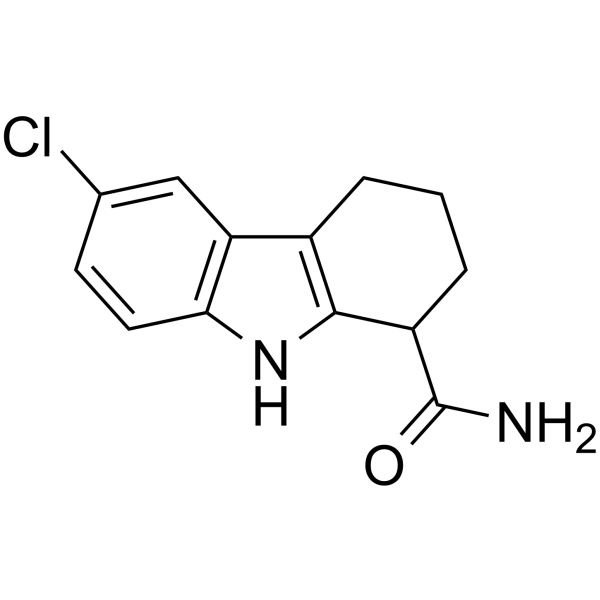
Selisistat (EX-527) is a potent and selective SirT1 (Sir2 in Drosophila melanogaster) inhibitor with an IC50 of 123 nM for SirT1. Selisistat alleviates pathology in multiple animal and cell models of Huntington's disease .
loading...
    loading...
Cat. No.: HY-P10861A
Target:  

Tau Protein

Research Areas:  

Neurological Disease

RI-AG03 acetate is a proteolytically stable tau aggregation inhibitor that crosses the blood-brain barrier and exhibits oral efficacy. RI-AG03 acetate inhibits tau aggregation and promotes the formation of alternative amorphous aggregates that are non-amyloidogenic. RI-AG03 acetate mediates cellular uptake through direct membrane penetration and macropinocytosis, and its conjugation with cell-penetrating peptide sequences (CPPs) enhances the binding of cells to liposomes. RI-AG03 acetate suppresses aggregation-dependent neurodegenerative and behavioral phenotypes, and extends the lifespan of Drosophila models of tauopathy. RI-AG03 acetate can be used for research on tau-related diseases such as Alzheimer's disease .
loading...
    loading...
Cat. No.: HY-153804
CAS No.: 864627-58-7
Purity:  99.68%
Synonyms: NCD
Target:  

Molecular Glues

Research Areas:  

Neurological Disease Cancer

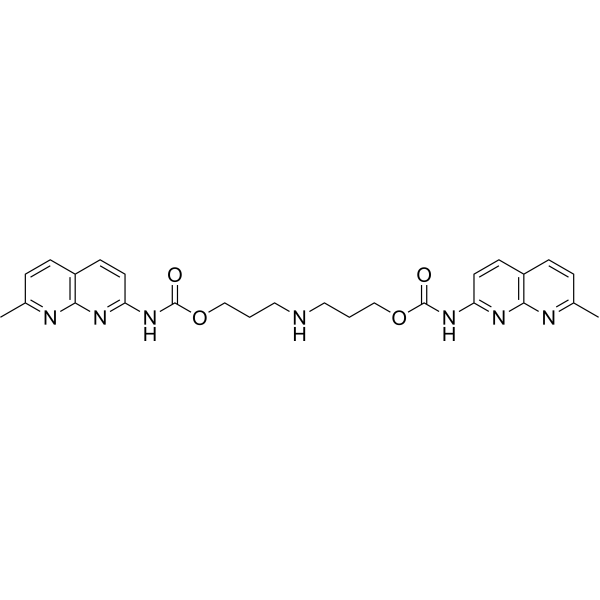
Naphthyridine carbamate dimer (NCD) is a molecular glue. Naphthyridine carbamate dimer induces designed structural changes in target functional DNA, thereby regulating its function. As a molecular glue, naphthyridine carbamate dimer stabilizes non-spontaneously formed GG homologous mismatched double-stranded DNA. Naphthyridine carbamate dimer reduces the formation of toxic RNA foci and regulates CGG repeat instability associated with fragile X syndrome and spinocerebellar ataxia type 31. Naphthyridine carbamate dimer can be used in research related to fragile X syndrome and spinocerebellar ataxia type 31 .
loading...
    loading...
Cat. No.: HY-P10861
Target:  

Tau Protein

Research Areas:  

Neurological Disease

RI-AG03 is a proteolytically stable tau aggregation inhibitor that crosses the blood-brain barrier and exhibits oral efficacy. RI-AG03 inhibits tau aggregation and promotes the formation of alternative amorphous aggregates that are non-amyloidogenic. RI-AG03 mediates cellular uptake through direct membrane penetration and macropinocytosis, and its conjugation with cell-penetrating peptide sequences (CPPs) enhances the binding of cells to liposomes. RI-AG03 suppresses aggregation-dependent neurodegenerative and behavioral phenotypes, and extends the lifespan of Drosophila models of tauopathy. RI-AG03 can be used for research on tau-related diseases such as Alzheimer's disease .
loading...
    loading...
Cat. No.: HY-15452R
CAS No.: 49843-98-3
Synonyms: EX-527 (Standard)
Research Areas:  

Inflammation/Immunology Cancer

Selisistat (Standard) is the analytical standard of Selisistat. This product is intended for research and analytical applications. Selisistat (EX-527) is a potent and selective SirT1 (Sir2 in Drosophila melanogaster) inhibitor with an IC50 of 123 nM for SirT1. Selisistat alleviates pathology in multiple animal and cell models of Huntington's disease .
loading...
    loading...
Cat. No.: HY-125172
CAS No.: 300670-16-0
Synonyms: Polyglutamine Aggregation inhibitor III
Target:  

Huntingtin

Research Areas:  

Others

C2-8 is an inhibitor of polyglutamine (polyQ) aggregation (IC50s=25 and 0.05 μM for recombinant HDQ51 and in PC12 cells, respectively). It also inhibits polyQ aggregation in organotypic hippocampal slice cultures isolated from R6/2 transgenic mice and reduces neurodegeneration in a dose-dependent manner in a Drosophila model of Huntington's disease. C2-8 (100 and 200 mg/kg) reduces huntingtin aggregate size, reduces neuronal atrophy, and improves motor performance in a rotarod test in the R6/2 transgenic mouse model of Huntington's disease.
loading...
    loading...
Cat. No.: HY-122989
CAS No.: 53948-10-0
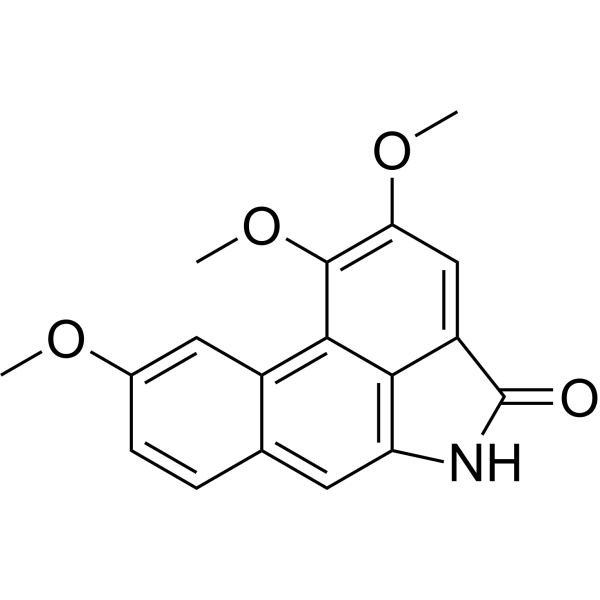
Aristolactam BIII is a potent DYRK1A inhibitor and inhibits the kinase activity of DYRK1A in vitro (IC50= 9.67 nM. Aristolactam BIII rescues the proliferative defects of DYRK1A transgenic (TG) mouse-derived fibroblasts and neurological and phenotypic defects of DS-like Drosophila models .
loading...
    loading...
Cat. No.: HY-121503
CAS No.: 68207-21-6
Target:  

Others

Research Areas:  

Neurological Disease

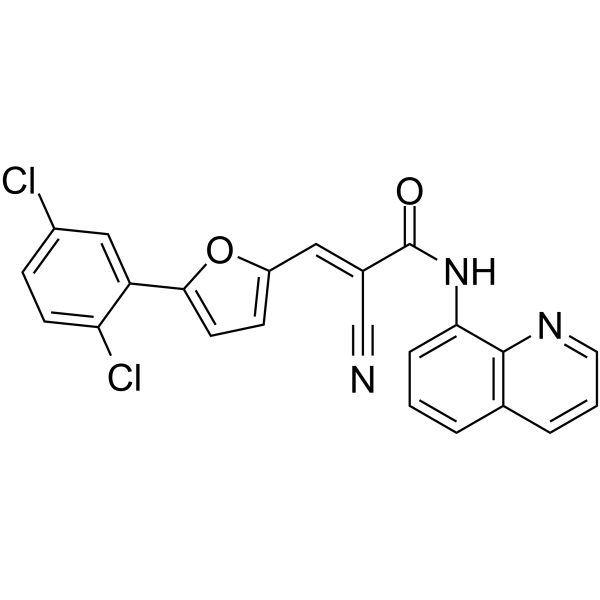
FD44 is a phenothiazine small molecule that inhibits the interaction between neuronal calcium sensor 1 (NCS-1) and the guanine exchange factor Ric8a, a key regulator of synapse number and neurotransmitter release probability. In the Drosophila genetic autism model of fragile X syndrome (FXS), FD44 restored normal synapse number and associative learning .
loading...
    loading...
Cat. No.: HY-119857
CAS No.: 304896-21-7
Synonyms: SIRT2 Inhibitor,Inactive Control
Target:  

Sirtuin

Research Areas:  

Neurological Disease

AGK7 is a potent inhibitor of sirtuin 2 (SIRT2). AGK7 rescues alpha-synuclein toxicity and modified inclusion morphology in a cellular model of Parkinson's disease. AGK7 protects against dopaminergic cell death both in vitro and in a Drosophila model of Parkinson's disease .
loading...
    loading...
Cat. No.: HY-169156
HDAC6-IN-49 (Compound 3) is an inhibitor for HDAC with IC50 of 0.012 and 0.735 μM for HDAC6 and HDAC1. HDAC6-IN-49 also exhibits inhibitory activities against MAO-B, cholinesterase (ChE), histamine receptor (H3R) and serotonin 6 receptor (5-HT6R). HDAC6-IN-49 exhibits neuroprotective efficacy on SH-SY5Y cell. HDAC6-IN-49 improves cognitive function and locomotor ability in Drosophila Parkinson's disease models and in C. elegans Alzheimer's disease models .
loading...
    loading...
Cat. No.: HY-163514
Research Areas:  

Neurological Disease

hAChE-IN-8 (Compound S-12) is a orally effective and selective inhibitor of hAChE (IC50=0.486 μM). hAChE-IN-8 also inhibits BACE-1 (IC50=0.542 μM), and does not inhibit Dyrk1A (IC50>10 μM). hAChE-IN-8 can reduce Aβ aggregation, has good blood-brain barrier penetration. hAChE-IN-8 is mainly used in Alzheimer's disease research .
loading...
    loading...
Cat. No.: HY-168731
Target:  

Cholinesterase (ChE)

Research Areas:  

Neurological Disease

AChE/BChE-IN-25 (Compound 6e) is the orally active inhibitor for hAChE and eqBChE with IC50 of 7.9 nM and 0.79 nM. AChE/BChE-IN-25 exhibits antioxidant activity, that scavenges free radical with IC50 of 22.91 μM. AChE/BChE-IN-25 exhibits neuroprotective effects by reducing mitochondrial and cellular oxidative stress in the Drosophila Alzheimer's disease model. AChE/BChE-IN-25 ameliorates Scopolamine (HY-N0296)-induced spatial and cognitive memory impairment in mouse model .
loading...
    loading...
Cat. No.: HY-N17667
CAS No.: 1174662-64-6
6’’-O-trans-p-Coumaroylgenipin gentiobioside (compound 2) is an iridoid glucoside that can be found in Gardenia jasminoides .
loading...
    loading...
Cat. No.: HY-183068
Research Areas:  

Cancer

AP4-43 is an orally active CLK1, CLK4, PI3K, DDR1, EGFR and NEK4 inhibitor. AP4-43 reduces growth of mammalian colorectal cancer organoids. AP4-43 improves survival in a transgenic Drosophila model of KRAS-mutant colorectal cancer. AP4-43 can be used for the research of KRAS-mutant colorectal cancer .
loading...
    loading...
Cat. No.: HY-181985
CAS No.: 69560-70-9
Target:  

Insecticide

Research Areas:  

Infection

Insecticidal agent 30 is an orally active insecticidal agent. Insecticidal agent 30 induces rapid contact mortality in adult Brassicogethes aeneus, achieves 100% 24-hour contact mortality against Brassicogethes aeneus, and exhibits moderate insecticidal activity against Drosophila melanogaster. Insecticidal agent 30 can be used for the research of pollen beetle (brassicogethes aeneus) infestation .
loading...
    loading...
  • 1

