14 Results for "

MTT assay

" in MedChemExpress (MCE) Product Catalog:
Products (14)

14 Results for "MTT assay" in MCE Product Catalog:

192
192 Publications Verification
Cat. No.: HY-15924
CAS No.: 298-93-1
Synonyms: MTT; Thiazolyl Blue Tetrazolium bromide; Methylthiazolyldiphenyl-tetrazolium bromide
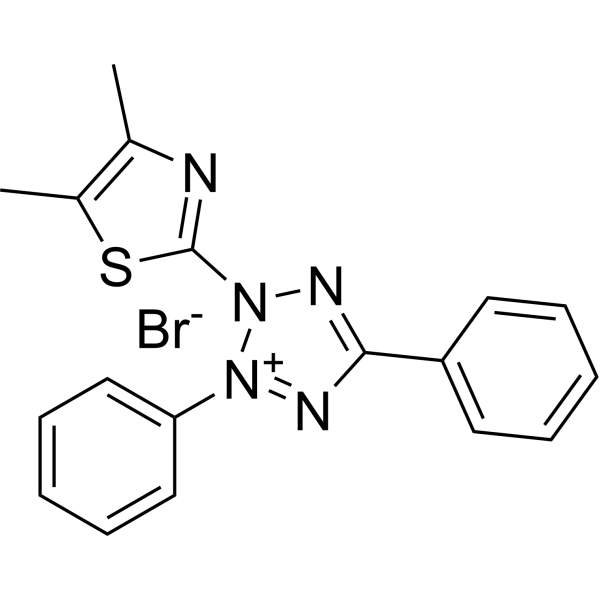
Thiazolyl Blue (MTT) is a cell-permeable and positively charged tetrazolium dye that is used to detect reductive metabolism in cells. Thiazolyl Blue is taken up by cells through the plasma membrane and then reduced to formazan by intracellular NAD (P) H-oxidoreductases. Thiazolyl Blue is frequently used in colorimetric assays to measure cell proliferation, cytotoxicity, and apoptosis .
loading...
    loading...
4
4 Cited Publications
Cat. No.: HY-12855A
CAS No.: 1391426-24-6
Purity:  99.89%
Synonyms: Lys01 trihydrochloride
Target:  

Autophagy

Research Areas:  

Cancer

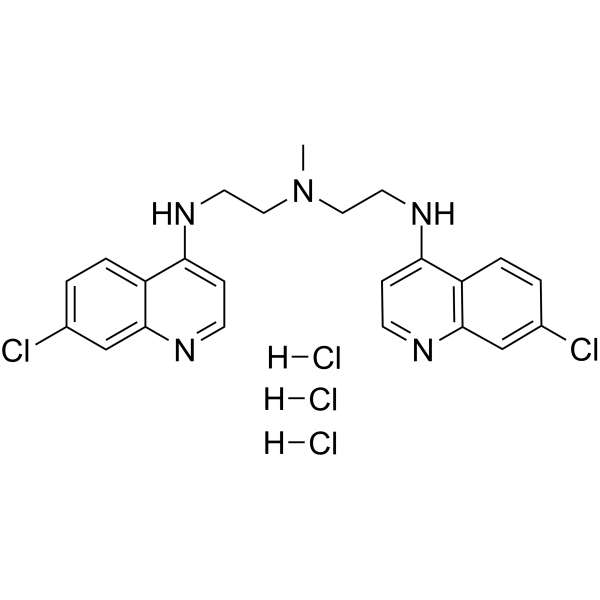
Lys05 (Lys01 trihydrochloride) is a novel lysosomal autophagy inhibitor with IC50 values of 3.6, 3.8, 6 and 7.9 μM for 1205Lu, c8161, LN229 and HT-29 cell line in the MTT assay.
loading...
    loading...
3
3 Cited Publications
Cat. No.: HY-N2127
CAS No.: 480-37-5
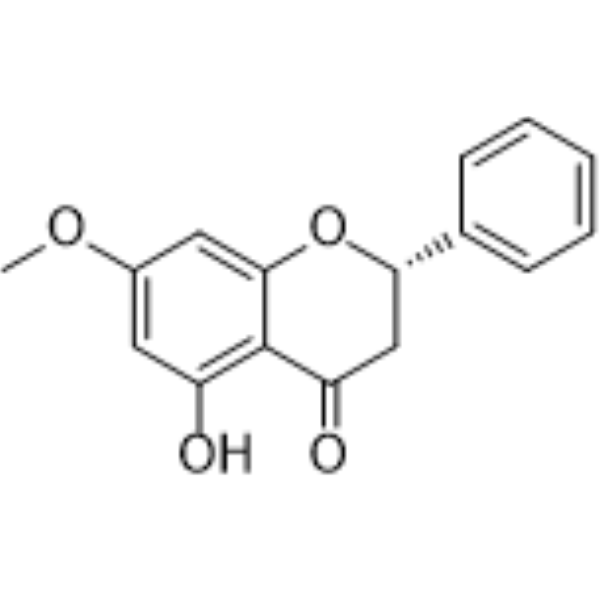
Pinostrobin is a flavonoid with anti-cancer, antioxidant, antiviral and neuroprotective activities. Pinostrobin has oral activity. Pinostrobin is a potent PCSK9 inhibitor that inhibits the catalytic activity of PCSK9. Pinostrobin can be used in the research of viral infections, cancer, leukemia, cardiovascular and cerebrovascular diseases, cirrhosis, inflammation and neurological diseases .
loading...
    loading...
Cat. No.: HY-137006
CAS No.: 57360-69-7
Target:  

Fluorescent Dye

Research Areas:  

Others

MTT Formazan is a purple water-insoluble product formed by the reduction of yellow soluble MTT by succinate dehydrogenase in the mitochondria of viable cells. The amount of MTT Formazan produced is proportional to cellular metabolic activity, and it can serve as an indicator for evaluating cell viability and proliferation. MTT Formazan exhibits solvent-dependent solubility properties, and its absorbance value can be measured by spectrophotometry to reflect cellular status. MTT Formazan also supports the assessment of cell viability in bacterial MTT assays. MTT Formazan can be used in photoacoustic microscopy to enhance the imaging effect of viable cells, especially in applications in the fields of three-dimensional cell culture and tissue engineering .
loading...
    loading...
Cat. No.: HY-16999
CAS No.: 1309684-94-3
Research Areas:  

Cancer

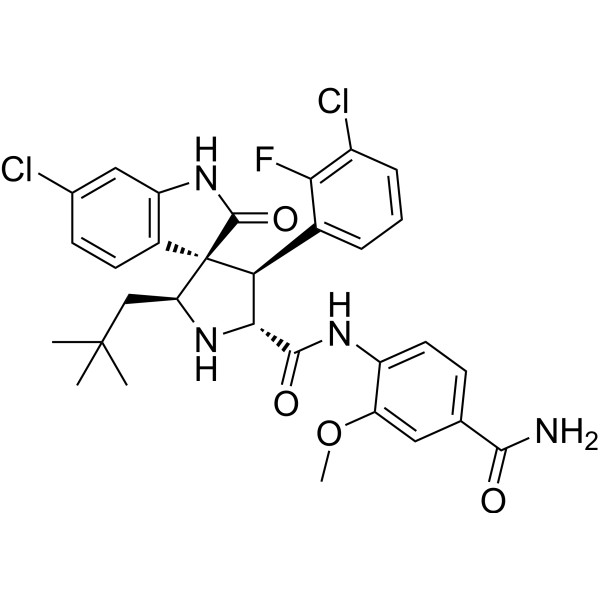
RO8994 (Compound 4) is an orally active, highly potent and selective spiroindolinone p53-MDM2 inhibitor with an IC50 value of 5 nM (HTRF binding assays) and 20 nM (MTT proliferation assays). RO8994 induces up-regulation of p53 expression and Apoptosis in wild-type p53 cancer cells. RO8994 also inhibits tumor growth in the tumor xenograft model .
loading...
    loading...
Cat. No.: HY-12108
CAS No.: 280571-30-4
Target:  

HIV Integrase HIV

Research Areas:  

Infection

S 1360 is a potent and selective inhibitor of HIV-1 integrase. S 1360 inhibits the catalytic activity of purified integrase ( IC50: 20 nM). The EC50, and CC50 of S 1360 in MTT assay (MT-4 cells infected with HIV-1 IIIB) are 200 nM and 12 μM, respectively. S 1360 has antiviral activity against both X4 tropic and R5 tropic strains, as well as NRTI, NNRTI and PI drug-resistant variants .
loading...
    loading...
Cat. No.: HY-W102335
CAS No.: 7004-04-8
Research Areas:  

Inflammation/Immunology Cancer

(Rac)-Threonine (Compound 19) is an amino acid derivative that can be found in the methanol (MeOH) extract of Rumex roseus L. The MeOH extract containing (Rac)-Threonine exhibits antioxidant and cytotoxic properties .
loading...
    loading...
Cat. No.: HY-D2422B
Research Areas:  

Cancer

Cy5-Paclitaxel is a fluorescently labeled drug probe formed by conjugating the fluorescent dye Cy5 (Cyanine 5) with the chemotherapeutic agent Paclitaxel, which is used to track the cellular uptake, subcellular distribution and drug delivery process of Paclitaxel. The Cy5 (Cyanine 5) fluorophore is covalently linked to Paclitaxel, possessing both fluorescent tracing function and the biological activities of Paclitaxel (promoting tubulin polymerization and arresting the cell cycle at the G2/M phase); after entering cells, Cy5 emits far-red fluorescence, enabling real-time monitoring of drug localization and release .
loading...
    loading...
Cat. No.: HY-N10778
CAS No.: 1301267-02-6
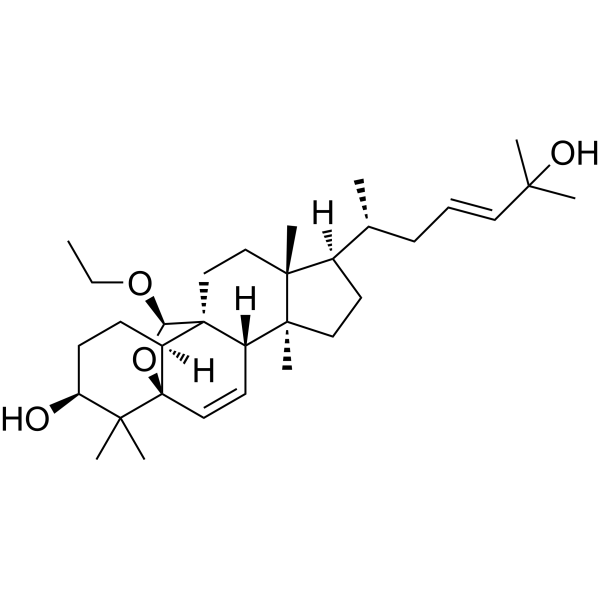
(19R,23E)-5b,19-Epoxy19-ethoxycucurbita-6,23-diene-3b,25-diol is a cucurbitane-type triterpenoid. (19R,23E)-5b,19-Epoxy19-ethoxycucurbita-6,23-diene-3b,25-diol has been tested to no effect against 5 cancer cell lines, MCF-7, HepG2, Du145, Colon205 and HL-60 by MTT assay .
loading...
    loading...
Cat. No.: HY-W013437
CAS No.: 51135-38-7
Target:  

Microtubule/Tubulin

Research Areas:  

Cancer

7-Benzoyloxindole (Compound 4a) is a tubulin destabilizer. 7-Benzoyloxindole disrupts the structure of microtubulin, thereby inhibiting the growth of tumor cells. 7-Benzoyloxindole can be used in the research of gastric cancer and lung cancer .
loading...
    loading...
Cat. No.: HY-D2422C
Research Areas:  

Cancer

Cy5-Paclitaxel bromide is a fluorescently labeled drug probe formed by conjugating the fluorescent dye Cy5 (Cyanine 5) with the chemotherapeutic agent Paclitaxel, which is used to track the cellular uptake, subcellular distribution and drug delivery process of Paclitaxel. The Cy5 (Cyanine 5) fluorophore is covalently linked to Paclitaxel, possessing both fluorescent tracing function and the biological activities of Paclitaxel (promoting tubulin polymerization and arresting the cell cycle at the G2/M phase); after entering cells, Cy5 emits far-red fluorescence, enabling real-time monitoring of drug localization and release .
loading...
    loading...
Cat. No.: HY-149003
CAS No.: 2494001-21-5
Target:  

PARP Apoptosis

Research Areas:  

Cancer

PARP1-IN-10 (compound 12c) is a no-cytotoxicity and potent PARP1 inhibitor with an IC50 value of 50.62 nM in vitro. PARP1-IN-10 causes cell cycle arrest at G2/M phase and apoptosis, and enhances the cytotoxicity of temozolomide (TMZ) .
loading...
    loading...
Cat. No.: HY-DY1086
CAS No.: 298-93-1
Synonyms: MTT (solution); Thiazolyl Blue Tetrazolium bromide (solution); Methylthiazolyldiphenyl-tetrazolium bromide (solution)
Thiazolyl Blue (solution) (MTT (solution)) is a cell-permeable and positively charged tetrazolium dye that is used to detect reductive metabolism in cells. Thiazolyl Blue is taken up by cells through the plasma membrane and then reduced to formazan by intracellular NAD (P) H-oxidoreductases. Thiazolyl Blue is frequently used in colorimetric assays to measure cell proliferation, cytotoxicity, and apoptosis .
Solvent and concentration: PBS: 5 mg/mL
loading...
    loading...
Cat. No.: HY-D3125
Target:  

Fluorescent Dye

Research Areas:  

Others

NtHzBtd is a fluorescent probe for detecting Fe 3+. NtHzBtd is applicable to the selective fluorescent detection of Fe 3+ ions and live cell imaging studies. NtHzBtd can selectively coordinate with Fe 3+ to form a 1:1 complex, triggering chelation enhanced quenching (CHEQ) and intramolecular charge transfer (ICT) processes, which result in fluorescence turn-off, thereby enabling sensitive detection of Fe 3+ and live cell fluorescence imaging. After binding to Fe 3+, NtHzBtd reduces fluorescence intensity, exhibits a rapid response property, with a limit of detection of 0.036 μM and a response time of approximately 55 s. The detection wavelengths are Ex/Em = 334/401 nm (solution system) .
loading...
    loading...
  • 1

