



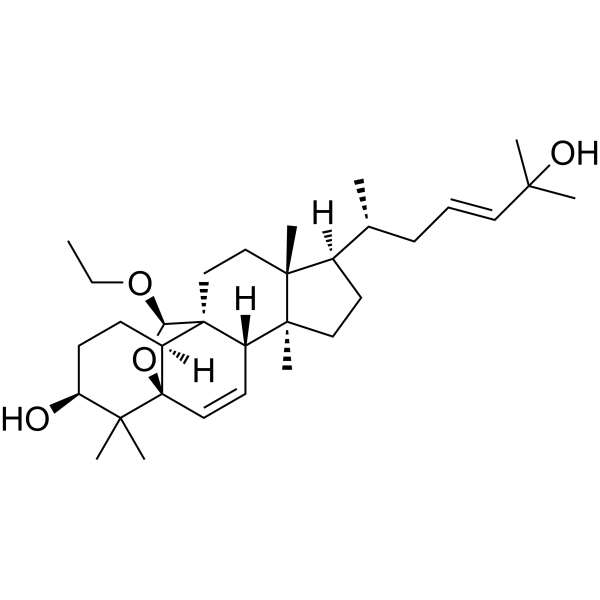
(19R,23E)-5b,19-Epoxy19-ethoxycucurbita-6,23-diene-3b,25-diol
(19R,23E)-5b,19-Epoxy19-ethoxycucurbita-6,23-diene-3b,25-diol is a cucurbitane-type triterpenoid. (19R,23E)-5b,19-Epoxy19-ethoxycucurbita-6,23-diene-3b,25-diol has been tested to no effect against 5 cancer cell lines, MCF-7, HepG2, Du145, Colon205 and HL-60 by MTT assay.
For research use only. We do not sell to patients.
- CAS No.: 1301267-02-6
- Formula: C32H52O4
- Molecular Weight:500.75
-
Storage:
Please store the product under the recommended conditions in the Certificate of Analysis.

To place orders, for customer services and technical support, please contact: MedChemExpress USA
Tel: 609-228-6898 E-mail: [email protected] [email protected]


-
 Biological Activity
-
Chemical Information
- Protocols
- Purity & Documentation
- References
-
 Help & FAQs




Biological Activity
Description


Chemical Information
-
CAS No. 1301267-02-6
-
Molecular Weight 500.75
-
Formula C32H52O4
-
SMILES
CCO[C@H]1[C@]23[C@@]4([H])[C@](C=C[C@@]2([H])[C@]5([C@](CC3)([C@@](CC5)([H])[C@H](C)C/C=C/C(C)(O)C)C)C)(C(C)([C@H](CC4)O)C)O1
-
Structure Classification
-
Initial Source
-
Shipping
Room temperature in continental US; may vary elsewhere.
-
Storage
Please store the product under the recommended conditions in the Certificate of Analysis.

Protocols
-
MTT Cell Proliferation Assay
The MTT assay is a colorimetric endpoint assay for estimating viable cell number, cell growth, cytotoxicity, or cell activation in cultured mammalian cells. Living cells reduce the yellow tetrazolium salt MTT into purple/blue formazan, while dead cells do not generate the same signal; the resulting color can be quantified with a multiwell spectrophotometer. MTT reduction is commonly interpreted as a readout of metabolic activity that often correlates with viable cell number, but it should not be treated as a direct cell-counting method unless the assay is optimized for the cell type and experimental condition. Studies show that MTT reduction can involve mitochondrial and non-mitochondrial reducing systems, and formazan may accumulate in intracellular lipid droplets rather than simply marking mitochondria.
-
Cell Viability Determination by MTT Colorimetric Assay
The following protocol uses the MTT colorimetric assay as a classic literature-established method for assessing cell viability/metabolic activity in cultured mammalian cells. MTT[3-(4,5-dimethylthiazol-2-yl)-2,5-diphenyltetrazolium bromide] is reduced by metabolically active cells to a colored formazan product; the amount of formazan is quantified spectrophotometrically and provides an indirect measure of metabolically active viable cells. Importantly, MTT reduction reflects cellular oxidoreductase/metabolic activity rather than an absolute direct count of living cells, so changes in cellular metabolism can alter the signal independently of cell number.


Purity & Documentation
References

Calculators
Concentration (start) × Volume (start) = Concentration (final) × Volume (final)


(19R,23E)-5b,19-Epoxy19-ethoxycucurbita-6,23-diene-3b,25-diol Related Classifications
HY-N10778 Related Classifications
 Powered by Bioz