1. Search Result
Search Result
Results for "

Melatonin (standard)

" in MedChemExpress (MCE) Product Catalog:

17

Inhibitors & Agonists

9

Natural
Products

Targets Recommended:
Cat. No. Product Name Target Research Areas Chemical Structure
  • HY-N0623R
    L-Tryptophan (standard)
    10+ Cited Publications

    Tryptophan (standard); Tryptophane (standard)

    Others Reference Standards Metabolic Disease
    L-Tryptophan (standard) is the analytical standard of L-Tryptophan. L-Tryptophan (Tryptophan) is an orally active and essential amino acid that is the precursor of serotonin, melatonin, and vitamin B3. L-Tryptophan can promote an increase in stemness and osteogenic ability of BMSCs in vitro and in vivo. L-Tryptophan inhibits cell proliferation and induced cell cycle arrest with high levels .
    L-Tryptophan (standard)
  • HY-B0075R
    Melatonin (standard)
    135+ Cited Publications

    N-Acetyl-5-methoxytryptamine (standard); Melatonin

    Reference Standards Melatonin Receptor Autophagy Mitophagy Endogenous Metabolite Apoptosis Neurological Disease Inflammation/Immunology Cancer
    Melatonin (Standard) is the analytical standard of Melatonin. This product is intended for research and analytical applications. Melatonin is a hormone made by the pineal gland that can activates melatonin receptor. Melatonin plays a role in sleep and possesses important antioxidative and anti-inflammatory properties . Melatonin is a novel selective ATF-6 inhibitor and induces human hepatoma cell apoptosis through COX-2 downregulation . Melatonin attenuates palmitic acid-induced (HY-N0830) mouse granulosa cells apoptosis via endoplasmic reticulum stress .
    Melatonin (standard)
  • HY-W015229R

    Indole-3-propionic acid (standard); 3-IPA (standard)

    Reference Standards Endogenous Metabolite Reactive Oxygen Species (ROS) Neurological Disease Metabolic Disease
    3-Indolepropionic acid (Standard) is the analytical standard of 3-Indolepropionic acid. This product is intended for research and analytical applications. 3-Indolepropionic acid is shown to be a powerful antioxidant and has potential in the treatment for Alzheimer’s disease. In Vitro: 3-Indolepropionic acid is shown to be a powerful antioxidant and has potential in the treatment for Alzheimer’s disease . 3-Indolepropionic acid is a more potent scavenger of hydroxyl radicals than melatonin. Similar to melatonin but unlike other antioxidants, 3-Indolepropionic acid scavenges radicals without subsequently generating reactive and pro-oxidant intermediate compounds . It is also suggested that indolepropionic acid, a gut microbiota-produced metabolite, is a potential biomarker for the development of type 2 diabetes (T2D) that may mediate its protective effect by preservation of β-cell function .
    3-Indolepropionic acid (Standard)
  • HY-107854R

    N-Acetylserotonin (standard); NorMelatonin (standard); O-DemethylMelatonin (standard)

    Reference Standards Endogenous Metabolite Trk Receptor Neurological Disease
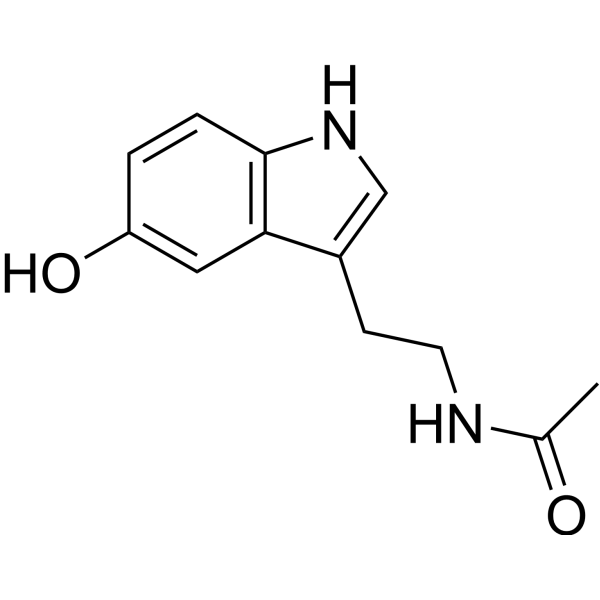
    N-Acetyl-5-hydroxytryptamine (Standard) is the analytical standard of N-Acetyl-5-hydroxytryptamine. This product is intended for research and analytical applications. N-Acetyl-5-hydroxytryptamine is a Melatonin precursor, and that it can potently activate TrkB receptor.
    N-Acetyl-5-hydroxytryptamine (Standard)
  • HY-113027R

    Reference Standards Endogenous Metabolite Others
    Melatonin (Standard) is the analytical standard of Melatonin. This product is intended for research and analytical applications. Melatonin is a hormone made by the pineal gland that can activates melatonin receptor. Melatonin plays a role in sleep and possesses important antioxidative and anti-inflammatory properties . Melatonin is a novel selective ATF-6 inhibitor and induces human hepatoma cell apoptosis through COX-2 downregulation . Melatonin attenuates palmitic acid-induced (HY-N0830) mouse granulosa cells apoptosis via endoplasmic reticulum stress .
    p-Hydroxymandelic acid (Standard)
  • HY-101176R

    Reference Standards Melatonin Receptor Cancer
    2-Iodomelatonin (Standard) is the analytical standard of 2-Iodomelatonin. This product is intended for research and analytical applications. 2-Iodomelatonin is a potent agonist of melatonin receptor 1 (MT1) with a Ki value of 28 pM, it is more 5-fold selective for MT1 ?over MT2 . 2-iodomelatonin can be used to identify, characterize and localize melatonin binding sites in the brain and peripheral tissues .
    2-Iodomelatonin (Standard)
  • HY-100908R

    N10-Acetyltryptamine (standard); Nb-Acetyltryptamine (standard); Nω-Acetyltryptamine (standard)

    Reference Standards Melatonin Receptor Neurological Disease
    N-Acetyltryptamine (Standard) is the analytical standard of N-Acetyltryptamine. This product is intended for research and analytical applications. N-Acetyltryptamine is a partial agonist for melatonin receptors in the retina . N-Acetyltryptamine is also used for determination of serotonin N-acetyl transferase activity .
    N-Acetyltryptamine (Standard)
  • HY-100609R

    Reference Standards Melatonin Receptor Neurological Disease
    4-P-PDOT (Standard) is the analytical standard of 4-P-PDOT. This product is intended for research and analytical applications. 4-P-PDOT is a potent, selective and affinity Melatonin receptor (MT2) antagonist. 4-P-PDOT is >300-fold more selective for MT2 than MT1. 4-P-PDOT significantly counteracts Melatonin-mediated antioxidant effects (GSH/GSSG ratio, phospho-ERK, Nrf2 nuclear translocation, Nrf2 DNA-binding activity) .
    4-P-PDOT (Standard)
  • HY-101254R

    N-0774 (standard)

    Reference Standards Melatonin Receptor Neurological Disease
    Luzindole (Standard) is the analytical standard of Luzindole. This product is intended for research and analytical applications. Luzindole (N-0774) is a selective melatonin receptor antagonist. Luzindole preferentially targets MT2 (Mel1b) over MT1 (Mel1a) with Ki values of 10.2 and 158 nM for human MT2 and MT1, respectively. Luzindole suppresses experimental autoimmune encephalomyelitis (EAE), and exerts antidepressant-like activity .
    Luzindole (Standard)
  • HY-14803R

    BMS-214778 (standard); VEC-162 (standard)

    Reference Standards Melatonin Receptor Neurological Disease Endocrinology
    Tasimelteon (Standard) is the analytical standard of Tasimelteon. This product is intended for research and analytical applications. Tasimelteon (BMS-214778) is an orally active and selective dual melatonin receptor agonist (DMRA). Tasimelteon has 2.1-4.4 times greater affinity for the MT2 receptor than for the MT1 receptor. Tasimelteon is a circadian regulator and has the potential for Non-24-Hour Sleep-Wake Disorder (Non-24) .
    Tasimelteon (Standard)
  • HY-W011956R

    Drug Metabolite Reference Standards Endogenous Metabolite Neurological Disease Metabolic Disease
    6-Hydroxymelatonin (Standard) is the analytical standard of 6-Hydroxymelatonin. This product is intended for research and analytical applications. 6-Hydroxymelatonin is the main metabolite of melatonin (HY-B0075) after being metabolized by CYP1A2 and can cross the blood-brain barrier. 6-Hydroxymelatonin has strong free radical scavenging ability and antioxidant activity, and can alleviate oxidative damage caused by various neurotoxins. 6-Hydroxymelatonin can cause oxidative DNA damage in the presence of copper ions through a "non-quinone" type redox cycling mechanism.
    6-Hydroxymelatonin (Standard)
  • HY-105285R

    Neu-P11 (standard)

    Reference Standards Melatonin Receptor 5-HT Receptor P2X Receptor TRP Channel Sodium Channel Neurological Disease
    Piromelatine (Standard) is the analytical standard of Piromelatine. This product is intended for research and analytical applications. Piromelatine (Neu-P11) is a melatonin MT1/MT2 receptor agonist, serotonin 5-HT1A/5-HT1D agonist, and serotonin 5-HT2B antagonist. Piromelatine (Neu-P11) possesses sleep promoting, analgesic, anti-neurodegenerative, anxiolytic and antidepressant potentials. Piromelatine (Neu-P11) also possesses pain-related P2X3, TRPV1, and Nav1.7 channel-inhibition capacities .
    Piromelatine (Standard)
  • HY-101074R

    2-PhenylMelatonin (standard)

    Melatonin Receptor Reference Standards Neurological Disease Inflammation/Immunology Cancer
    UCM 608 (Standard) is the analytical standard of UCM 608 (HY-101074). This product is intended for research and analytical applications. UCM 608 is a high affinity melatonin (MT) membrane receptor agonist. The pKi values for MT1 and MT2 are 10.7 and 10.4 .
    UCM 608 (Standard)
  • HY-W015169AR

    5-HT Receptor Reference Standards Endogenous Metabolite Neurological Disease Cancer
    5-Methoxytryptamine (hydrochloride) (Standard) is the analytical standard of 5-Methoxytryptamine (hydrochloride) (HY-W015169A). This product is intended for research and analytical applications. 5-Methoxytryptamine hydrochloride, a metabolite of Melatonin, is a nonselective 5-HT receptor agonist. 5-Methoxytryptamine hydrochloride has no affinity for the 5-HT3 receptor. 5-Methoxytryptamine hydrochloride is also a potent antioxidant and has radioprotective action .
    5-Methoxytryptamine hydrochloride (Standard)
  • HY-W015169R

    O-Methylserotonin (standard)

    Drug Metabolite 5-HT Receptor Reference Standards Endogenous Metabolite Neurological Disease Cancer
    5-Methoxytryptamine (Standard) is the analytical standard of 5-Methoxytryptamine (HY-W015169). This product is intended for research and analytical applications. 5-Methoxytryptamine, a metabolite of Melatonin, is a nonselective 5-HT receptor agonist. 5-Methoxytryptamine has no affinity for the 5-HT3 receptor. 5-Methoxytryptamine is also a potent antioxidant and has radioprotective action .
    5-Methoxytryptamine (Standard)
  • HY-101358R

    AH-002 (standard)

    Melatonin Receptor Reference Standards Neurological Disease
    8-M-PDOT (Standard) is the analytical standard of 8-M-PDOT (HY-101358). This product is intended for research and analytical applications. 8-M-PDOT (AH-002) is a selective melatonin MT2 receptor agonist. 8-M-PDOT is 5.2-fold selective for MT2 over MT1 receptors. 8-M-PDOT binds human recombinant MT2 and MT2 receptors with pKi values of 8.23 and 8.95 respectively. 8-M-PDOT has anxiolytic-like activity .
    8-M-PDOT (Standard)
  • HY-113440R

    Reference Standards Interleukin Related Endogenous Metabolite Melatonin Receptor TNF Receptor ERK MMP Neurological Disease Metabolic Disease Inflammation/Immunology
    5-Methoxytryptophol (Standard) is the analytical standard of 5-Methoxytryptophol. This product is intended for research and analytical applications. 5-Methoxytryptophol is a 5-methoxyindole alcohol structurally homologous to Melatonin (HY-B0075). It is secreted by the mammalian pineal gland and exhibits an inverse circadian rhythm. 5-Methoxytryptophol regulates bone metabolism by activating the ERK1/2 pathway. It reduces the levels of pro-inflammatory cytokines TNF-α and IL-1β, as well as proteolytic enzymes MMP-1 and MMP-2, in serum and dental pulp tissues, thereby ameliorating acute pulpitis. 5-Methoxytryptophol induces rapid sleep in mice, while high doses cause respiratory depression and death. 5-Methoxytryptophol. 5-Methoxytryptophol can be used in studies related to acute pulpitis, hypnosis, and bone metabolism.
    5-Methoxytryptophol (Standard)

Inquiry Online

Your information is safe with us. * Required Fields.

Salutation


Country or Region *

Applicant Name *


Organization Name *

Department *


Email Address *


Product Name *

Cat. No.


Requested quantity *

Phone Number *


Remarks

Inquiry Online

Inquiry Information

Product Name:
Cat. No.:
Quantity:
MCE Japan Authorized Agent:

