



Piromelatine (Standard)
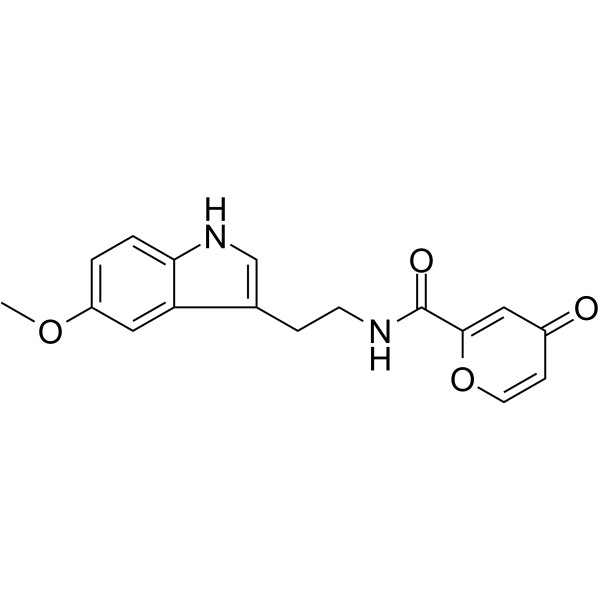
Piromelatine (Standard) is the analytical standard of Piromelatine. This product is intended for research and analytical applications. Piromelatine (Neu-P11) is a melatonin MT1/MT2 receptor agonist, serotonin 5-HT1A/5-HT1D agonist, and serotonin 5-HT2B antagonist. Piromelatine (Neu-P11) possesses sleep promoting, analgesic, anti-neurodegenerative, anxiolytic and antidepressant potentials. Piromelatine (Neu-P11) also possesses pain-related P2X3, TRPV1, and Nav1.7 channel-inhibition capacities.
For research use only. We do not sell to patients.
- Purity : 98%
- CAS No.: 946846-83-9
- Formula: C17H16N2O4
- Molecular Weight:312.32
-
Storage:
Please store the product under the recommended conditions in the Certificate of Analysis.


To place orders, for customer services and technical support, please contact: MedChemExpress USA
Tel: 609-228-6898 E-mail: [email protected] [email protected]


-
 Product Information
-
Chemical Information
- Purity & Documentation
-
 Help & FAQs




Product Information
Information
Application
The compound is the grade of analytical standard, which is the reference standard supplied assay. It is commonly used in qualitative, quantitative and methodological research experiments in HPLC, GC and MS.


Chemical Information
-
CAS No. 946846-83-9
-
Molecular Weight 312.32
-
Formula C17H16N2O4
-
SMILES
O=C(C1=CC(C=CO1)=O)NCCC2=CNC3=CC=C(OC)C=C23
-
Synonyms
Neu-P11 (Standard)
-
Shipping
Room temperature in continental US; may vary elsewhere.
-
Storage
Please store the product under the recommended conditions in the Certificate of Analysis.


Purity & Documentation
References
[1]. Meihua She, et al. Piromelatine, a Novel Melatonin Receptor Agonist, Stabilizes Metabolic Profiles and Ameliorates Insulin Resistance in Chronic Sleep Restricted Rats. Eur J Pharmacol. 2014 Mar 15;727:60-5. [Content Brief]
[2]. L Huang, et al. Blood Pressure Reducing Effects of Piromelatine and Melatonin in Spontaneously Hypertensive Rats. Eur Rev Med Pharmacol Sci. 2013 Sep;17(18):2449-56. [Content Brief]
[3]. Yuan-Yuan Liu, et al. Piromelatine Exerts Antinociceptive Effect via Melatonin, Opioid, and 5HT1A Receptors and Hypnotic Effect via Melatonin Receptors in a Mouse Model of Neuropathic Pain. Psychopharmacology (Berl). 2014 Oct;231(20):3973-85. [Content Brief]

Calculators
Concentration (start) × Volume (start) = Concentration (final) × Volume (final)


Piromelatine (Standard) Related Classifications
HY-105285R Related Classifications
 Powered by Bioz