6 Results for "

NADPH-dependent metabolism

" in MedChemExpress (MCE) Product Catalog:
Products (6)

6 Results for "NADPH-dependent metabolism" in MCE Product Catalog:

Cat. No.: HY-122940
CAS No.: 644-06-4
Purity:  99.95%
Synonyms: Ageratochromene
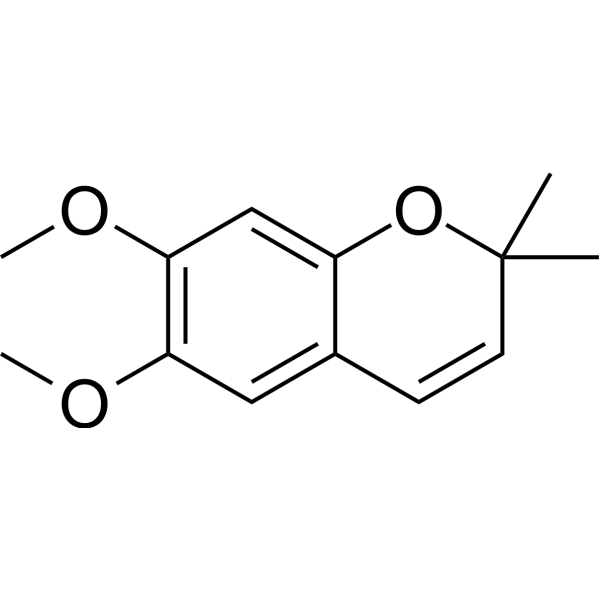
Precocene II (Ageratochromene) is a plant larva hormone antagonists that inhibits the biosynthesis of juvenile hormone. Precocene II inhibits corpora allata function and downregulates juvenile hormone levels, while exerting multiple effects including inducing precocious metamorphosis, forming macropterous morphs, inhibiting ovarian growth, producing cytotoxicity, disrupting insect development, and causing sterility and kidney damage. Precocene II blocks normal nymphal development, causes renal tubular damage and increases blood urea nitrogen levels, and also blocks juvenile hormone biosynthesis in vitro. Precocene II undergoes oxidative metabolism catalyzed by NADPH-dependent monooxygenase to generate a variety of metabolites. Precocene II can be applied in studies related to insect growth regulation and nephrotoxicity .
loading...
    loading...
Cat. No.: HY-117806
CAS No.: 1388225-79-3
Research Areas:  

Cancer

TSR-011-isomer is an isomer of Belizatinib (HY-17603), a ALK inhibitor with an IC50 of 6 nM. TSR-011-isomer acts as a substrate for metabolic hydrolysis and NADPH-dependent metabolism. TSR-011-isomer undergoes enzymatic hydrolysis in mouse plasma and NADPH-dependent metabolism in mouse liver microsomes, thereby supporting clearance processes. TSR-011-isomer can be used in studies related to ALK-driven cancers .
loading...
    loading...
Cat. No.: HY-E71567
Research Areas:  

Others

2-Hydroxymethylglutarate dehydrogenase (EC 1.1.1.291) is an NADPH-dependent D-ribulose reductase—a type of oxidoreductase—that catalyzes the reduction of D-ribulose to D-arabitol. It plays a key role in pentose metabolism, sugar alcohol metabolism, and carbon source utilization in microorganisms and fungi.
loading...
    loading...
Cat. No.: HY-E71772A
Research Areas:  

Others

3-Oxo-5-β-steroid 4-dehydrogenase from human (Recombinant) (EC 1.3.1.3) belongs to the NADPH-dependent short-chain dehydrogenase/reductase superfamily (AKR family). It catalyzes the 5β-reduction of the Δ4 double bond in steroid molecules and is involved in bile acid synthesis and steroid hormone metabolism, serving as a crucial enzyme for maintaining hepatic cholesterol metabolism and endocrine homeostasis.
loading...
    loading...
Cat. No.: HY-184860
CAS No.: 3913-64-2
Synonyms: (2S)-Hydroxypropanal
Target:  

Endogenous Metabolite

Research Areas:  

Metabolic Disease

L-Lactaldehyde ((2S)-Hydroxypropanal) is a chiral aldehyde, metabolic intermediate, and enzyme substrate. L-Lactaldehyde is oxidized to L-lactate by NAD-dependent lactaldehyde dehydrogenase. L-Lactaldehyde is reduced to L-1,2-propanediol by NADH/NADPH-dependent oxidoreductases. L-Lactaldehyde is used in studies of microbial sugar metabolism and carbonyl metabolism .
loading...
    loading...
Cat. No.: HY-122940R
CAS No.: 644-06-4
Synonyms: Ageratochromene (Standard)
Precocene II (Standard) is the analytical standard of Precocene II (HY-122940). This product is intended for research and analytical applications. Precocene II (Ageratochromene) is a plant larva hormone antagonists that inhibits the biosynthesis of juvenile hormone. Precocene II inhibits corpora allata function and downregulates juvenile hormone levels, while exerting multiple effects including inducing precocious metamorphosis, forming macropterous morphs, inhibiting ovarian growth, producing cytotoxicity, disrupting insect development, and causing sterility and kidney damage. Precocene II blocks normal nymphal development, causes renal tubular damage and increases blood urea nitrogen levels, and also blocks juvenile hormone biosynthesis in vitro. Precocene II undergoes oxidative metabolism catalyzed by NADPH-dependent monooxygenase to generate a variety of metabolites. Precocene II can be applied in studies related to insect growth regulation and nephrotoxicity .
loading...
    loading...

