5 Results for "

PIKK-family proteins

" in MedChemExpress (MCE) Product Catalog:
Products (5)

5 Results for "PIKK-family proteins" in MCE Product Catalog:

5
5 Cited Publications
Cat. No.: HY-11002
CAS No.: 1080622-86-1
Purity:  99.74%
Target:  

ATM/ATR

Research Areas:  

Cancer

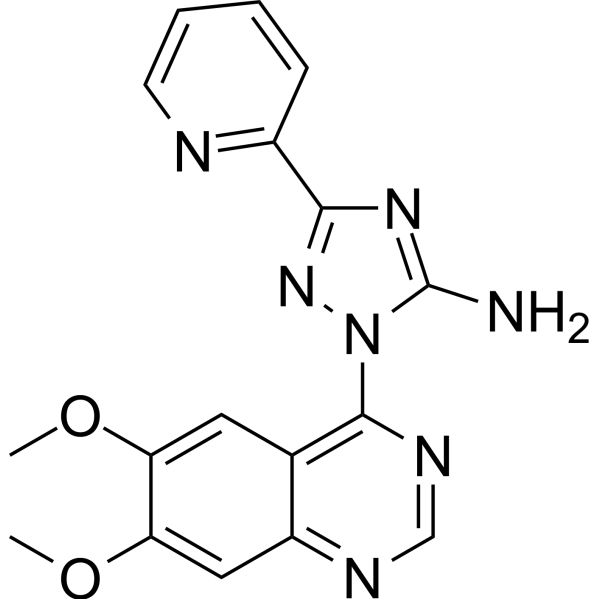
CP-466722 is a rapidly reversible inhibitor of ATM, with an IC50 of 0.41 μM, and has no effects on PI3K or closely related PI3K-like protein kinase (PIKK) family members.
loading...
    loading...
Cat. No.: HY-103702
CAS No.: 1807337-58-1
TIP48/49-IN-1 is an orally active, specific RUVBL1/2 (TIP48/49) ATPase inhibitor with an IC50 of 59 nM against purified RUVBL1/2. TIP48/49-IN-1 inhibits the DNA replication process, leading to S-phase arrest. TIP48/49-IN-1 induces apoptosis. TIP48/49-IN-1 can be used for the research of non-small cell lung cancer (NSCLC) cells .
loading...
    loading...
Cat. No.: HY-142671
CAS No.: 2601571-19-9
Target:  

ATM/ATR

Research Areas:  

Cancer

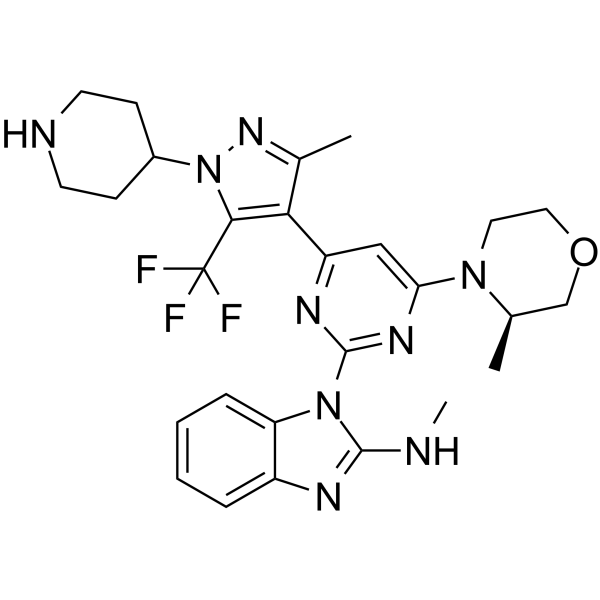
ATR-IN-5 is a potent inhibitor of ATR. ATR is a class of protein kinases involved in genome stability and DNA damage repair, and is a member of the PIKK family. ATR-IN-5 has the potential for the research of ATR kinase-mediated diseases such as proliferative diseases and cancer (extracted from patent CN112047938A, compound D24) .
loading...
    loading...
Cat. No.: HY-142672
CAS No.: 2746446-99-9
Target:  

ATM/ATR

Research Areas:  

Cancer

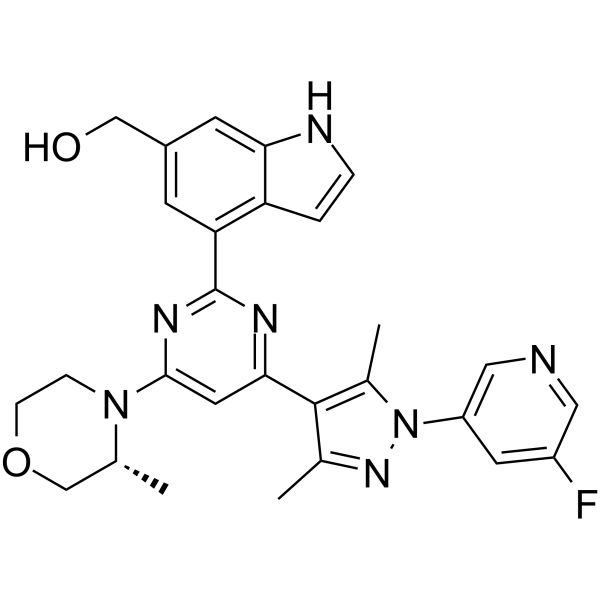
ATR-IN-6 is a potent inhibitor of ATR. ATR is a class of protein kinases involved in genome stability and DNA damage repair, and is a member of the PIKK family. ATR-IN-6 has the potential for the research of ATR kinase-mediated diseases such as proliferative diseases and cancer (extracted from patent WO2021233376A1, compound A22) .
loading...
    loading...
Cat. No.: HY-11002R
CAS No.: 1080622-86-1
Research Areas:  

Cancer

CP-466722 (Standard) is the analytical standard of CP-466722 (HY-11002). This product is intended for research and analytical applications. CP-466722 is a rapidly reversible inhibitor of ATM, with an IC50 of 0.41 μM, and has no effects on PI3K or closely related PI3K-like protein Kinase (PIKK) family members.
loading...
    loading...

