11 Results for "

PKC C1 domain

" in MedChemExpress (MCE) Product Catalog:
Products (11)

11 Results for "PKC C1 domain" in MCE Product Catalog:

2
2 Cited Publications
Cat. No.: HY-105231
CAS No.: 83314-01-6
Purity:  99.70%
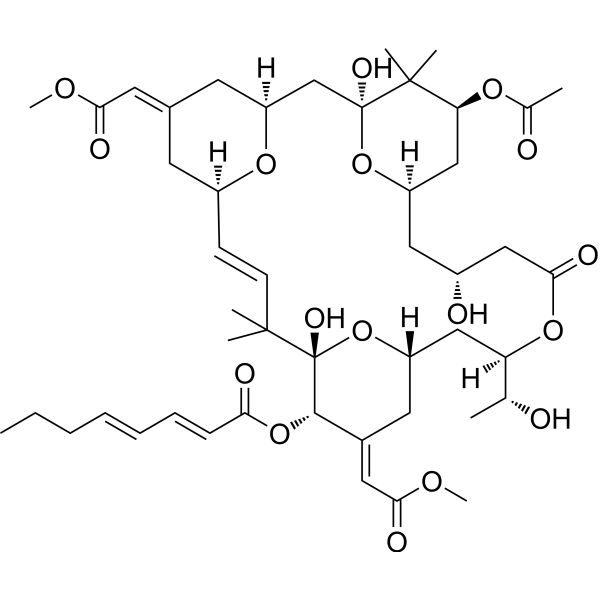
Bryostatin 1 is a natural macrolide isolated from the bryozoan Bugula neritina and is a potent and central nervous system (CNS)-permeable PKC modulator. Bryostatin 1 binds to the isolated C1 domain of Munc13-1 and the full-length Munc13-1 protein with Kis of 8.07 nM and 0.45 nM, respectively. Bryostatin 1 has anti-cancer, anti-inflammatory, neuroprotective, anti-HIV-1 infection properties .
loading...
    loading...
Cat. No.: HY-109076
CAS No.: 943001-56-7
Purity:  95.89%
Synonyms: EBC-46
Target:  

PKC Caspase

Research Areas:  

Cancer

Tigilanol tiglate (EBC-46) is a protein kinase C (PKC)/C1 domain activator. Tigilanol tiglate is associated with mitochondrial/endoplasmic reticulum (ER) dysfunction, leading to activation of the unfolded protein response (UPRmt/ER) and subsequent induction of ATP depletion, organelles expansion, Caspase activation, gasdermin E cleavage, and terminal necrosis. Tigilanol tiglate, as a small anti-tumor molecule with immunomodulatory effects, can be used in the study of head and neck squamous cell carcinoma and soft tissue sarcoma .
loading...
    loading...
Cat. No.: HY-E70852
Target:  

PKC

Research Areas:  

Cancer

PKC is a family of serine/threonine kinases involved in several processes including proliferation, differentiation, apoptosis, and migration. PKCα is a classical PKC isoform that contains a C1 domain that binds to diacylglycerol (DAG). PKCα Recombinant Human Active Protein Kinase is a recombinant PKCα protein that can be used to study PKCα-related functions .
loading...
    loading...
Cat. No.: HY-149489
CAS No.: 742104-91-2
Target:  

PKC

Research Areas:  

Neurological Disease

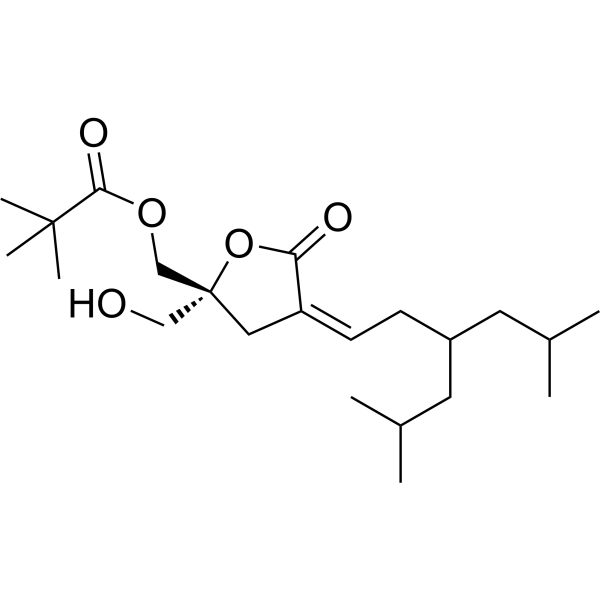
JH-131e-153, a diacylglycerol (DAG)-lactone, is a small molecule activator of Munc13-1, targeting the C1 domain. The activation sequence of JH-131e-153 on Munc13-1 is WT>I590≈R592A≈W588A. The C1 domain of Munc13-1 and protein kinase C (PKC) are homologous in sequence and structure. The activation sequence of JH-131e-153 on Munc13-1 and PKC was PKCα>Munc13-1>PKCε. JH-131e-153 regulates neuronal processes through Munc13-1 and can be further used in the study of neurodegenerative diseases .
loading...
    loading...
Cat. No.: HY-118834
CAS No.: 70497-14-2
Synonyms: Lyngbyatoxin A
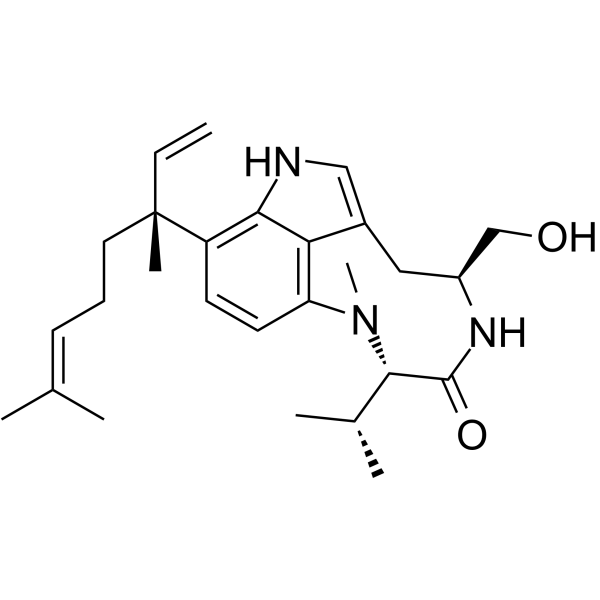
Teleocidin A1 (Lyngbyatoxin A) is a PKC activator with a Ki value of 0.11 nM for binding to the PKCδ-C1B peptide. Teleocidin A1 exhibits anticancer activity against cervical cancer and leukemia. Teleocidin A1 can induce seaweed dermatitis, food poisoning and local skin toxicity. Teleocidin A1 can be used in studies related to cervical cancer, seaweed dermatitis and food poisoning .
loading...
    loading...
Cat. No.: HY-N19700
CAS No.: 124986-26-1
Target:  

PKC

Calphostin D is a protein kinase C (Protein Kinase, PKC) inhibitor with an IC50 of 6.4 μM. Calphostin D achieves selective inhibition by interacting with the unique C1 regulatory domain of PKC. As a photosensitizer, Calphostin D generates reactive oxygen species upon exposure to light. Calphostin D can be used in cancer-related research .
loading...
    loading...
Cat. No.: HY-184494
Target:  

Gli PKC

Research Areas:  

Metabolic Disease Cancer

GLI-IN-1 is a potent, PKC-dependent Gli inhibitor. GLI-IN-1 binds to the C1 domain of PKC, forms hydrogen-bonding interactions with the M239 residue, and mediates the inhibition of downstream Gli via a PKC-mediated, Smoothened-independent mechanism. GLI-IN-1 can be used in studies of Gli-driven cancers and osteogenic differentiation .
loading...
    loading...
Cat. No.: HY-E70853
Target:  

PKC

Research Areas:  

Cancer

PKCδ is a PKC isoform. PKCδ is expressed ubiquitously among cells and tissues. It is activated by diacylglycerol produced by receptor-mediated hydrolysis of membrane inositol phospholipids as well as by tumor-promoting phorbol ester through the binding of these compounds to the C1 region in its regulatory domain. PKCδ Recombinant Human Active Protein Kinase is a recombinant PKCδ protein that can be used to study PKCδ-related functions .
loading...
    loading...
Cat. No.: HY-155599
CAS No.: 2982527-11-5
Target:  

HIV PKC

Research Areas:  

Infection

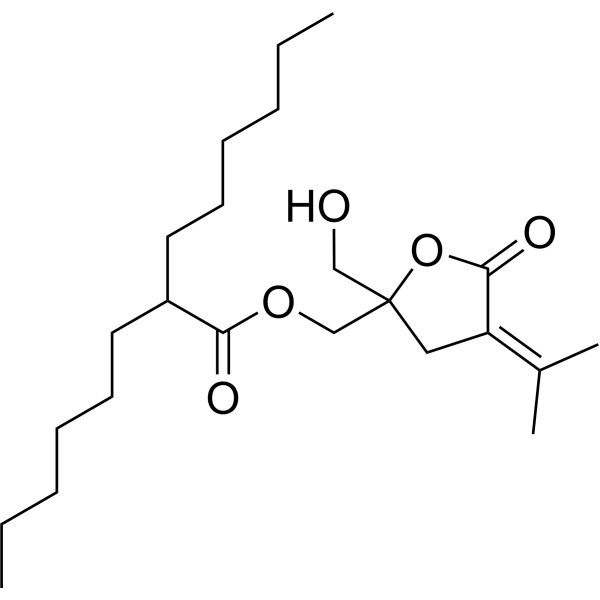
HIV-1 protease-IN-10 (Compound 2) has HIV-1 latency reversing activity (IC50: 0.22 μM). HIV-1 protease-IN-10 binds to the PKCδ C1b domain (IC50: 0.69 μM). HIV-1 protease-IN-10 has stability against esterase-mediated hydrolysis .
loading...
    loading...
Cat. No.: HY-134058
CAS No.: 589-82-2
Research Areas:  

Others

3-Heptanol is a biotransformation product of n-heptane. 3-Heptanol can act as the building block in the synthesis of 4-(3-adamantan-1-yl-ureido)-butyric acid and cyclohexanecarboxylic acid derivatives as sEH inhibitors. 3-Heptanol can be used as a solvent to form microenvironments around single-walled carbon nanotubes. 3-Heptanol can be used in the preperation of substituted pyrimidine derivatives as C1 domain-targeted isophthalate analogs to study their binding affinities towards PKCα isoform .
loading...
    loading...
Cat. No.: HY-134058S
Synonyms: Butylethylcarbinol-d4
3-Heptanol-d4 (Butylethylcarbinol-d4) is the deuterium labeled 3-Heptanol (HY-134058). 3-Heptanol is a biotransformation product of n-heptane. 3-Heptanol can act as the building block in the synthesis of 4-(3-adamantan-1-yl-ureido)-butyric acid and cyclohexanecarboxylic acid derivatives as sEH inhibitors. 3-Heptanol can be used as a solvent to form microenvironments around single-walled carbon nanotubes. 3-Heptanol can be used in the preperation of substituted pyrimidine derivatives as C1 domain-targeted isophthalate analogs to study their binding affinities towards PKCα isoform .
loading...
    loading...
  • 1

