12 Results for "

Phenol hydrogen

" in MedChemExpress (MCE) Product Catalog:
Products (12)

12 Results for "Phenol hydrogen" in MCE Product Catalog:

2
2 Cited Publications
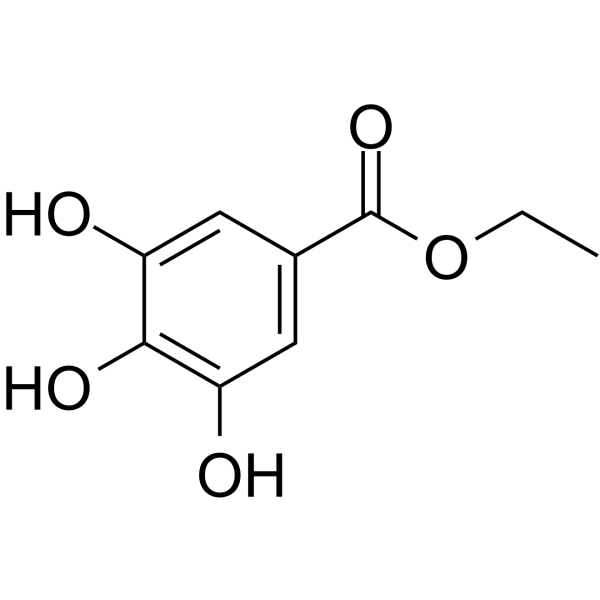
Cat. No.: HY-N0525
CAS No.: 831-61-8
Ethyl gallate is a nonflavonoid phenolic compound and also a scavenger of hydrogen peroxide.
loading...
    loading...
2
2 Cited Publications
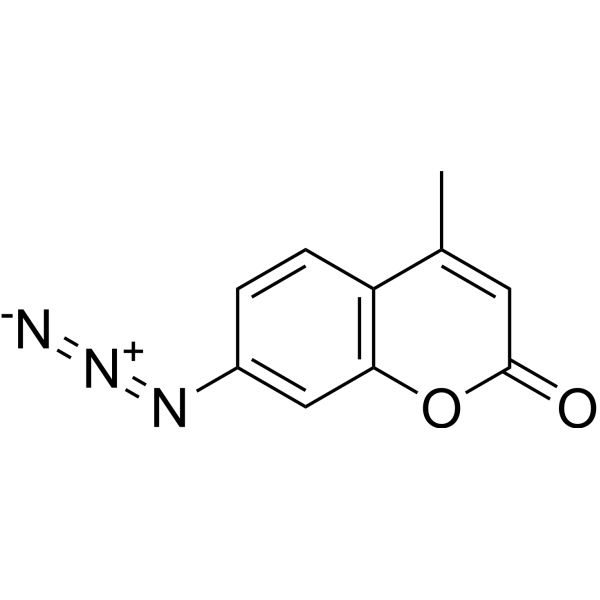
Cat. No.: HY-119323
CAS No.: 95633-27-5
Purity:  99.11%
Target:  

Fluorescent Dye

Research Areas:  

Others

7-Azido-4-methylcoumarin is a selective coumarin-based fluorescent probe for hydrogen sulfide (H2S). In the presence of H2S, the aromatic azido group of 7-Azido-4-methylcoumarin is selectively reduced to produce the fluorescently active 7-amino-4-methylcoumarin (AMC). 7-Azido-4-methylcoumarin binds to the coumarin/phenol-binding site of BSA, the aglycone-binding site of UGT1A6, and the substrate-binding site of SULT1A1, respectively. 7-Azido-4-methylcoumarin retains its fluorescent properties after covalent binding, acts as a fluorescent H2S probe, and does not react with cysteine, homocysteine or glutathione (Ex/Em = 340/445 nm) .
loading...
    loading...
1
1 Cited Publications
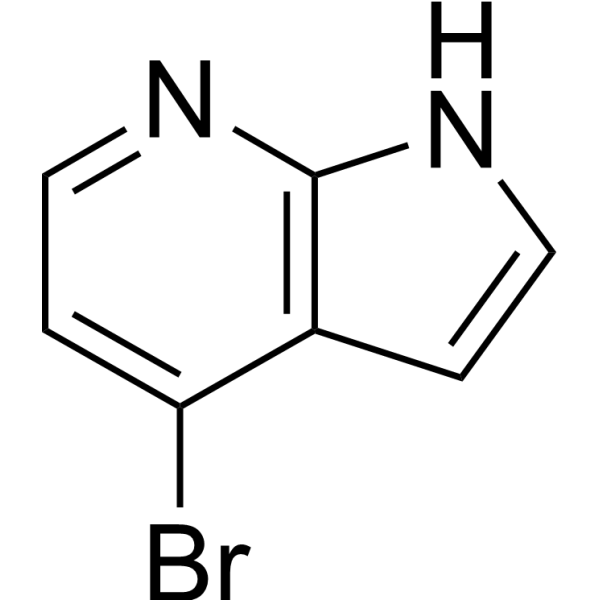
Cat. No.: HY-30014
CAS No.: 348640-06-2
4-Bromo-7-azaindole is a brominated derivative of 7-azaindole. 4-Bromo-7-azaindole serves as a substrate for palladium-catalyzed C-N and C-O cross-coupling reactions, reacting with amides, amines, amino acid esters and phenols .
loading...
    loading...
Cat. No.: HY-Y1094
CAS No.: 12092-47-6
Synonyms: Chloro(1,5-cyclooctadiene)rhodium(I) dimer
Research Areas:  

Cardiovascular Disease Cancer

[Rh(cod)Cl]2 (Chloro (1,5-cyclooctadiene) rhodium (I) dimer) is an organometallic rhodium (I) dimer precursor and platelet aggregation inhibitor. [Rh(cod)Cl]2 inhibits PAF-induced aggregation in washed rabbit platelets. [Rh(cod)Cl]2 inhibits aggregation induced by PAF, Thrombin, ADP and Collagen in human platelet-rich plasma. [Rh(cod)Cl]2 acts as a catalyst precursor for the hydrogenation of aromatic hydrocarbons, phenols, olefins and BINOL derivatives. [Rh(cod)Cl]2 is used in the research of cardiovascular diseases such as thromboinflammation-related disorders, tumor metastasis and atherosclerosis .
loading...
    loading...
Cat. No.: HY-P2888A
CAS No.: 80619-01-8
Synonyms: BOD, bacillus cereus
Target:  

Endogenous Metabolite

Research Areas:  

Metabolic Disease

Bilirubin oxidase, bacillus cereus is a multi-copper oxidase that catalyzes the oxidation of bilirubin into biliverdin, as well as other tetrapyrroles, phenols, and aryl diamines. Bilirubin oxidase, bacillus cereus can serve as a single-enzyme deoxygenator, catalyzing the direct reduction of oxygen to water in the presence of electron donor substrates, without releasing hydrogen peroxide. Bilirubin oxidase, bacillus cereus can be used to develop enzyme-based biosensors .
loading...
    loading...
Cat. No.: HY-P2888C
Synonyms: BOD, Bacillus pumilus
Target:  

Endogenous Metabolite

Research Areas:  

Metabolic Disease

Bilirubin oxidase (BOD), Bacillus pumilus is a multicopper oxidase that catalyzes the oxidation of bilirubin to biliverdin, as well as other tetrapyrrole, phenols, and aryl diamines. Bilirubin oxidase, Bacillus pumilus can serve as a single-enzyme deoxygenator, catalyzing the direct reduction of oxygen to water in the presence of electron donor substrates, without releasing hydrogen peroxide. Bilirubin oxidase, Bacillus pumilus can be used to develop enzyme-based biosensors .
loading...
    loading...
Cat. No.: HY-W015752R
CAS No.: 2174-64-3
5-Methoxyresorcinol (Standard) is an analytical standard for 5-Methoxyresorcinol (HY-W015752). This product is intended for research and analytical applications. 5-Methoxyresorcinol is a model molecule for the A ring of flavonoids, specifically mimicking the chemical behavior of the resorcinol-type A ring in catechins. 5-Methoxyresorcinol exhibits very low tocopherol regeneration activity. 5-Methoxyresorcinol shows little inhibition of cholesteryl ester transfer protein (CETP).
loading...
    loading...
Cat. No.: HY-N0525R
CAS No.: 831-61-8
Ethyl gallate (Standard) is the analytical standard of Ethyl gallate. This product is intended for research and analytical applications. Ethyl gallate is a nonflavonoid phenolic compound and also a scavenger of hydrogen peroxide.
loading...
    loading...
Cat. No.: HY-N15727
CAS No.: 1251459-63-8
2,5-Dimethylchromone-7-O-β-D-glucopyranoside is an orally active chromone glycoside found in the underground parts of Rheum australe. 2,5-Dimethylchromone-7-O-β-D-glucopyranoside shows a DPPH radical scavenging activity with an IC50 value of 66.9 μM. 2,5-Dimethylchromone-7-O-β-D-glucopyranoside scavenges free radicals by providing hydrogen atoms through phenolic hydroxyl groups, inhibiting lipid peroxidation. 2,5-Dimethylchromone-7-O-β-D-glucopyranoside is promising for research of oxidative stress-related diseases such as inflammation and skin diseases .
loading...
    loading...
Cat. No.: HY-132188A
Research Areas:  

Metabolic Disease

Manganese Peroxidase, Nematoloma frowardii (EC 1.11.1.13) is a hemecontaining glycoprotein that is produced by ligninolytic basidiomycetes. It requires hydrogen peroxide as an oxidant. Manganese Peroxidase, Nematoloma frowardii (EC 1.11.1.13) oxidizes Mn2+ to Mn3+. Mn3+ oxidizes phenolic rings to phenoxy radicals which results in the decomposition of various compounds.
loading...
    loading...
Cat. No.: HY-W016183
CAS No.: 1806-29-7
Synonyms: o,o'-BiPhenol
2,2'-Biphenol (o,o'-Biphenol) is an anti-inflammatory agent and the major non-protein-bound phenolic metabolite activated by rat bone marrow homogenate and hydrogen peroxide. 2,2'-Biphenol inhibits lipopolysaccharide (LPS) (HY-D1056)-induced COX-2 mRNA and protein expression. 2,2'-Biphenol suppresses the binding of AP-1 and NF-κB to their respective consensus sequences. 2,2'-Biphenol is applicable to research related to inflammation .
loading...
    loading...
Cat. No.: HY-N17779
CAS No.: 173658-86-1
3-O-Caffeoyl-5-O-feruloylquinic acid is a quinic acid-based phenolic compound that can be isolated from Eryngium bourgatii. 3-O-Caffeoyl-5-O-feruloylquinic acid regulates free radical scavenging and inflammatory pathways, exerting antioxidant activity through electron transfer and hydrogen atom transfer mechanisms. It also inhibits TNF-α-induced reactive oxygen species (ROS) production and the production of monocyte chemoattractant protein-1 (MCP-1) and its transcripts in human umbilical vein endothelial cells (HUVECs).
loading...
    loading...
  • 1

