
1. Search Result
Search Result
Results for "

Rhodamine 6G

" in MedChemExpress (MCE) Product Catalog:

14

Inhibitors & Agonists

7

Fluorescent Dyes

1

Biochemical Assay Reagents

3

Peptides

1

Natural
Products

Cat. No. Product Name Target Research Areas Chemical Structure
  • HY-D0309
    Rhodamine 6G
    4 Publications Verification

    Basic Red 1

    Environmental Pollutants Fluorescent Dye Cancer
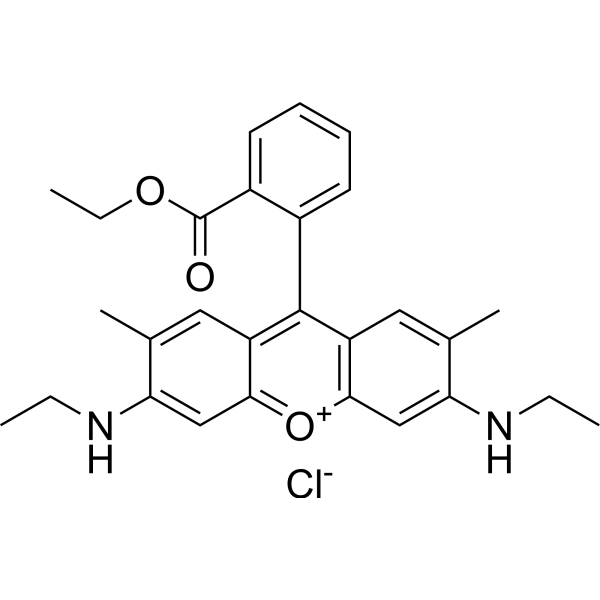
    Rhodamine dyes are membrane-permeable cationic fluorescent probes that specifically recognize mitochondrial membrane potentials, thereby attaching to mitochondria and producing bright fluorescence, and at certain concentrations, rhodamine dyes have low toxicity to cells, so they are commonly used to detect mitochondria in animal cells, plant cells, and microorganisms .
    Rhodamine 6G
  • HY-D1599

    R6GH

    Fluorescent Dye Others
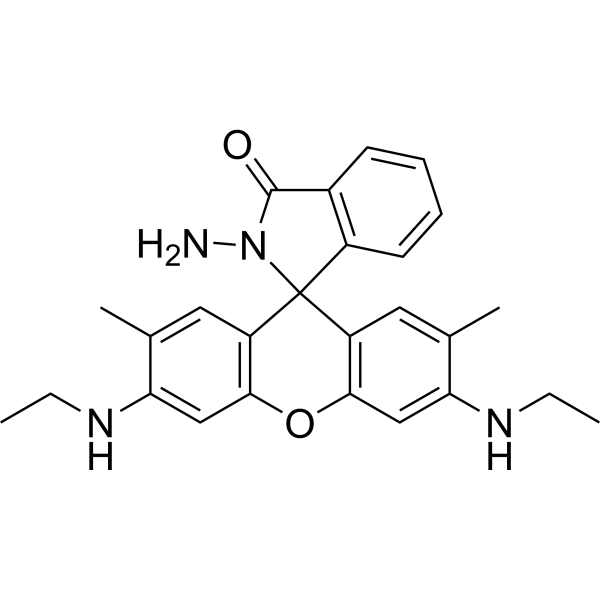
    Rhodamine 6G hydrazide (R6GH) is a fluorescent dye. Rhodamine 6G hydrazide can be used in selective colorimetric and fluorescent sensing .
    Rhodamine 6G hydrazide
  • HY-D0309R

    Basic Red 1 (Standard)

    Fluorescent Dye Reference Standards Cancer
    Rhodamine 6G (Standard) is the analytical standard of Rhodamine 6G. This product is intended for research and analytical applications. Rhodamine dyes are membrane-permeable cationic fluorescent probes that specifically recognize mitochondrial membrane potentials, thereby attaching to mitochondria and producing bright fluorescence, and at certain concentrations, rhodamine dyes have low toxicity to cells, so they are commonly used to detect mitochondria in animal cells, plant cells, and microorganisms .
    Rhodamine 6G (Standard)
  • HY-W247098

    DHR 6G

    Reactive Oxygen Species (ROS) Cancer
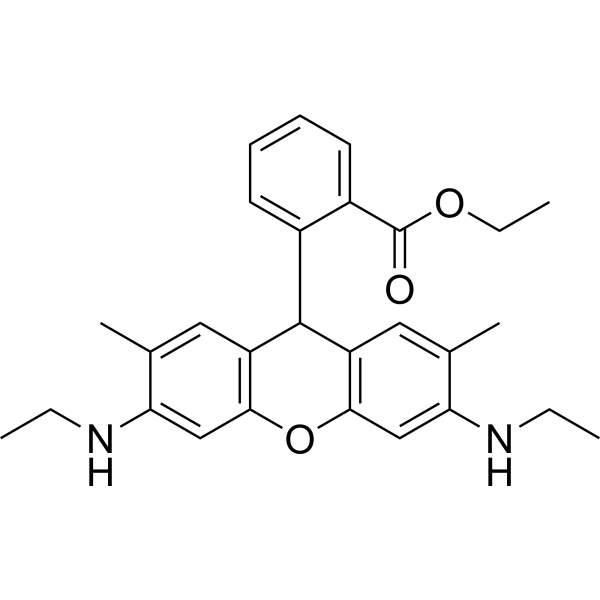
    Dihydrorhodamine 6G (DHR 6G) is the reduced form of Rhodamine 6G, which is used as fluorescent mitochondrial dye. It is nonfluorescent, but it readily enters most of the cells and is oxidized by oxidative species or by cellular redox systems to the fluorescent rhodamine 6G that accumulates in mitochondrial membranes. Dihydrorhodamine 6G is useful for detecting reactive oxygen species (ROS) including superoxide .
    Dihydrorhodamine 6G
  • HY-W127780

    Basic Red 1 perchlorate

    Fluorescent Dye Others
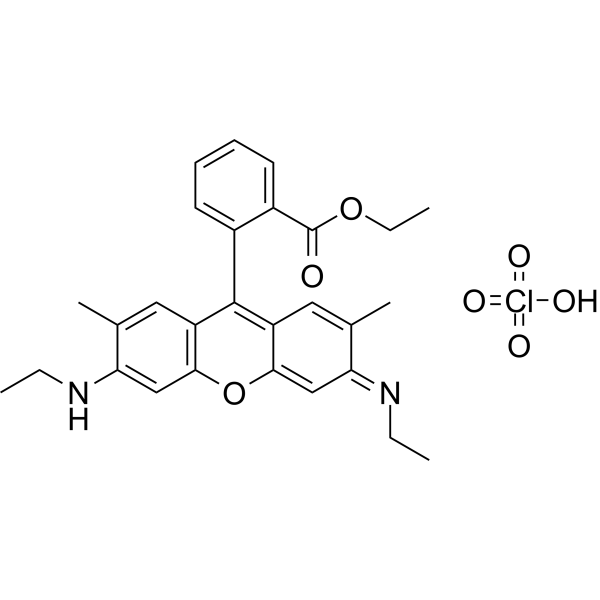
    Rhodamine dyes are membrane-permeable cationic fluorescent probes that specifically recognize mitochondrial membrane potentials, thereby attaching to mitochondria and producing bright fluorescence, and at certain concentrations, rhodamine dyes have low toxicity to cells, so they are commonly used to detect mitochondria in animal cells, plant cells, and microorganisms .
    Rhodamine 6G perchlorate
  • HY-D3056

    Fluorescent Dye Others
    5(6)-Rhodamine 6G maleimide is a maleimide-based fluorescent reagent based on Rhodamine 6G (HY-D0309). Maleimide can be labeled by forming a stable thioester structure through an affinity addition reaction with a thiol group (-SH) (Ex/Em = 526/547 nm).
    5(6)-Rhodamine 6G maleimide
  • HY-D3053

    Fluorescent Dye Others
    5(6)-Rhodamine 6G NHS ester is a reactive ester fluorescent reagent based on Rhodamine 6G (HY-D0309). NHS ester is a highly reactive ester capable of covalently coupling with primary amine groups in molecules such as proteins, peptides, amino sugars, and nucleic acids to form stable amide bonds (Ex/Em = 526/547 nm).
    5(6)-Rhodamine 6G NHS ester
  • HY-D3054

    Fluorescent Dye Others
    5(6)-Rhodamine 6G amine is a primary amine fluorescent reagent based on Rhodamine 6G (HY-D0309). Primary amines can be covalently linked with various functional groups such as carboxylic acids, active esters (e.g., NHS esters), and isothiocyanates to achieve labeling (Ex/Em = 526/547 nm).
    5(6)-Rhodamine 6G amine
  • HY-172268

    Fluorescent Dye Others
    R6G phosphoramidite for oligonucleotide synthesis, pure 6-isomer. R6G (rhodamine 6G) is a xanthene dye of the rhodamine family with high fluorescence quantum yield and high molar extinction coefficient. Relative to those of fluorescein, the absorption (518 nm) and emission (542 nm) maxima of 6-R6G are shifted into the long-wave region.
    R6G phosphoramidite, 6-isomer
  • HY-157483

    P-glycoprotein Cancer
    P-gp inhibitor 18 (compound 6G) is a potent inhibitor of P-gp. P-gp inhibitor 18 inhibits rhodamine 123 efflux in the P-gp overexpressed leukemia cells, K562/Dox .
    P-gp inhibitor 18
  • HY-N7539

    Others Metabolic Disease
    Cognac oil, mainly found in wine lees, has unique fatty acid profiles, including Palmitic acid (59.26%), Linoleic acid (11.92%), Myristic acid (8.97%), Oleic acid (8.3%) and other fatty acids. Cognac oil leads to a general increase in the permeation of R6G (Rhodamine 6G) across all the membranes .
    Cognac oil
  • HY-P4403

    (Z-Asp-Glu-Val-Asp)₂-Rhodamine 110

    Fluorescent Dye Apoptosis Caspase Others
    Z-DEVD-R110 ((Z-Asp-Glu-Val-Asp)2-Rhodamine 110) is a fluorogenic caspase-3/7 substrate. Z-DEVD-R110 can be used to detect apoptosis. Z-DEVD-R110 is a rhodamine derivative with two four–amino acid (DEVD) peptides linked to the fuorophore .
    Z-DEVD-R110
  • HY-P10322

    Fluorescent Dye Cancer
    Z-IETD-R110 is a fluorescent substrate of caspases. Z-IETD-R110 acts as a substrate for caspase-8. When caspase-8 is activated, it can recognize and cut Z-IETD-R110, releasing fluorophore, which can be detected by fluorescence microscopy. Z-IETD-R110 can be used to study oxidative stress-induced apoptosis, particularly in pancreatic acinar cells .
    Z-IETD-R110
  • HY-P11476

    Ser/Thr Protease Fluorescent Dye Drug Derivative Others
    (Z-AR)2Rh110 is a Rhodamine derivative. (Z-AR)2Rh110 can be hydrolyzed by trypsin .
    (Z-AR)2Rh110

Inquiry Online

Your information is safe with us. * Required Fields.

Salutation


Country or Region *

Applicant Name *


Organization Name *

Department *


Email Address *


Product Name *

Cat. No.


Requested quantity *

Phone Number *


Remarks

Inquiry Online

Inquiry Information

Product Name:
Cat. No.:
Quantity:
MCE Japan Authorized Agent:

