6 Results for "

W/O emulsions

" in MedChemExpress (MCE) Product Catalog:
Products (6)

6 Results for "W/O emulsions" in MCE Product Catalog:

3
3 Cited Publications
Cat. No.: HY-126403
CAS No.: 61788-85-0
Synonyms: PEG-40 hydrogenated castor oil; Macrogolglycerol hydroxystearate; Castor oil, hydrogenated, polyethoxylated
Ethoxylated hydrogenated castor oil (PEG-40 hydrogenated castor oil) is a combination of synthetic polyethylene glycol (PEG) with natural castor oil. Ethoxylated hydrogenated castor oil can be used to emulsify and solubilize oil-in-water (o/w) emulsions. Ethoxylated hydrogenated castor oil can be used as a cosolvent in vivo .
loading...
    loading...
Cat. No.: HY-108294
CAS No.: 3055-99-0
Purity:  ≥98.0%
Synonyms: Nonaoxyethylene monododecyl ether
Research Areas:  

Others

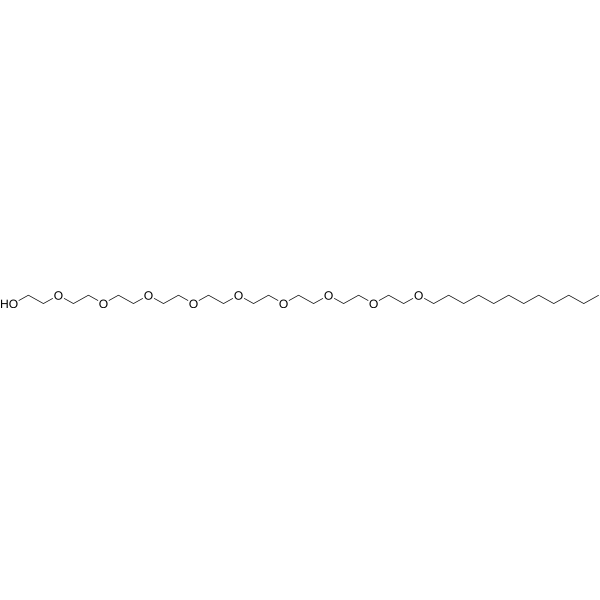
Nonaethylene glycol monododecyl ether (Nonaoxyethylene monododecyl ether) is a nonionic surfactant and polyethylene glycol (PEG) detergent that can be used to form initial coalesced O/W emulsion droplets, as well as for protein separation and purification .
loading...
    loading...
Cat. No.: HY-159750
Research Areas:  

Inflammation/Immunology

M903 is a new type of mineral oil-based adjuvant, which belongs to water-in-oil-in-water (w/o/w) emulsion. It can enhance both cellular and humoral immunity against non-specific antigens, stimulate specific immunity against the antigens, delay the release of the antigens in the body, and improve the immunity of animals. It is applicable to various veterinary vaccines, including inactivated vaccines and genetically engineered subunit vaccines, such as pig vaccines for foot-and-mouth disease and blue ear disease.
loading...
    loading...
Cat. No.: HY-108294R
CAS No.: 3055-99-0
Synonyms: Nonaoxyethylene monododecyl ether (Standard)
Research Areas:  

Others

Nonaethylene glycol monododecyl ether (Standard) is the analytical standard of Nonaethylene glycol monododecyl ether (HY-108294). This product is intended for research and analytical applications. Nonaethylene glycol monododecyl ether (Nonaoxyethylene monododecyl ether) is a nonionic surfactant and polyethylene glycol (PEG) detergent that can be used to form initial coalesced O/W emulsion droplets, as well as for protein separation and purification .
loading...
    loading...
Cat. No.: HY-159749
M902 is a new type of mineral oil-based adjuvant, which belongs to oil-in-water (O/W) emulsion. It rapidly stimulates the body to produce an immune response, has a low oil content, high safety, can induce natural immune responses, improve the efficiency of antigen uptake and presentation, induce the production of various cytokines, and increase the level of specific antibodies against antigens in the animal body. It is applicable to various veterinary vaccines, including inactivated vaccines and genetically engineered subunit vaccines, such as vaccine for Porcine Circovirus and Mycoplasma Hyopneumoniae.
loading...
    loading...
Cat. No.: HY-134096
CAS No.: 78323-98-5
Synonyms: DNS-M
Target:  

Fluorescent Dye

Research Areas:  

Others

Dansyl-morpholine (DNS-M) is a Fluorescent probe for lipid droplet imaging, cancer cell discrimination, and real-time tracking of lipid droplet dynamics. As a solvatochromic probe with a donor-π-acceptor structure, it relies on hydrophobic interaction for its mechanism of action: its good lipophilicity, confirmed by an oil-water partition coefficient LogP = 2.35, allows it to rapidly penetrate cell membranes, and it specifically localizes to the hydrophobic core of lipid droplets; its fluorescence is strongly enhanced in the nonpolar environment of lipid droplets, while it emits very weak fluorescence in polar environments like PBS buffer, and it exhibits a bathochromic shift in emission wavelength with increasing solvent polarity. It has negligible cytotoxicity, with cell viability remaining over 95% after 24-hour incubation with 100 μM of the probe, and it possesses excellent photostability, retaining over 97% of initial fluorescence intensity after 60 continuous laser scans. For cell imaging applications, its excitation/emission wavelengths for lipid droplet labeling are Ex/Em = 405/480−540 nm, and in a simulative lipid environment O/W emulsion, it has an excitation wavelength of ~346 nm and emission wavelength of ~500 nm, giving a Stokes shift of 154 nm[1].
loading...
    loading...

