



10 Results for "

axon growth

" in MedChemExpress (MCE) Product Catalog:
Products (10)

10 Results for "axon growth" in MCE Product Catalog:

Cat. No.: HY-116392E
CAS No.: 109836-82-0
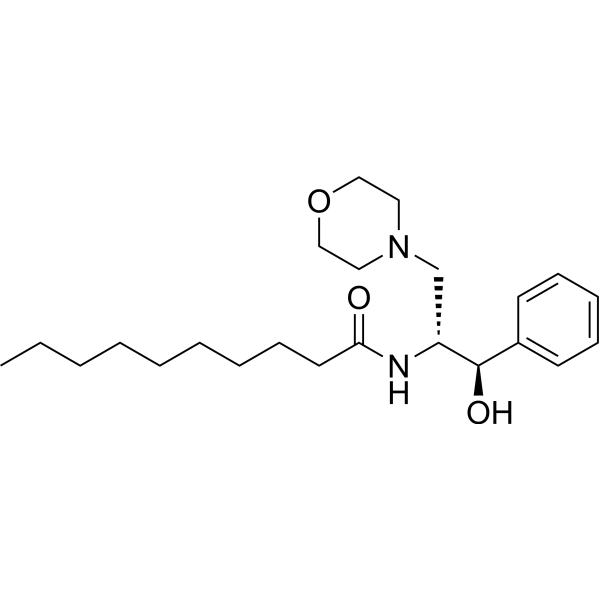
D-threo-PDMP is a potent glucoceramide synthase (GCS) inhibitor, which reduces the glycosphingolipids (such as GM3 and GD3) on the cell surface by inhibiting glycosylation, reduces the total length of the axon plexus and the number of axon branch points, and inhibits neurite growth. D-threo-PDMP inhibits the synthesis of GM3, thereby reducing the adhesion ability of B16 melanoma cells and mimicking the pathological effects of hyperglycemia/TGF-β1. D-threo-PDMP inhibits the synthesis of GD3, thereby protecting liver cells from apoptosis induced by TNF-α. D-threo-PDMP can be used to study diseases related to targeted glycosphingolipid metabolism .
loading...
    loading...
Cat. No.: HY-116392F
CAS No.: 139889-62-6
Purity:  ≥98.0%
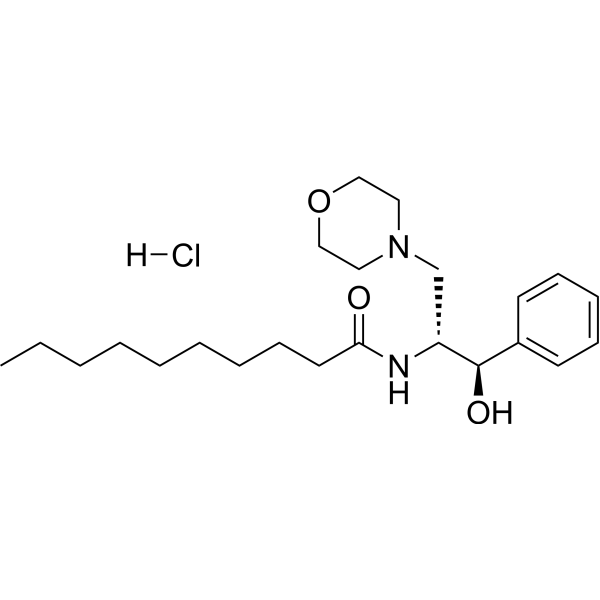
D-threo-PDMP hydrochloride is a potent glucoceramide synthase (GCS) inhibitor, which reduces the glycosphingolipids (such as GM3 and GD3) on the cell surface by inhibiting glycosylation, reduces the total length of the axon plexus and the number of axon branch points, and inhibits neurite growth. D-threo-PDMP hydrochloride inhibits the synthesis of GM3, thereby reducing the adhesion ability of B16 melanoma cells and mimicking the pathological effects of hyperglycemia/TGF-β1. D-threo-PDMP hydrochloride inhibits the synthesis of GD3, thereby protecting liver cells from apoptosis induced by TNF-α. D-threo-PDMP hydrochloride can be used to study diseases related to targeted glycosphingolipid metabolism .
loading...
    loading...
Cat. No.: HY-P5118A
Target:  

Inhibitory Antibodies

Research Areas:  

Neurological Disease

Tat-peptide 190-208 TFA is a cell-permeable and Tat-labeled fusion peptide, corresponding to residues 190-208 of rat G3BP1. Tat sequence from HIV, is placed at the least conserved end of the sequence, for cell permeability. Tat-peptide 190-208 TFA increases axon growth and increases the number of neurites per neuron. Tat-peptide 190-208 TFA likely exhibits an axon intrinsic mechanism. Tat-peptide 190-208 TFA can be used for ischemic protection during endovascular repair for intracranial aneurysms .
loading...
    loading...
Cat. No.: HY-P5118
Target:  

Inhibitory Antibodies

Research Areas:  

Neurological Disease

Tat-peptide 190-208 is a cell-permeable and Tat-labeled fusion peptide, corresponding to residues 190-208 of rat G3BP1. Tat sequence from HIV, is placed at the least conserved end of the sequence, for cell permeability. Tat-peptide 190-208 increases axon growth and increases the number of neurites per neuron. Tat-peptide 190-208 likely exhibits an axon intrinsic mechanism. Tat-peptide 190-208 can be used for ischemic protection during endovascular repair for intracranial aneurysms .
loading...
    loading...
Cat. No.: HY-P5119
Target:  

Inhibitory Antibodies

Research Areas:  

Neurological Disease

Tat-peptide 168-189 is a cell-permeable and Tat-labeled fusion peptide, corresponding to residues 168-189 of rat G3BP1. Tat sequence from HIV, is placed at the least conserved end of the sequence, for cell permeability. Tat-peptide 168-189 is the negtive control of Tat-peptide 190-208 (HY-P5118), as Tat-peptide 190-208 increases axon growth and increases the number of neurites per neuron .
loading...
    loading...
Cat. No.: HY-P5119A
Target:  

Inhibitory Antibodies

Research Areas:  

Neurological Disease

Tat-peptide 168-189 is a cell-permeable and Tat-labeled fusion peptide, corresponding to residues 168-189 of rat G3BP1. Tat sequence from HIV, is placed at the least conserved end of the sequence, for cell permeability. Tat-peptide 168-189 is the negtive control of Tat-peptide 168-189 TFA (HY-P5118A), as Tat-peptide 168-189 TFA increases axon growth and increases the number of neurites per neuron .
loading...
    loading...
Cat. No.: HY-P5353B
Synonyms: IKVAV sequence TFA; Laminin A-chain fragment TFA
Target:  

Inhibitory Antibodies

Research Areas:  

Cancer

PA22-2 (IKVAV sequence; Laminin A-chain fragment) TFA is a laminin receptor ligand. PA22-2 TFA competes with laminin for receptor binding sites, thereby mediating biological responses such as cell adhesion, migration, morphology regulation and angiogenesis. PA22-2 TFA promotes adhesion, spreading, directional migration and axon growth of specific cells, and supports endothelial cell mobilization and vascular formation. PA22-2 TFA inhibits laminin-mediated adhesion and migration in melanoma cells, and its antiserum reacts with the laminin A chain and native laminin, effectively blocking cell adhesion and axon growth .
loading...
    loading...
Cat. No.: HY-187355
Target:  

mAChR

Research Areas:  

Neurological Disease

VU6077564 is a reversible competitive antagonist of M1 mAChR, with an IC50 of 31 nM in human (CHO cells) and 39.5 nM in rats. VU6077564 promotes axon growth of sensory neurons from adult rat dorsal root ganglia cultured in vitro. VU6077564 can be used for the research of peripheral neuropathy .
loading...
    loading...
Cat. No.: HY-183405
CAS No.: 143984-56-9
Target:  

RAR/RXR

Research Areas:  

Neurological Disease

CD2019 is a selective retinoic acid receptor β (RARβ) agonist, with a Kd value of 26 nM for RARβ and an AC50 value of 3.8 nM for human RARβ. CD2019 regulates downstream biological effects via the PI3K signaling pathway. CD2019 suppresses squamous metaplasia, inhibits squamous differentiation markers, maintains pseudostratified epithelial structure, induces neurite and axon growth, and promotes functional recovery; it exhibits cytotoxicity at higher concentrations and reduces endogenous retinol levels. CD2019 can be used in studies related to squamous metaplasia, spinal cord injury and embryonic malformations .
loading...
    loading...
Cat. No.: HY-112500
CAS No.: 1465248-60-5
Synonyms: SPL-B
Target:  

Microtubule/Tubulin

Research Areas:  

Neurological Disease

Spindlactone B (SPL-B) is a TACC3 inhibitor. Spindlactone B reduces the level of acetylated Microtubules. Spindlactone B can be used in the research of neurological diseases .
loading...
    loading...

