1. Search Result
Search Result
Results for "

cytochrome P450 genes

" in MedChemExpress (MCE) Product Catalog:

7

Inhibitors & Agonists

1

Screening Libraries

1

Natural
Products

Targets Recommended:
Cat. No. Product Name Target Research Areas Chemical Structure
  • HY-125904
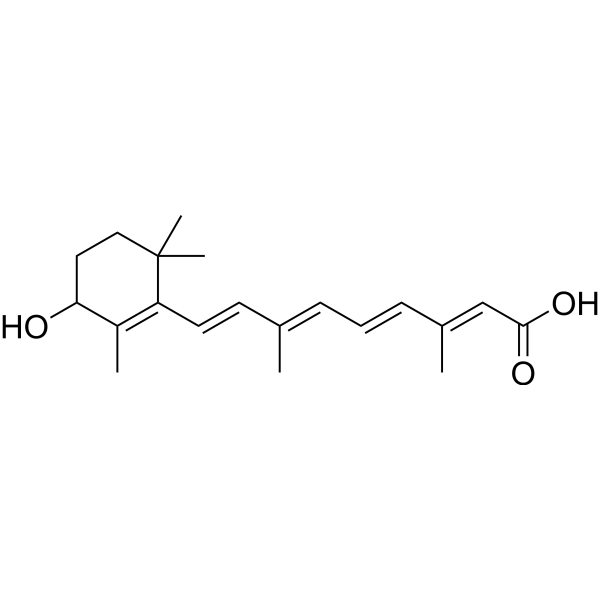
    4-Hydroxyretinoic acid
    1 Publications Verification

    RAR/RXR UGT Cytochrome P450 Apoptosis Drug Derivative Neurological Disease Inflammation/Immunology Cancer
    4-Hydroxyretinoic acid (4-HRA) is a derivative of Retinoic acid (HY-14649). 4-Hydroxyretinoic acid is formed via the catalysis of retinol by cytochrome P-450 isoenzymes. 4-Hydroxyretinoic acid also serves as a substrate for UDP-glucuronosyltransferase (s) and recombinant UGT2B7. 4-Hydroxyretinoic acid binds to the nuclear receptor RAR (Retinoic Acid Receptor), activates RAR and RXR-alpha, subsequently regulates gene expression and cell differentiation, and induces cancer cell apoptosis (Apoptosis). 4-Hydroxyretinoic acid also participates in multiple physiological processes such as immunoregulation, neuroprotection and antioxidation .
    4-Hydroxyretinoic acid
  • HY-164322

    Insecticide Others
    Cyproflanilide is a meta-diamide insecticide. Cyproflanilide exhibits potent insecticidal activity against third Chilo suppressalis and Spodoptera frugiperda larvae. Cyproflanilide can be used for the research of insect pests .
    Cyproflanilide
  • HY-138051

    Cytochrome P450 Cancer
    TUPS can inhibit the gene expression of epoxide hydrolase (sEH) and cytochrome P450 (CYP). TUPS can be used in cardiovascular disease-related research .
    TUPS
  • HY-121888

    PPAR Metabolic Disease
    20-HEPE is a metabolite of eicosapentaenoic acid formed by ω-oxidation of EPA by cytochrome P450 (CYP) ω-oxidases, including human CYP4F3B. At 10 μM, it activates peroxisome proliferator-activated receptor α (PPARα) in COS-7 cells expressing a luciferase reporter gene. 20-HEPE also activates mouse transient receptor potential vanilloid receptor 1 (mTRPV1) in vitro but lacks analgesic activity in rats.
    20-HEPE
  • HY-W762015

    1,2,3,6,7,8-HxCDF

    Cytochrome P450 Cancer
    1,2,3,6,7,8-Hexachlorodibenzofuran (1,2,3,6,7,8-HxCDF) is a dioxin-like polychlorinated dibenzofuran (PCDF). 1,2,3,6,7,8-Hexachlorodibenzofuran induces expression of the genes encoding aryl hydrocarbon hydroxylase (AHH) and ethoxyresorufin-O-deethylase (EROD) in H-4-II-E rat hepatoma cells (EC50s = 1.47 and 1.24 nM, respectively). 1,2,3,6,7,8-Hexachlorodibenzofuran reduces weight, induces thymic atrophy, and induces the expression of genes encoding the cytochrome P450 (CYP) isoform CYP1A1 and 4-chlorobiphenyl hydroxylase in rats (EC50s = 3.2, 0.9, 0.35, and 0.21 µmol/kg, respectively) .
    1,2,3,6,7,8-Hexachlorodibenzofuran
  • HY-178786

    RET Potassium Channel Cytochrome P450 Cancer
    RET-IN-31 (Compound 13) is an orally active, selective RET inhibitor (IC50s: 1.4 nM, 1.9 nM, 3.8 nM for RET WT, RET V804L, RET V804M, respectively). RET-IN-31 inhibits hERG and Cytochrome P450 (IC50s: 13.6 μM, 7.9 μM, 12.8 μM, 16.9 μM, 8.9 μM, 13.0 μM for CYP1A2, CYP2C9, CYP2C19, CYP2D6, CYP3A4-M, CYP3A4-T, respectively). RET-IN-31 has anti-cancer effects against activated RET mutations and gene fusion-driven cancers .
    RET-IN-31
  • HY-N19180

    Drug Derivative Others
    Hancockiamide C is a phenylacetic piperazine natural products found in Aspergillus hancockii. Hancockiamide C is synthesized via the hkm biosynthetic gene cluster, involving NRPS Hkm11 and the acetyltransferase Hkm3. Hancockiamide C inhibits seed germination of Arabidopsis thaliana (MIC = 6.3 μg/mL), but shows no activity against Eragrostis tef seeds .
    Hancockiamide C

Inquiry Online

Your information is safe with us. * Required Fields.

Salutation


Country or Region *

Applicant Name *


Organization Name *

Department *


Email Address *


Product Name *

Cat. No.


Requested quantity *

Phone Number *


Remarks

Inquiry Online

Inquiry Information

Product Name:
Cat. No.:
Quantity:
MCE Japan Authorized Agent:

