13 Results for "

dead bacteria

" in MedChemExpress (MCE) Product Catalog:
Products (13)

13 Results for "dead bacteria" in MCE Product Catalog:

5
5 Cited Publications
Cat. No.: HY-D0093
CAS No.: 61926-22-5
Synonyms: EthD-1
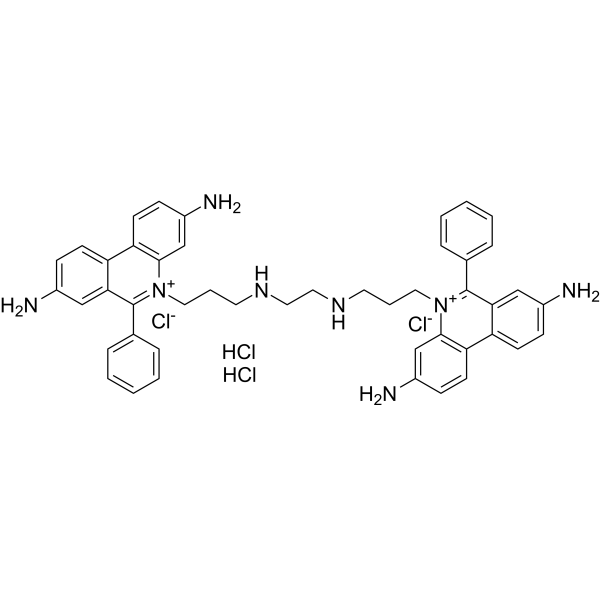
Ethidium homodimer (EthD-1) is a high-affinity fluorescent nucleic acid dye commonly used to stain mammals, bacteria, yeast, and fungi. Ethidium homodimer binds to DNA or RNA, enhancing fluorescence more than 30 times. The Ethidium homodimer has a strong positive charge, so it cannot cross cell membranes and stain living cells; But the Ethidium homodimer can cross the disordered region of the dead cell membrane to reach the nucleus and embed the DNA double strand to produce red fluorescence. Therefore, Ethidium homodimer is a relatively sensitive nucleic acid stain that can accurately detect nucleic acids in solution or in decomposing cells. Ethidium homodimer binds DNA, Ex/Em=528/617 nm .
loading...
    loading...
2
2 Cited Publications
Cat. No.: HY-K1095

MCE Live & Dead Bacterial Viability and Counting Kit is based on dual-fluorescence staining technology, which can effectively differentiate live bacteria from dead bacteria and enable quantitative detection using flow cytometry. It can also be used for quantitative analysis of various bacterial mixtures.

loading...
    loading...
1
1 Cited Publications
Cat. No.: HY-D1444
CAS No.: 91416-20-5
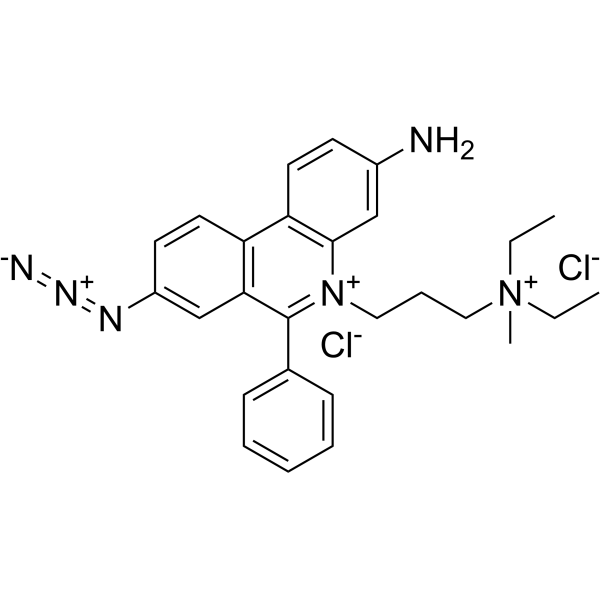
Propidium monoazide is a cell-impermeant photoreactive DNA-binding dye that preferentially binds to dsDNA. Propidium monoazide (PMA) prevents DNA from dead bacteria from being amplified during the PCR. PMA-PCR enhanced both the specificity and the sensitivity of PCR . Propidium monoazide is a click chemistry reagent, it contains an Azide group and can undergo copper-catalyzed azide-alkyne cycloaddition reaction (CuAAc) with molecules containing Alkyne groups. It can also undergo strain-promoted alkyne-azide cycloaddition (SPAAC) reactions with molecules containing DBCO or BCN groups.
loading...
    loading...
Cat. No.: HY-D0259
CAS No.: 16423-68-0
Synonyms: Erythrosin extra bluish; Tetraiodofluorescein disodium
Research Areas:  

Infection

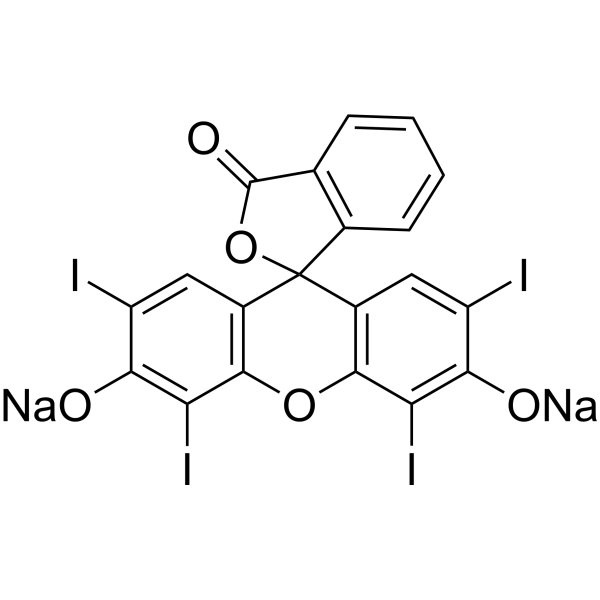
Erythrosine B (Erythrosin extra bluish; Tetraiodofluorescein) is a visible red dye and insecticide with colorimetric and fluorescent properties. Erythrosine B serves as a membrane-impermeant live-cell dye for Gram-positive and Gram-negative bacteria, primarily staining dead cells with damaged plasma membranes. Erythrosine B exhibits photosensitive larvicidal toxicity against Culex pipiens quinquefasciatus larvae. Erythrosine B is used in live/dead bacterial assays in colorimetric and fluorescent measurements for low-, medium-, and high-throughput experiments, as well as in research related to mosquito-borne diseases and food coloring .
loading...
    loading...
Cat. No.: HY-107864
CAS No.: 15905-32-5
Purity:  99.07%
Synonyms: Erythrosin extra bluish free acid; Tetraiodofluorescein
Research Areas:  

Infection

Erythrosine B free acid​ (Erythrosin extra bluish free acid; Tetraiodofluorescein) is a visible red dye and insecticide with colorimetric and fluorescent properties. Erythrosine B free acid serves as a membrane-impermeant live-cell dye for Gram-positive and Gram-negative bacteria, primarily staining dead cells with damaged plasma membranes. Erythrosine B free acid exhibits photosensitive larvicidal toxicity against Culex pipiens quinquefasciatus larvae. Erythrosine B free acid is used in live/dead bacterial assays in colorimetric and fluorescent measurements for low-, medium-, and high-throughput experiments, as well as in research related to mosquito-borne diseases and food coloring .
loading...
    loading...
Cat. No.: HY-D2582
DMAO is a membrane-permeable DNA fluorescent dye stains live and dead bacteria. (Ex/Em = 490/540 nm) .
loading...
    loading...
Cat. No.: HY-D1246
CAS No.: 58880-05-0
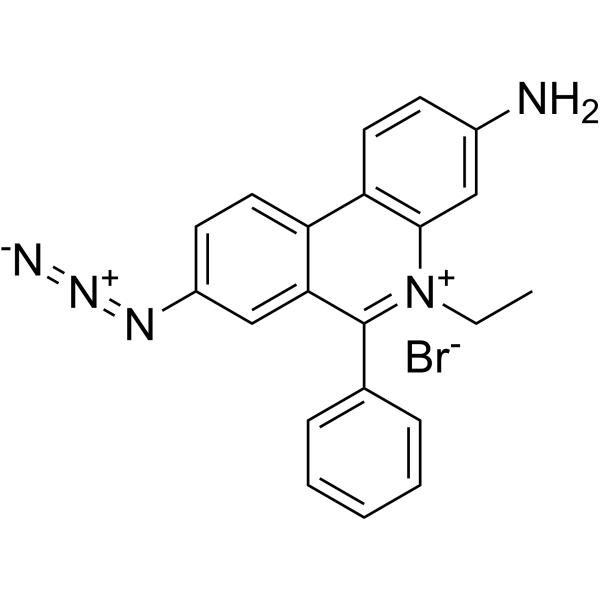
Ethidium monoazide bromide is a DNA intercalating fluorescent dye that enters bacteria with damaged membranes. Ethidium monoazide bromide can be covalently linked to DNA by photoactivation. Ethidium monoazide bromide stains only dead cells . Ethidium monoazide (bromide) is a click chemistry reagent, it contains an Azide group and can undergo copper-catalyzed azide-alkyne cycloaddition reaction (CuAAc) with molecules containing Alkyne groups. It can also undergo strain-promoted alkyne-azide cycloaddition (SPAAC) reactions with molecules containing DBCO or BCN groups.
loading...
    loading...
Cat. No.: HY-D0259R
CAS No.: 16423-68-0
Synonyms: Erythrosin extra bluish (Standard); Tetraiodofluorescein disodium (Standard)
Research Areas:  

Infection

Erythrosine B (Standard) (Erythrosin extra bluish (Standard); Tetraiodofluorescein disodium (Standard)) is the analytical standard of Erythrosine B (HY-D0259). This product is intended for research and analytical applications. Erythrosine B (Erythrosin extra bluish; Tetraiodofluorescein) is a visible red dye and insecticide with colorimetric and fluorescent properties. Erythrosine B serves as a membrane-impermeant live-cell dye for Gram-positive and Gram-negative bacteria, primarily staining dead cells with damaged plasma membranes. Erythrosine B exhibits photosensitive larvicidal toxicity against Culex pipiens quinquefasciatus larvae. Erythrosine B is used in live/dead bacterial assays in colorimetric and fluorescent measurements for low-, medium-, and high-throughput experiments, as well as in research related to mosquito-borne diseases and food coloring .
loading...
    loading...
Cat. No.: HY-107864A
CAS No.: 12227-78-0
Synonyms: Erythrosin extra bluish aluminum; Tetraiodofluorescein aluminum
Research Areas:  

Infection

Erythrosine B aluminum​ (Erythrosin extra bluish aluminum; Tetraiodofluorescein aluminum) is a visible red dye and insecticide with colorimetric and fluorescent properties. Erythrosine B aluminum serves as a membrane-impermeant live-cell dye for Gram-positive and Gram-negative bacteria, primarily staining dead cells with damaged plasma membranes. Erythrosine B aluminum exhibits photosensitive larvicidal toxicity against Culex pipiens quinquefasciatus larvae. Erythrosine B aluminum is used in live/dead bacterial assays in colorimetric and fluorescent measurements for low-, medium-, and high-throughput experiments, as well as in research related to mosquito-borne diseases and food coloring .
loading...
    loading...
Cat. No.: HY-107864R
CAS No.: 15905-32-5
Synonyms: Erythrosin extra bluish free acid (Standard); Tetraiodofluorescein (Standard)
Research Areas:  

Infection

Erythrosine B free acid (Standard) (Erythrosin extra bluish free acid (Standard); Tetraiodofluorescein (Standard)) is the analytical standard of Erythrosine B free acid (HY-107864). This product is intended for research and analytical applications. Erythrosine B free acid​ (Erythrosin extra bluish free acid; Tetraiodofluorescein) is a visible red dye and insecticide with colorimetric and fluorescent properties. Erythrosine B free acid serves as a membrane-impermeant live-cell dye for Gram-positive and Gram-negative bacteria, primarily staining dead cells with damaged plasma membranes. Erythrosine B free acid exhibits photosensitive larvicidal toxicity against Culex pipiens quinquefasciatus larvae. Erythrosine B free acid is used in live/dead bacterial assays in colorimetric and fluorescent measurements for low-, medium-, and high-throughput experiments, as well as in research related to mosquito-borne diseases and food coloring .
loading...
    loading...
Cat. No.: HY-D3459
SYTO-9 is a cell-permeable fluorescent dye that can be used for nucleic acid staining. The fluorescence intensity of SYTO-9 increases significantly upon binding to RNA and DNA . SYTO-9 can stain RNA and DNA in live and dead eukaryotic cells, as well as in Gram-positive and Gram-negative bacteria. SYTO-9 is applicable for fluorescence microscopy, flow cytometry, fluorophotometry, and bacterial counting in aquatic systems (RNA: Ex/Em = 486/501 nm; DNA: Ex/Em = 485/498 nm) .
loading...
    loading...
Cat. No.: HY-DY2047
Research Areas:  

Infection

Phosphotungstic Acid Negative Staining Solution (3%, pH 7.0) is an electron microscopy negative stain. Phosphotungstic Acid Negative Staining Solution (3%, pH 7.0) forms an electron-dense background around samples, enabling the imaging of viruses, bacterial, macromolecules and organelles .
loading...
    loading...
Cat. No.: HY-D3391
RMR-Tre is a fluorescent probe targeting the mycobacterial acyltransferase Ag85. Under the catalysis of Ag85, RMR-Tre undergoes 6-position mycoloylation and anchors to the mycobacterial membrane, while achieving fluorescence activation by inhibiting the intramolecular twisted charge transfer state transition. RMR-Tre can distinguish live mycobacteria from dead ones through metabolism-driven labeling, enabling rapid, wash-free, low-background detection of viable bacteria. RMR-Tre reports the drug resistance of Mycobacterium tuberculosis via the trehalose catalytic shift activity readout associated with TreS. In addition, RMR-Tre can be combined with flow cytometry or high-content imaging techniques to visualize and quantitatively analyze the metabolic heterogeneity of Mycobacterium tuberculosis related to persistence and drug resistance. RMR-Tre is widely used in tuberculosis-related research .
loading...
    loading...
  • 1

