



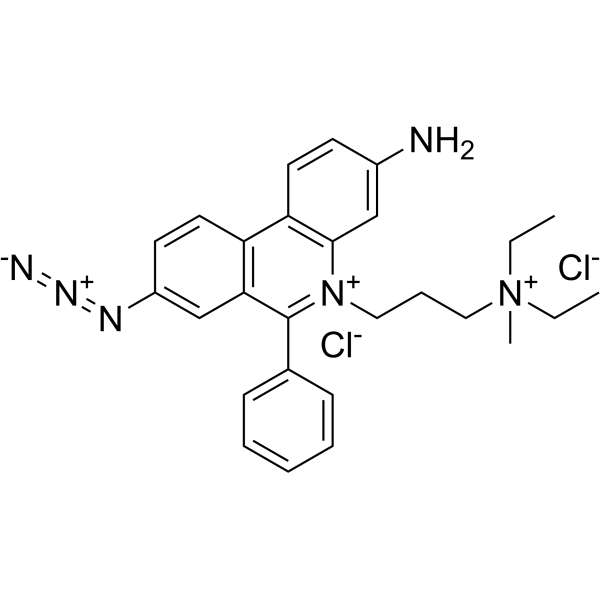
Propidium monoazide
Based on 1 publication(s) in Google Scholar
Propidium monoazide is a cell-impermeant photoreactive DNA-binding dye that preferentially binds to dsDNA. Propidium monoazide (PMA) prevents DNA from dead bacteria from being amplified during the PCR. PMA-PCR enhanced both the specificity and the sensitivity of PCR. Propidium monoazide is a click chemistry reagent, it contains an Azide group and can undergo copper-catalyzed azide-alkyne cycloaddition reaction (CuAAc) with molecules containing Alkyne groups. It can also undergo strain-promoted alkyne-azide cycloaddition (SPAAC) reactions with molecules containing DBCO or BCN groups.
Nos produits utilisent uniquement pour la recherche. Nous ne vendons pas aux patients.
- CAS No.: 91416-20-5
- Formule: C27H32Cl2N6
- Masse moléculaire:511.49
-
Stockage:
-20°C, sealed storage, away from moisture and light
* In solvent : -80°C, 6 months; -20°C, 1 month (sealed storage, away from moisture and light)

To place orders, for customer services and technical support, please contact: MedChemExpress USA
Tel: 609-228-6898 E-mail: [email protected] [email protected]


-
 Activité biologique
-
Chemical Information
-
Solvant et solubilité
- Protocole
- Pureté et documentation
- Références
-
 Help & FAQs


Publications Citing Use of MedChemExpress (MCE) Propidium monoazide
More

Activité biologique
Description
In Vitro
Guide (The following is the experimental plan we recommend. This plan serves only as a reference guide. The specific operations should be adjusted according to your actual needs.)
Propidium monoazide-PCR[1]
Propidium monoazide is used to label bacteria.
In a dimly lit room, add 5 μL of 2 mM photoreaction dye Propidium monoazide to 500 mL of the sample, resulting in a final concentration of 20 μM/μL.
2) Incubate the sample in the dark for 5 minutes (cover with aluminum foil), and gently shake the tube to ensure thorough mixing. Perform light activation with the PMA-LiteTM LED light source for 10 minutes.
2. Extract bacterial DNA
3. Perform PCR.
MedChemExpress (MCE) has not independently confirmed the accuracy of these methods. They are for reference only. Further protocols information, click here.


Chemical Information
-
CAS No. 91416-20-5
-
Appearance Solid
-
Masse moléculaire 511.49
-
Formule C27H32Cl2N6
-
Color Brown to reddish brown
-
SMILES
[N-]=[N+]=NC1=CC2=C(C3=C([N+](CCC[N+](CC)(CC)C)=C2C4=CC=CC=C4)C=C(N)C=C3)C=C1.[Cl-].[Cl-]
-
Livraison
Room temperature in continental US; may vary elsewhere.
-
Stockage
-20°C, sealed storage, away from moisture and light
* In solvent : -80°C, 6 months; -20°C, 1 month (sealed storage, away from moisture and light)


Publications (1)
-
Journal Impact Factor
-
Most Recent
-
Arch Microbiol
Microbial viability assessment with PMA-qPCR: challenges, opportunities, and future directions. [Abstract]2025 Nov 3;207(12):343. PMID: 41182402


Solvant et solubilité
In Vitro:
DMSO : 2 mg/mL (3.91 mM; Need ultrasonic; Hygroscopic DMSO has a significant impact on the solubility of product, please use newly opened DMSO)
Please refer to the solubility information to select the appropriate solvent. Once prepared, please aliquot and store the solution to prevent product inactivation from repeated freeze-thaw cycles.
Storage method and period of stock solution: -80°C, 6 months; -20°C, 1 month (sealed storage, away from moisture and light). When stored at -80°C, please use it within 6 months. When stored at -20°C, please use it within 1 month.
Please refer to the solubility information to select the appropriate solvent. Once prepared, please aliquot and store the solution to prevent product inactivation from repeated freeze-thaw cycles.
Storage method and period of stock solution: -80°C, 6 months; -20°C, 1 month (sealed storage, away from moisture and light). When stored at -80°C, please use it within 6 months. When stored at -20°C, please use it within 1 month.
Concentration (start) × Volume (start) = Concentration (final) × Volume (final)

Protocole
-
EdU Incorporation Assay (Click Chemistry-Based DNA Synthesis Measurement)
The EdU incorporation assay measures DNA synthesis by adding the thymidine analog 5-ethynyl-2′-deoxyuridine to cells or tissues, where it is incorporated into newly synthesized DNA during S phase. Incorporated EdU is detected by copper-catalyzed azide-alkyne cycloaddition, in which a fluorescent azide covalently reacts with the ethynyl group on EdU, allowing S-phase cells to be detected by fluorescence microscopy, flow cytometry, or high-content imaging. EdU detection does not require DNA denaturation or anti-BrdU antibody access, which preserves sample structure and improves compatibility with immunostaining and multiparameter cytometry compared with BrdU-based detection. EdU can be cytotoxic in a cell-type- and exposure-dependent manner, so pulse duration, concentration, and continuous-labeling designs should be validated for each cell type.


Pureté et documentation
-
Fiche technique (274 KB)
-
SDS (252 KB)
- English - EN (252 KB)
- Français - FR (252 KB)
- Deutsch - DE (252 KB)
- Norwegian - NO (252 KB)
- Español - ES (252 KB)
- Swedish - SV (252 KB)
- Italian - IT (252 KB)
- Korean - KR (252 KB)
- Portuguese - PT (252 KB)
-
Instruction de manipulation (2659 KB)
Références


Complete Stock Solution Preparation Table
Please refer to the solubility information to select the appropriate solvent. Once prepared, please aliquot and store the solution to prevent product inactivation from repeated freeze-thaw cycles.
Storage method and period of stock solution: -80°C, 6 months; -20°C, 1 month (sealed storage, away from moisture and light). When stored at -80°C, please use it within 6 months. When stored at -20°C, please use it within 1 month.
| Optional Solvent | Concentration Solvent Mass | 1 mg | 5 mg | 10 mg | 25 mg |
|---|---|---|---|---|---|
| DMSO | 1 mM | 1.9551 mL | 9.7754 mL | 19.5507 mL | 48.8768 mL |


Propidium monoazide Related Classifications
HY-D1444 Related Classifications
 Powered by Bioz