
5 Results for "

disulfide linkage

" in MedChemExpress (MCE) Product Catalog:
Products (5)

5 Results for "disulfide linkage" in MCE Product Catalog:

  • Targets Recommended:
1
1 Cited Publications
Cat. No.: HY-P99493
CAS No.: 868747-45-9
Synonyms: IMGN242; huC242-DM4
Cantuzumab ravtansine (IMGN242; huC242-DM4), an ADC, is a humanized monoclonal antibody, huC242, covalently linked via a disulfide bond to DM4 (HY-12454). Cantuzumab ravtansine has broad antitumor efficacy against a range of CanAg-positive human tumor xenografts .
loading...
    loading...
Cat. No.: HY-P5461
CAS No.: 646038-39-3
Target:  

Bacterial

Research Areas:  

Others

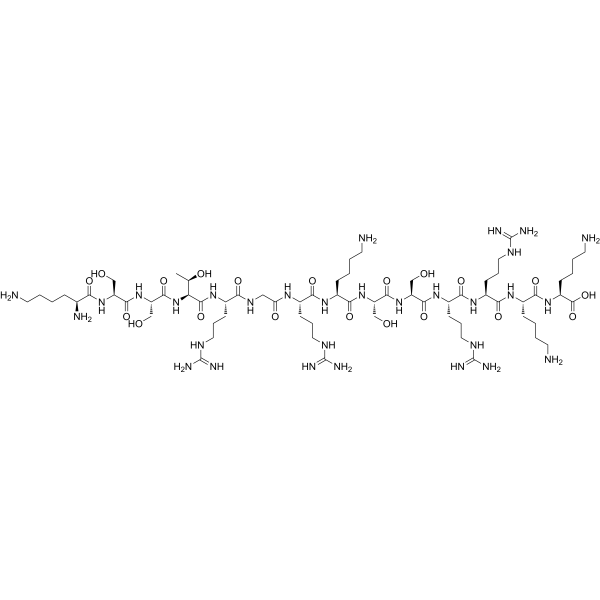
CHRG01 is a biological active peptide. (CHRG01 is derived from human b-defensin 3 (hBD3) C-terminal amino acids 54 to 67, with all Cys residues substituted with Ser. This substitution removes all disulfide bond linkages within the sequence. CHRG01, like hBD3, displays electrostatic-dependent antimicrobial properties.)
loading...
    loading...
Cat. No.: HY-185474
Target:  

Drug Derivative

Research Areas:  

Cancer

Chondroitin sulfate-cholesterol is a cholesterol derivative. Chondroitin sulfate-cholesterol can form reduction-responsive shell-sheddable micelles via disulfide bond linkage and be used to efficiently encapsulate hydrophobic drugs and achieve intracellular triggered release. Chondroitin sulfate-cholesterol can be used for cancer research .
loading...
    loading...
Cat. No.: HY-W1061408
CAS No.: 1263065-01-5
Research Areas:  

Others

Thiol-modifier C3 S-S Phosphoramidite is a thiol phosphoramidite modifier containing a C3 spacer and a disulfide linkage for introducing thiol functionality during oligonucleotide synthesis. Thiol-modifier C3 S-S Phosphoramidite can be used for reversible oligonucleotide conjugation, surface immobilization, and biosensor-related applications.
loading...
    loading...
Cat. No.: HY-W591360
CAS No.: 1240737-77-2
Research Areas:  

Others

Iodoacetamido-PEG6-azide is an aqueous soluble PEG linker containing an azide and a terminal Iodoacetamido group. The azide group can react with alkyne, BCN, DBCO via Click Chemistry to yield a stable triazole linkage. The Iodoacetamido moiety is commonly used to bind covalently with the thiol group of cysteine so the protein cannot form disulfide bonds.
loading...
    loading...

