11 Results for "

enzyme-catalyzed reaction

" in MedChemExpress (MCE) Product Catalog:
Products (11)

11 Results for "enzyme-catalyzed reaction" in MCE Product Catalog:

Cat. No.: HY-W694629
CAS No.: 15715-58-9
Triethylammonium bicarbonate is a biochemical reagent that can be used to prepare buffer solutions that maintains the stable pH environment required for processes such as enzyme-catalyzed reactions .
loading...
    loading...
Cat. No.: HY-W090942
CAS No.: 13171-93-2
Research Areas:  

Others

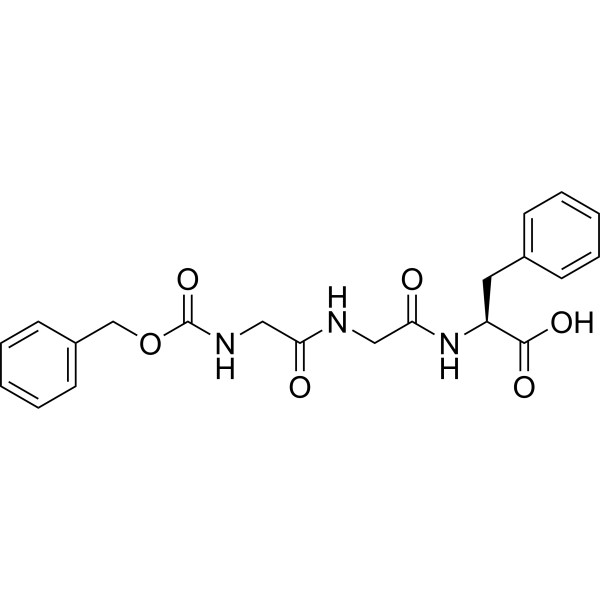
Z-Gly-Gly-Phe-OH is a substrate for pepsin and thermolysin. Z-Gly-Gly-Phe-OH has an IC50 of 15.8 μM for open sodium channels under pepsin catalysis. Z-Gly-Gly-Phe-OH forms peptide bonds with amine components (such as H-Leu-NHPh) through enzyme-catalyzed condensation reactions, and is active as an intermediate in peptide synthesis .
loading...
    loading...
Cat. No.: HY-W045537
CAS No.: 102185-33-1
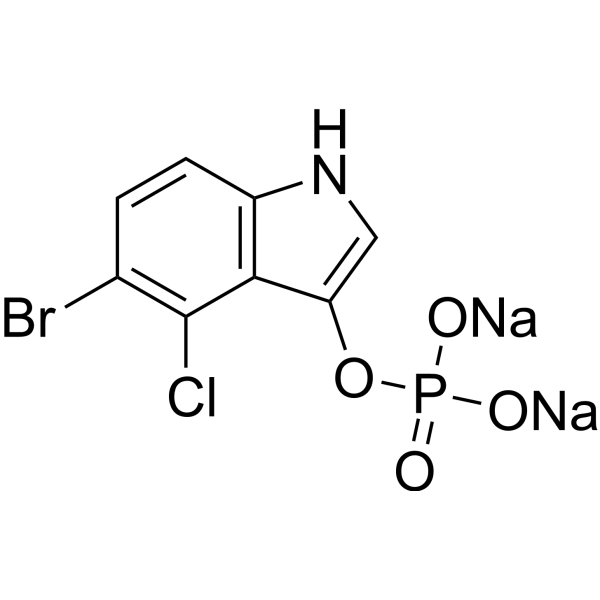
Sodium 5-bromo-4-chloro-1H-indol-3-yl phosphate is commonly used as a substrate for phosphatase assays in biochemistry and molecular biology. This compound is converted by phosphatases to a yellow compound that can be easily measured spectrophotometrically or fluorometrically. Furthermore, it has been used as a useful reagent in enzyme-catalyzed reactions and a tool for studying signal transduction pathways.
loading...
    loading...
Cat. No.: HY-N2018
CAS No.: 6763-34-4
Synonyms: α-D-Xylopyranose
α-D-Xylose (α-D-Xylopyranose) is a basic component of the five-carbon fraction of biomass and a precursor of hemicellulose. α-D-Xylose participates in a variety of enzyme-catalyzed reactions, which in turn participate in a variety of metabolic pathways. In addition, α-D-Xylose is also used in tanning, dyeing and as a diabetic food .
loading...
    loading...
Cat. No.: HY-W243460
CAS No.: 39208-15-6
Research Areas:  

Others

EDTA copper (II) disodium salt, 97% is a negatively charged copper (II)-ethylenediaminetetraacetic acid chelate and also an adsorption substrate. EDTA copper (II) disodium salt, 97% forms amide bonds with chitosan amino groups in weakly acidic (pH 3-5) solutions, while it forms the CuEDTA (OH) 3− hydroxyl complex in strongly alkaline (pH > 12) solutions. EDTA copper (II) disodium salt, 97% can be adsorbed onto granular activated carbon, with electrostatic interactions dominating its pH-dependent adsorption behavior. EDTA copper (II) disodium salt, 97% can be used to eliminate the inhibition of enzyme-catalyzed reactions caused by trace heavy metals .
loading...
    loading...
Cat. No.: HY-161306
CAS No.: 2760854-72-4
Target:  

HDAC

Research Areas:  

Cancer

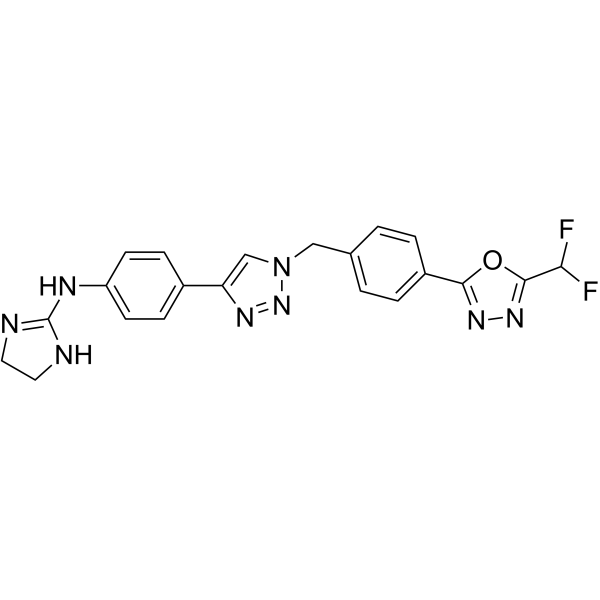
ITF5924 (compound 1) is a potent and highly selective HDAC6 inhibitor with an IC50 of 7.7 nM. ITF5924 shows greater than 104-fold selectivity for HDAC6 over all other HDAC subtypes. ITF5924 containing a difluoromethyl-1,3,4-oxadiazole (DFMO) moiety is slow-binding substrate analog of HDAC6 that undergo an enzyme-catalyzed ring opening reaction, forming a tight and long-lived enzyme-inhibitor complex .
loading...
    loading...
Cat. No.: HY-W777640
CAS No.: 94452-17-2
6-Hexadecanoylamino-4-methylumbelliferyl β-D-galactopyranoside is a specific fluorescent substrate with the function of detecting galactosidase activity. 6-Hexadecanoylamino-4-methylumbelliferyl β-D-galactopyranoside can be used in biomedical research to observe the efficiency of enzyme-catalyzed reactions. 6-Hexadecanoylamino-4-methylumbelliferyl β-D-galactopyranoside is also widely used in the analysis of polysaccharides and carbohydrate enzymology.
loading...
    loading...
Cat. No.: HY-154871
CAS No.: 2152-75-2
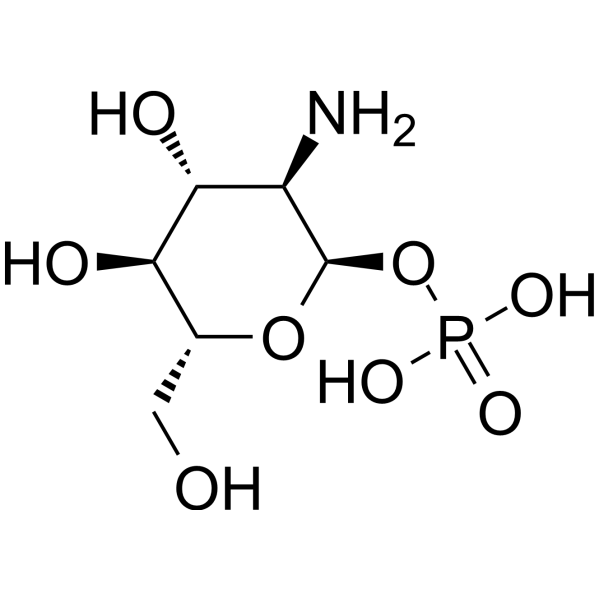
α-D-Glucosamine 1-phosphate is a glycosyl donor analog of Glc-1-P. α-D-Glucosamine 1-phosphate acts as a glycosyl donor to produce α(1→4)-linked glucosamine chains in the enzyme-catalyzed polymerization reaction mediated by thermostable α-glucan phosphorylase. α-D-Glucosamine 1-phosphate serves as a glycosyl donor analog to generate a pentasaccharide with a glucosamine residue at the non-reducing end in the maltotetraose glucosamination reaction catalyzed by potato α-glucan phosphorylase. α-D-Glucosamine 1-phosphate is used for the synthesis of amphiphilic block polysaccharides with pH-responsive assembly/disassembly properties .
loading...
    loading...
Cat. No.: HY-167663
CAS No.: 149494-37-1
Target:  

5-HT Receptor

Research Areas:  

Neurological Disease

Ebalzotan is a 5-HT1A receptor agonist with activity in the study of depression. Ebalzotan can serve as a precursor to important active pharmaceutical ingredients. The synthesis of Ebalzotan involves a multi-enzyme catalyzed reduction reaction to obtain saturated primary or secondary alcohols in high yields and high enantioselectivity .
loading...
    loading...
Cat. No.: HY-167663A
CAS No.: 294843-95-1
Target:  

5-HT Receptor

Research Areas:  

Neurological Disease

(S)-Ebalzotan is the S-form of Ebalzotan (HY-167663). Ebalzotan is a 5-HT1A receptor agonist with activity in the study of depression. Ebalzotan can serve as a precursor to important active pharmaceutical ingredients. The synthesis of Ebalzotan involves a multi-enzyme catalyzed reduction reaction to obtain saturated primary or secondary alcohols in high yields and high enantioselectivity .
loading...
    loading...
Cat. No.: HY-P2726A
Aldolase, Spinach (EC 4.1.2.13) is an enzyme catalyzing a reversible reaction that splits the aldol, fructose 1,6-bisphosphate, into the triose phosphates dihydroxyacetone phosphate (DHAP) and glyceraldehyde 3-phosphate (G3P). Aldolase, Spinach (EC 4.1.2.13) can also produce DHAP from other (3S,4R)-ketose 1-phosphates such as fructose 1-phosphate and sedoheptulose 1,7-bisphosphate.
loading...
    loading...
  • 1

