10 Results for "

estrogen dependent disease

" in MedChemExpress (MCE) Product Catalog:
Products (10)

10 Results for "estrogen dependent disease" in MCE Product Catalog:

3
3 Cited Publications
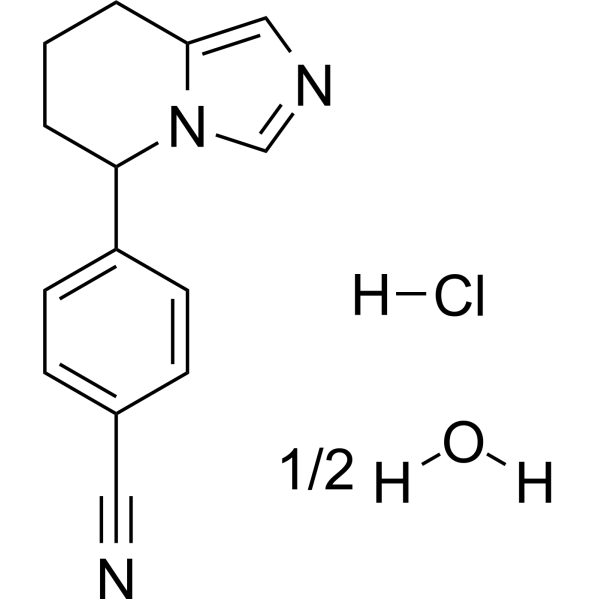
Cat. No.: HY-14247B
CAS No.: 176702-70-8
Synonyms: CGS 16949A hemihydrate; (Rac)-FAD286 hydrochloride hemihydrate
Target:  

Cytochrome P450

Research Areas:  

Endocrinology Cancer

Fadrozole hydrochloride hemihydrate is an orally active, potent, selective and nonsteroidal aromatase inhibitor, with an IC50 of 6.4 nM. Fadrozole hydrochloride hemihydrate inhibits the production of estrogen and progesterone, with IC50 values of 0.03 and 120 μM. Fadrozole hydrochloride hemihydrate shows prevention of spontaneous tumours. Fadrozole hydrochloride hemihydrate can be used for the research of estrogen-dependent disease and cancer .
loading...
    loading...
Cat. No.: HY-164764
CAS No.: 1067189-44-9
Target:  

Estrogen Receptor/ERR

Research Areas:  

Endocrinology

ADX61623 is a potent follicle stimulating hormone (FSH) receptor (FSHR) negative allosteric modulator (NAM). ADX61623 shows luteinizing hormone receptor (LH-R) activity and is not active on thyroid-stimulating hormone (TSH) receptors. ADX61623 can be used for the study of estrogen dependent disease .
loading...
    loading...
Cat. No.: HY-120767
CAS No.: 1321816-57-2
Synonyms: KLH-2109 choline; OBE-2109 choline
Target:  

GnRH Receptor

Research Areas:  

Inflammation/Immunology Cancer

Linzagolix choline (KLH-2109 choline) is a non-peptide gonadotropin-releasing hormone (GnRH) antagonist with oral activity. Linzagolix choline inhibits the release of endogenous gonadotropins such as luteinizing hormone LH and follicle-stimulating hormone FSH by binding to the GnRH receptor within the pituitary gland. This inhibition results in a reduction in the production of sex hormones such as estrogen and progesterone, which in turn affects the course of sex hormone-dependent diseases. Linzagolix choline can be used in the study of sex hormone-dependent diseases such as endometriosis and uterine fibroids .
loading...
    loading...
Cat. No.: HY-173279
CAS No.: 889959-22-2
Target:  

Cytochrome P450

Research Areas:  

Endocrinology

CYP19A1-IN-1 (Compound 9) is a CYP19A1 inhibitor with an IC50 of 271 nM. CYP19A1-IN-1 inhibits the activity of converting androgens to estrogens by binding to CYP19A1. CYP19A1-IN-1 can be used in the research of sex hormone-related diseases such as estrogen-dependent breast cancer .
loading...
    loading...
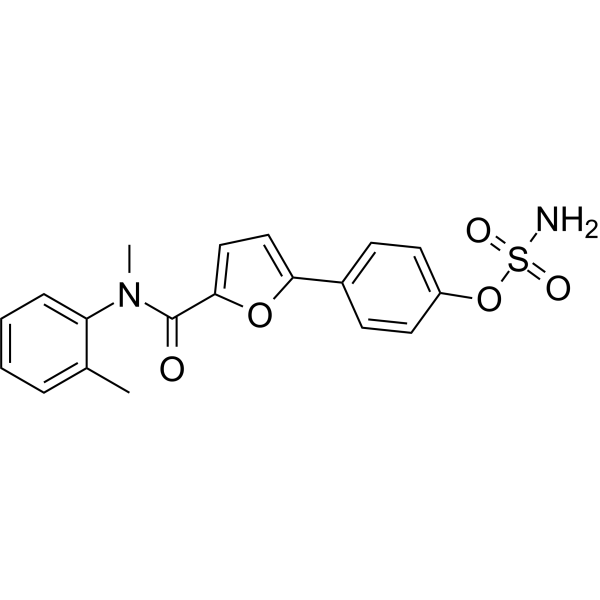
Cat. No.: HY-151199
CAS No.: 2990549-70-5
Target:  

Steroid Sulfatase

Research Areas:  

Endocrinology Cancer

Steroid sulfatase/17β-HSD1-IN-1 is a potent steroid sulfatase and 17β-hydroxysteroid dehydrogenase type 1 (17β-HSD1) inhibitor with an IC50 value of 28 nM for cellular human steroid sulfatase. Steroid sulfatase/17β-HSD1-IN-1 can be used to research estrogen-dependent diseases .
loading...
    loading...
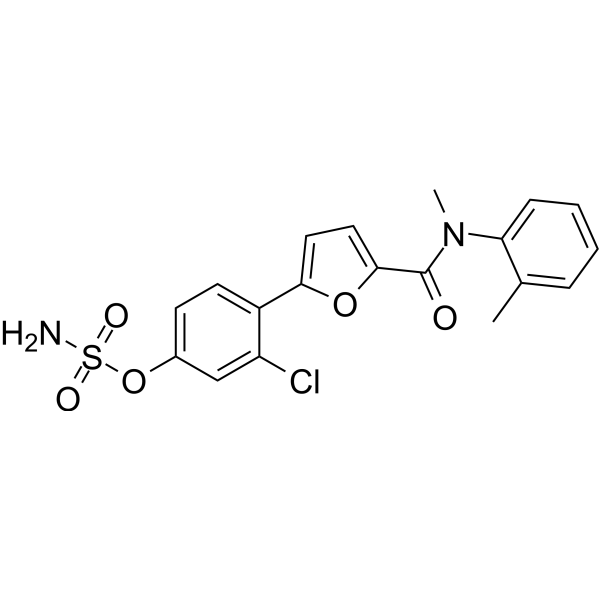
Cat. No.: HY-151201
CAS No.: 2990549-76-1
Target:  

Steroid Sulfatase

Research Areas:  

Cancer

Steroid sulfatase/17β-HSD1-IN-3 (compound 19) is a dual inhibitor of steroid sulfatase (STS) and 17β-hydroxysteroid dehydrogenase type 1 (17β HSD1). Steroid sulfatase/17β-HSD1-IN-3 irreversibly inhibits hSTS activity with anIC50 value of 27 nM. Steroid sulfatase/17β-HSD1-IN-3 can be used in the study of endometriosis and other estrogen-dependent diseases .
loading...
    loading...
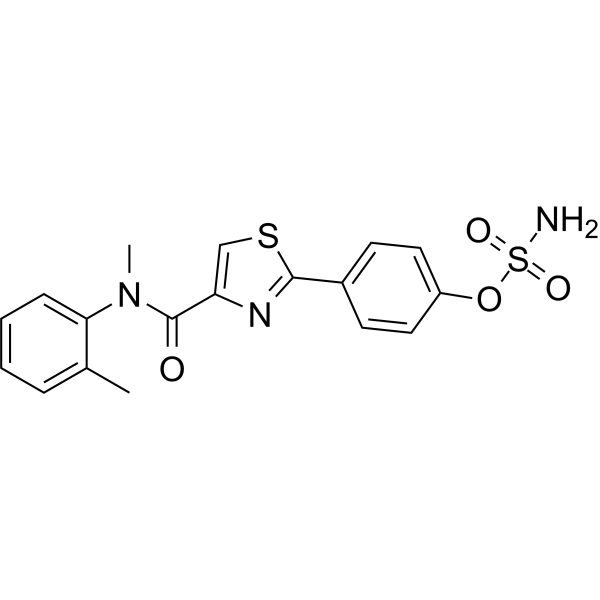
Cat. No.: HY-151202
CAS No.: 2990549-94-3
Target:  

Steroid Sulfatase

Research Areas:  

Cancer

Steroid sulfatase/17β-HSD1-IN-4 (compound 37) is a dual inhibitor of steroid sulfatase (STS) and 17β-hydroxysteroid dehydrogenase type 1 (17β HSD1). Steroid sulfatase/17β-HSD1-IN-4 irreversibly inhibits hSTS activity with anIC50 value of 63 nM. Steroid sulfatase/17β-HSD1-IN-4 can be used in the study of endometriosis and other estrogen-dependent diseases .
loading...
    loading...
Cat. No.: HY-187622
CAS No.: 148714-92-5
Target:  

Cytochrome P450

Research Areas:  

Metabolic Disease Cancer

Org 33201 is an orally active and selective Aromatase inhibitor with an IC50 of 2.2 nM. Org 33201 inhibits the activity of Aromatase by binding to its heme iron. Org 33201 can be used in the study of estrogen-dependent diseases (such as postmenopausal breast cancer) .
loading...
    loading...
Cat. No.: HY-119080
CAS No.: 532435-68-0
Target:  

Progesterone Receptor

Research Areas:  

Endocrinology Cancer

CP8754 is an orally active, selective human progesterone receptor (hPR) antagonist that blocks progesterone-mediated signaling pathways. CP8754 competitively inhibits the binding of [ 3H]-progesterone to hPR. And in vitro, CP8754 inhibits progesterone-dependent exogenous luciferase and endogenous alkaline phosphatase expression; while in vivo, CP8754 inhibits rabbit endometrial transformation. CP8754 does not significantly bind to human glucocorticoid receptors (hGR), estrogen receptors (hER), or rat androgen receptors (rAR). CP8754 can be used in the study of progesterone-related diseases such as breast cancer, endometriosis, uterine fibroids, and meningioma, as well as hormone-dependent tumors .
loading...
    loading...
Cat. No.: HY-167151
CAS No.: 2107327-36-4
PaPE-1 is a pathway-preferential estrogen receptor (ER) agonist that preferentially activates ER non-nuclear-initiated signaling while minimally activating nuclear-initiated signaling. PaPE-1 exhibits Ki values of 10 μM and 25 μM for human ERα and ERβ, respectively. The relatively low ER affinity and rapid receptor dissociation of PaPE-1 facilitate the triggering of non-nuclear mTOR/MAPK/AKT signaling, while reducing the recruitment of ERα to chromatin and sustained nuclear ER-dependent transcription. PaPE-1 is suitable for research related to non-nuclear ER signaling, metabolic disorders, ischemic brain injury, Alzheimer's disease, and ER-positive breast cancer .
loading...
    loading...

