



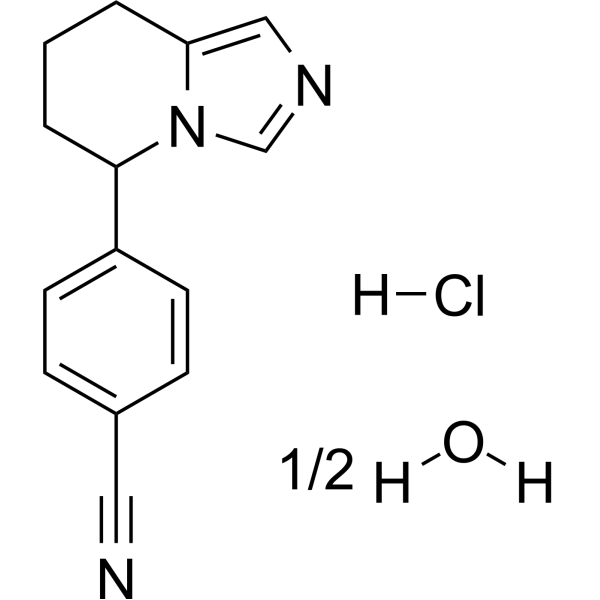
Fadrozole hydrochloride hemihydrate
Based on 3 publication(s) in Google Scholar
Fadrozole hydrochloride hemihydrate is an orally active, potent, selective and nonsteroidal aromatase inhibitor, with an IC50 of 6.4 nM. Fadrozole hydrochloride hemihydrate inhibits the production of estrogen and progesterone, with IC50 values of 0.03 and 120 μM. Fadrozole hydrochloride hemihydrate shows prevention of spontaneous tumours. Fadrozole hydrochloride hemihydrate can be used for the research of estrogen-dependent disease and cancer.
For research use only. We do not sell to patients.
- Purity : 99.59%
- CAS No.: 176702-70-8
- Formula: C14H13N3.ClH.1/2H2O
- Molecular Weight:268.74
-
Storage:
4°C, sealed storage, away from moisture
* In solvent : -80°C, 6 months; -20°C, 1 month (sealed storage, away from moisture)

To place orders, for customer services and technical support, please contact: MedChemExpress USA
Tel: 609-228-6898 E-mail: [email protected] [email protected]


-
 Biological Activity
-
Chemical Information
-
Solvent & Solubility
- Protocols
- Purity & Documentation
- References
-
 Help & FAQs


Publications Citing Use of MedChemExpress (MCE) Fadrozole hydrochloride hemihydrate
More

Biological Activity
Description
IC50 & Target
|
Aromatase |
In Vitro
Synthesis of other cytochrome P-450 dependent steroids can be suppressed to various degrees with higher doses of Fadrozole hydrochloride hemihydrate[1].
MedChemExpress (MCE) has not independently confirmed the accuracy of these methods. They are for reference only. Further protocols information, click here.
In Vivo
Fadrozole hydrochloride hemihydrate prevents the development of both benign and malignant spontaneus mammary neoplasns in female Sprague-Dawley rats. It also slows the spontaneous development of ptuitary pars distalis adenomas in female rats, and reduces the incidence of spontaneous hepatocellular tumours in male and female rats[2].
Administration of Fadrozole hydrochloride hemihydrate in male and female mice accompanies with a 70% reduction in parasite burden. This protective effect is associated in male mice with a recovery of the specific cellular immune response[3].
MedChemExpress (MCE) has not independently confirmed the accuracy of these methods. They are for reference only.


Chemical Information
-
CAS No. 176702-70-8
-
Appearance Solid
-
Molecular Weight 268.74
-
Formula C14H13N3.ClH.1/2H2O
-
Color White to light yellow
-
SMILES
N#CC1=CC=C(C=C1)C2CCCC3=CN=CN23.[H]Cl.[H]O[H].[1/2]
-
Synonyms
CGS 16949A hemihydrate; (Rac)-FAD286 hydrochloride hemihydrate
-
Shipping
Room temperature in continental US; may vary elsewhere.
-
Storage
4°C, sealed storage, away from moisture
* In solvent : -80°C, 6 months; -20°C, 1 month (sealed storage, away from moisture)


Publications (3)
-
Journal Impact Factor
-
Most Recent
-
Ecotoxicol Environ Saf
Effect of bisphenol A on craniofacial cartilage development in zebrafish (Danio rerio) embryos: A morphological study. [Abstract]2021 Apr 1:212:111991. PMID: 33548570 -
-
Dis Model Mech
Sex hormone receptors, calcium-binding protein and Yap1 signaling regulate sex-dependent liver cell proliferation following partial hepatectomy. [Abstract]2024 Oct 1;17(10):dmm050900. PMID: 39397390


Solvent & Solubility
In Vitro:
DMSO : 100 mg/mL (372.11 mM; Need ultrasonic; Hygroscopic DMSO has a significant impact on the solubility of product, please use newly opened DMSO)
Please refer to the solubility information to select the appropriate solvent. Once prepared, please aliquot and store the solution to prevent product inactivation from repeated freeze-thaw cycles.
Storage method and period of stock solution: -80°C, 6 months; -20°C, 1 month (sealed storage, away from moisture). When stored at -80°C, please use it within 6 months. When stored at -20°C, please use it within 1 month.
Please refer to the solubility information to select the appropriate solvent. Once prepared, please aliquot and store the solution to prevent product inactivation from repeated freeze-thaw cycles.
Storage method and period of stock solution: -80°C, 6 months; -20°C, 1 month (sealed storage, away from moisture). When stored at -80°C, please use it within 6 months. When stored at -20°C, please use it within 1 month.
Concentration (start) × Volume (start) = Concentration (final) × Volume (final)
In Vivo:
Select the appropriate dissolution method based on your experimental animal and administration route.
- For the following dissolution methods, please ensure to first prepare a clear stock solution using an In Vitro approach and then sequentially add co-solvents:
- To ensure reliable experimental results, the clarified stock solution can be appropriately stored based on storage conditions. As for the working solution for In Vivo experiments, it is recommended to prepare freshly and use it on the same day.
- The percentages shown for the solvents indicate their volumetric ratio in the final prepared solution. If precipitation or phase separation occurs during preparation, heat and/or sonication can be used to aid dissolution.
Add each solvent one by one: 10% DMSO 40% PEG300 5% Tween-80 45% Saline
Solubility: ≥ 2.5 mg/mL (9.30 mM); Clear solution
This protocol yields a clear solution of ≥ 2.5 mg/mL (saturation unknown).
Taking 1 mL working solution as an example, add 100 μL DMSO stock solution (25.0 mg/mL) to 400 μL PEG300, and mix evenly; then add 50 μL Tween-80 and mix evenly; then add 450 μL Saline to adjust the volume to 1 mL.
Preparation of Saline: Dissolve 0.9 g sodium chloride in ddH₂O and dilute to 100 mL to obtain a clear Saline solution.
Add each solvent one by one: 10% DMSO 90% (20% SBE-β-CD in Saline)
Solubility: ≥ 2.5 mg/mL (9.30 mM); Clear solution
This protocol yields a clear solution of ≥ 2.5 mg/mL (saturation unknown).
Taking 1 mL working solution as an example, add 100 μL DMSO stock solution (25.0 mg/mL) to 900 μL 20% SBE-β-CD in Saline, and mix evenly.
Preparation of 20% SBE-β-CD in Saline (4°C, storage for one week): 2 g SBE-β-CD powder is dissolved in 10 mL Saline, completely dissolve until clear.
In Vivo Dissolution Calculator
Please enter the basic information of animal experiments:
-
-
-
-
Recommended: Prepare an additional quantity of animals to account for potential losses during experiments.
Please enter your animal formula composition:
-
%DMSO +
Recommended: Keep the proportion of DMSO in working solution below 2% if your animal is weak.
-
%+
-
+%Tween-80 + +
-
%Saline +
The co-solvents required include: DMSO, . All of co-solvents are available by MedChemExpress (MCE). , Tween 80. All of co-solvents are available by MedChemExpress (MCE).
Working solution concentration: 0.22 mg/mL
Method for preparing stock solution: mg drug dissolved in μL DMSO. Stock solution concentration: mg/mL. * In solvent : -80°C, 6 months; -20°C, 1 month (sealed storage, away from moisture)
1. Take μL DMSO stock solution;
2. Add μL .
μL , mix evenly;
3. Then add μL Tween 80, mix evenly;
4. Then add μL
Please ensure that the stock solution in the first step is dissolved to a clear state, and add co-solvents in sequence. You can use ultrasonic heating (ultrasonic cleaner, recommended frequency 20-40 kHz), vortexing, etc. to assist dissolution.

Protocols
-
Cell Cytotoxicity Assay
Cytotoxicity assays are usually based on the assessment of cell membrane damage, which can also be indirectly detected by measuring cell viability. Detection methods include MTT assay, CKK-8 assay, LDH assay and ATP assay, etc.
-
Research Protocol for Endocrine Diseases
Endocrine diseases often arise from disrupted hormone production, hormone signaling, or target-tissue responsiveness; for diabetes-focused endocrine disease models, insulin signaling regulates glucose uptake, hepatic glucose output, lipid metabolism, and β-cell compensation. Type 2 diabetes develops through interacting defects in insulin resistance, β-cell dysfunction, adipose inflammation, hepatic glucose overproduction, altered incretin signaling, and ectopic lipid metabolism. A major unresolved question is whether endocrine dysfunction is driven primarily by target-tissue insulin resistance, intrinsic β-cell failure, immune/inflammatory stress, or combined multi-organ failure that differs by disease stage.


Purity & Documentation
-
Data Sheet (276 KB)
-
SDS (420 KB)
- English - EN (420 KB)
- Français - FR (420 KB)
- Deutsch - DE (420 KB)
- Norwegian - NO (420 KB)
- Español - ES (420 KB)
- Swedish - SV (420 KB)
- Italian - IT (420 KB)
- Korean - KR (420 KB)
- Portuguese - PT (420 KB)
-
Handling Instructions (2659 KB)
References
[1]. Browne LJ, et al. Fadrozole hydrochloride: a potent, selective, nonsteroidal inhibitor of aromatase for the treatment of estrogen-dependent disease. J Med Chem. 1991 Feb;34(2):725-36. [Content Brief]
[2]. Gunson DE, et al. Prevention of spontaneous tumours in female rats by fadrozole hydrochloride, an aromatase inhibitor. Br J Cancer. 1995 Jul;72(1):72-5. [Content Brief]
[3]. Morales-Montor J, et al. Inhibition of p-450 aromatase prevents feminisation and induces protection during cysticercosis. Int J Parasitol. 2002 Oct;32(11):1379-87. [Content Brief]


Complete Stock Solution Preparation Table
Please refer to the solubility information to select the appropriate solvent. Once prepared, please aliquot and store the solution to prevent product inactivation from repeated freeze-thaw cycles.
Storage method and period of stock solution: -80°C, 6 months; -20°C, 1 month (sealed storage, away from moisture). When stored at -80°C, please use it within 6 months. When stored at -20°C, please use it within 1 month.
| Optional Solvent | Concentration Solvent Mass | 1 mg | 5 mg | 10 mg | 25 mg |
|---|---|---|---|---|---|
| DMSO | 1 mM | 3.7211 mL | 18.6053 mL | 37.2107 mL | 93.0267 mL |
| 5 mM | 0.7442 mL | 3.7211 mL | 7.4421 mL | 18.6053 mL | |
| 10 mM | 0.3721 mL | 1.8605 mL | 3.7211 mL | 9.3027 mL | |
| 15 mM | 0.2481 mL | 1.2404 mL | 2.4807 mL | 6.2018 mL | |
| 20 mM | 0.1861 mL | 0.9303 mL | 1.8605 mL | 4.6513 mL | |
| 25 mM | 0.1488 mL | 0.7442 mL | 1.4884 mL | 3.7211 mL | |
| 30 mM | 0.1240 mL | 0.6202 mL | 1.2404 mL | 3.1009 mL | |
| 40 mM | 0.0930 mL | 0.4651 mL | 0.9303 mL | 2.3257 mL | |
| 50 mM | 0.0744 mL | 0.3721 mL | 0.7442 mL | 1.8605 mL | |
| 60 mM | 0.0620 mL | 0.3101 mL | 0.6202 mL | 1.5504 mL | |
| 80 mM | 0.0465 mL | 0.2326 mL | 0.4651 mL | 1.1628 mL | |
| 100 mM | 0.0372 mL | 0.1861 mL | 0.3721 mL | 0.9303 mL |


Fadrozole hydrochloride hemihydrate Related Classifications
HY-14247B Related Classifications
 Powered by Bioz