

14 Results for "

intrinsic permeability

" in MedChemExpress (MCE) Product Catalog:
Products (14)

14 Results for "intrinsic permeability" in MCE Product Catalog:

22
22 Cited Publications
Cat. No.: HY-125746
CAS No.: 878557-19-8
Purity:  99.77%
Target:  

Fluorescent Dye

Research Areas:  

Metabolic Disease

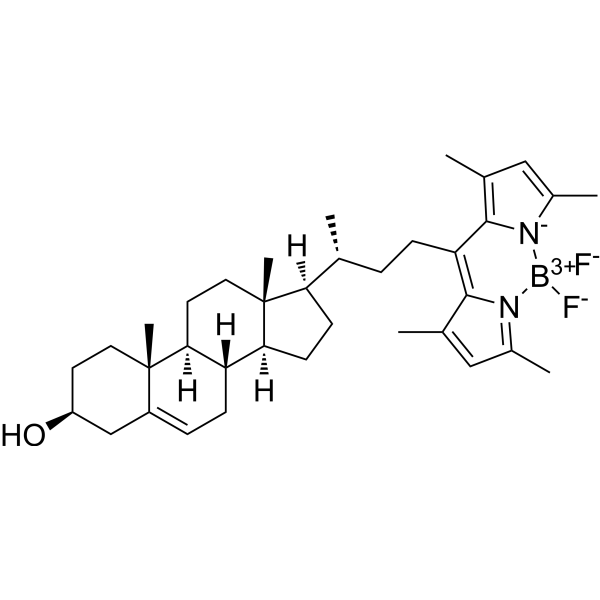
BODIPY-cholesterol is an intrinsically lipophilic, and cell-permeable analog of cholesterol with a fluorescent BODIPY group. BODIPY-cholesterol can be used to monitor sterol uptake and inter-organelle sterol flux in cells. (Excitation/Emission: 505/515 nm) .
loading...
    loading...
Cat. No.: HY-137371
CAS No.: 148409-20-5
Purity:  97.31%
Research Areas:  

Infection Cancer

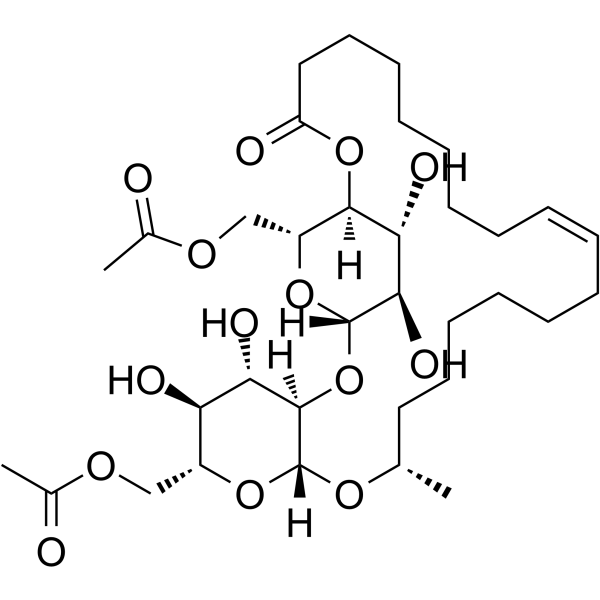
Lactonic sophorolipid is an apoptosis inducer and antimicrobial surfactant with antitumor activity. Lactonic sophorolipid regulates Bax/Bcl-gene expression through caspase-3/9 and induces apoptosis in tumor cells. Lactonic sophorolipid can disrupt cell membrane permeability and exert antibacterial effects (MIC for oral pathogens is 100-400 μg/mL). Lactonic sophorolipid promotes mitochondrial membrane potential depolarization, activates the intrinsic apoptotic pathway, and can synergize with antibiotics to enhance the antibacterial effect. Lactonic sophorolipid can be used in liver cancer research and the development of oral hygiene antibacterial agents[1][2][3].
loading...
    loading...
Cat. No.: HY-DY1029
CAS No.: 878557-19-8
Target:  

Fluorescent Dye

Research Areas:  

Others

BODIPY-cholesterol (solution) is an intrinsically lipophilic, and cell-permeable analog of cholesterol with a fluorescent BODIPY group. BODIPY-cholesterol can be used to monitor sterol uptake and inter-organelle sterol flux in cells. (Excitation/Emission: 505/515 nm) .
Solvent and concentration: DMSO: 1 mM
loading...
    loading...
Cat. No.: HY-149591
CAS No.: 2600795-07-9
M4K2009 is an orally active, blood-brain barrier permeable type I ALK2 inhibitor, with an IC50 value of 8-13 nM against human ALK2. M4K2009 exhibits moderate off-target inhibitory activity against hERG potassium channels (Potassium Channel), with an IC50 of 8 μM against the human channel. M4K2009 can be used in studies related to diffuse intrinsic pontine glioma .
loading...
    loading...
Cat. No.: HY-155939
CAS No.: 2863635-04-3
Purity:  98.30%
Target:  

TGF-β Receptor

Research Areas:  

Cancer

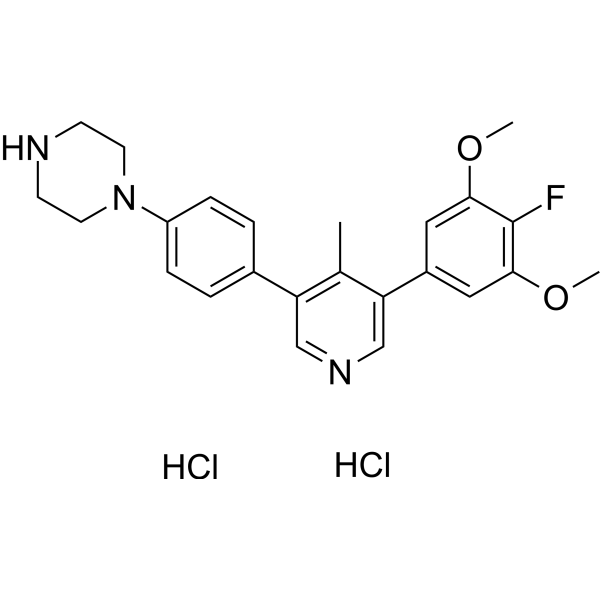
M4K2163 dihydrochloride is a potent, selective, blood-brain barrier (BBB) permeable activin receptor-like kinase-2 (ALK2) inhibitor, with an IC50 of 19 nM. M4K2163 dihydrochloride can be used in the research of diffuse intrinsic pontine glioma (DIPG) .
loading...
    loading...
Cat. No.: HY-P5118A
Target:  

Inhibitory Antibodies

Research Areas:  

Neurological Disease

Tat-peptide 190-208 TFA is a cell-permeable and Tat-labeled fusion peptide, corresponding to residues 190-208 of rat G3BP1. Tat sequence from HIV, is placed at the least conserved end of the sequence, for cell permeability. Tat-peptide 190-208 TFA increases axon growth and increases the number of neurites per neuron. Tat-peptide 190-208 TFA likely exhibits an axon intrinsic mechanism. Tat-peptide 190-208 TFA can be used for ischemic protection during endovascular repair for intracranial aneurysms .
loading...
    loading...
Cat. No.: HY-19405
CAS No.: 178309-91-6
Target:  

Neurokinin Receptor

Research Areas:  

Others

UK-224671 is a potent and selective NK2 receptor antagonist. UK-224671 is affected by P-gp efflux and poor intrinsic membrane permeability, resulting in low oral bioavailability .
loading...
    loading...
Cat. No.: HY-164401
CAS No.: 1802735-28-9
Research Areas:  

Cancer

QBS10072S is a LAT1-selective substrate with blood-brain barrier permeability that inhibits tumor growth. QBS10072S enters LAT1-expressing tumor cells via LAT1-mediated active transport, induces interstrand DNA cross-linking and cell apoptosis, and reduces leptomeningeal dissemination. QBS10072S can be used in studies related to glioblastoma multiforme, diffuse intrinsic pontine glioma, triple-negative breast cancer brain metastases, and aggressive T-cell lymphoma .
loading...
    loading...
Cat. No.: HY-P5118
Target:  

Inhibitory Antibodies

Research Areas:  

Neurological Disease

Tat-peptide 190-208 is a cell-permeable and Tat-labeled fusion peptide, corresponding to residues 190-208 of rat G3BP1. Tat sequence from HIV, is placed at the least conserved end of the sequence, for cell permeability. Tat-peptide 190-208 increases axon growth and increases the number of neurites per neuron. Tat-peptide 190-208 likely exhibits an axon intrinsic mechanism. Tat-peptide 190-208 can be used for ischemic protection during endovascular repair for intracranial aneurysms .
loading...
    loading...
Cat. No.: HY-146072
CAS No.: 3032742-74-5
Target:  

IRAK

Research Areas:  

Cancer

IRAK4-IN-11 (compound 6) is a potent IRAK4 inhibitor with an IC50 of 0.008 µM. IRAK4-IN-11 shows cell pIRAK4 potencies with an IC50 of 0.19 µM .
loading...
    loading...
Cat. No.: HY-146073
Target:  

IRAK

Research Areas:  

Cancer

IRAK4-IN-12 (compound 37) is a potent IRAK4 inhibitor with an IC50 of 0.015 µM. IRAK4-IN-12 shows cell pIRAK4 potencies with an IC50 of 0.5 µM .
loading...
    loading...
Cat. No.: HY-149591A
CAS No.: 2772902-12-0
M4K2009 hydrochloride is an orally active, blood-brain barrier permeable type I ALK2 inhibitor, with an IC50 value of 8-13 nM against human ALK2. M4K2009 hydrochloride exhibits moderate off-target inhibitory activity against hERG potassium channels (Potassium Channel), with an IC50 of 8 μM against the human channel. M4K2009 hydrochloride can be used in studies related to diffuse intrinsic pontine glioma .
loading...
    loading...
Cat. No.: HY-164401A
CAS No.: 1802735-31-4
Research Areas:  

Cancer

QBS10072S dihydrochloride is a LAT1-selective substrate with blood-brain barrier permeability that inhibits tumor growth. QBS10072S dihydrochloride enters LAT1-expressing tumor cells via LAT1-mediated active transport, induces interstrand DNA cross-linking and cell apoptosis, and reduces leptomeningeal dissemination. QBS10072S dihydrochloride can be used in studies related to glioblastoma multiforme, diffuse intrinsic pontine glioma, triple-negative breast cancer brain metastases, and aggressive T-cell lymphoma .
loading...
    loading...
Cat. No.: HY-184290
CAS No.: 3062852-59-6
Research Areas:  

Neurological Disease Cancer

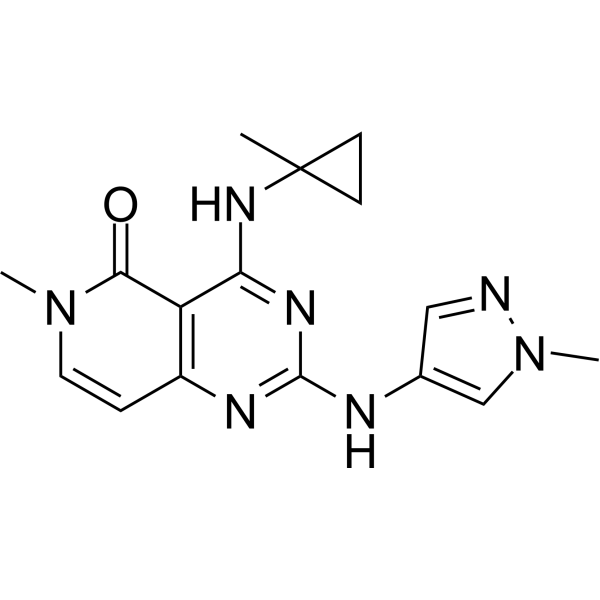
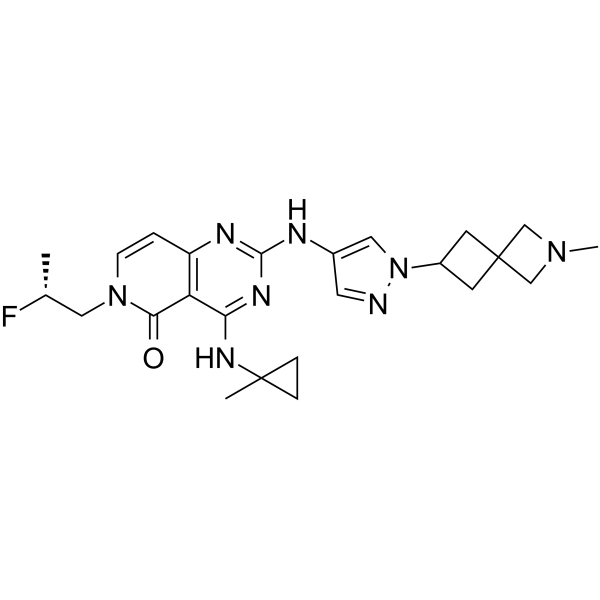
PRMT5-IN-56 is a PRMT5⋅MTA complex inhibitor with an IC50 of 0.2 nM, oral activity, and blood-brain barrier penetration. PRMT5-IN-56 inhibits PRMT5 methyltransferase activity in an MTA-cooperative manner, suppresses symmetrical dimethylarginine levels in MTAP-deficient cells. PRMT5-IN-56 suppresses proliferation of MTAP-deleted cancer cells with high selectivity over MTAP-wild type cells. PRMT5-IN-56 induces dose-dependent tumor growth inhibition in subcutaneous xenograft models, inhibits intracranial tumor progression, and prolongs survival in orthotopic brain xenograft models. PRMT5-IN-56 exhibits high intrinsic permeability, good oral bioavailability, and a high brain-to-plasma ratio. PRMT5-IN-56 can be used for the research of MTAP-deleted cancers and glioblastoma .
loading...
    loading...
  • 1

