1. Search Result
Search Result
Results for "

mouse mesenteric arteries

" in MedChemExpress (MCE) Product Catalog:

4

Inhibitors & Agonists

1

Natural
Products

Cat. No. Product Name Target Research Areas Chemical Structure
  • HY-132184

    5,6-EET; (±)5,6-EpETrE

    Adrenergic Receptor Calcium Channel Endocrinology
    5,6-Epoxyeicosatrienoic acid (5,6-EET; (±)5,6-EpETrE) is a fully racemic version of the enantiomeric forms biosynthesized from arachidonic acid by cytochrome P450 enzymes. In solution, 5,6-Epoxyeicosatrienoic acid degrades into 5,6-DiHET and 5,6-δ-lactone, which can be converted to 5,6-DiHET and quantified by GC-MS. In neuroendocrine cells, such as the anterior pituitary and pancreatic islets, 5,6-Epoxyeicosatrienoic acid has been implicated in the mobilization of calcium and hormone secretion. 5,6-Epoxyeicosatrienoic acid is an inhibitor of T-type voltage-gated calcium channels (Cav3) that inhibits isoforms Cav3.1, Cav3.2 (IC50=0.54 μM), and Cav3. and decreases nifedipine-resistant phenylephrine-induced vasoconstriction in isolated mouse mesenteric arteries via Cav3.2 blockade when used at a concentration of 3 μM. In addition, it is a substrate of COX-1 and COX-2.
    5,6-Epoxyeicosatrienoic acid
  • HY-113040A

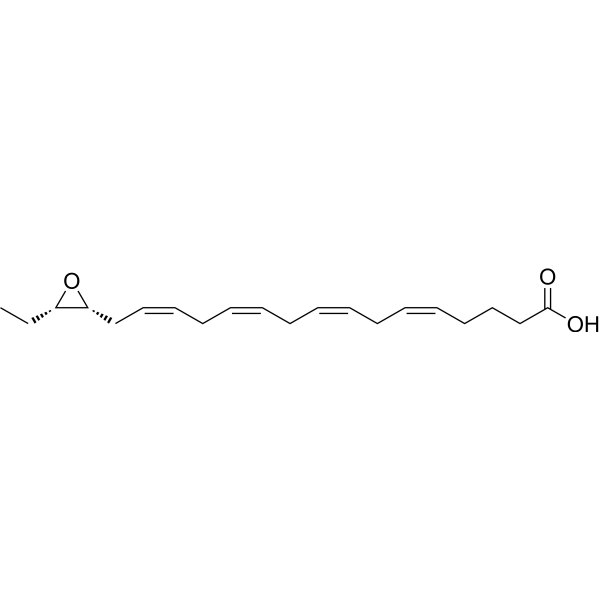
    17(R),18(S)-EETeTr

    Calcium Channel Cardiovascular Disease
    (17R,18S)-Epoxyeicosatetraenoic acid (17 (R),18 (S)-EETeTr) is a physiologically active fatty acid metabolite and also a vasodilator targeting BKα. (17R,18S)-Epoxyeicosatetraenoic acid activates the outward potassium current mediated by BK channels, and this effect is independent of the BKβ1 subunit, intracellular/extracellular calcium levels, and sarcoplasmic reticulum calcium release regulated by RyR3. (17R,18S)-Epoxyeicosatetraenoic acid is produced by the epoxidation of eicosapentaenoic acid mediated by CYP1A1 variants. (17R,18S)-Epoxyeicosatetraenoic acid is applicable to research related to arrhythmia .
    (17R,18S)-Epoxyeicosatetraenoic acid
  • HY-N4267

    Calcium Channel Platelet-activating Factor Receptor (PAFR) UGT Leukotriene Receptor TNF Receptor PGE synthase Interleukin Related Cardiovascular Disease Infection Inflammation/Immunology
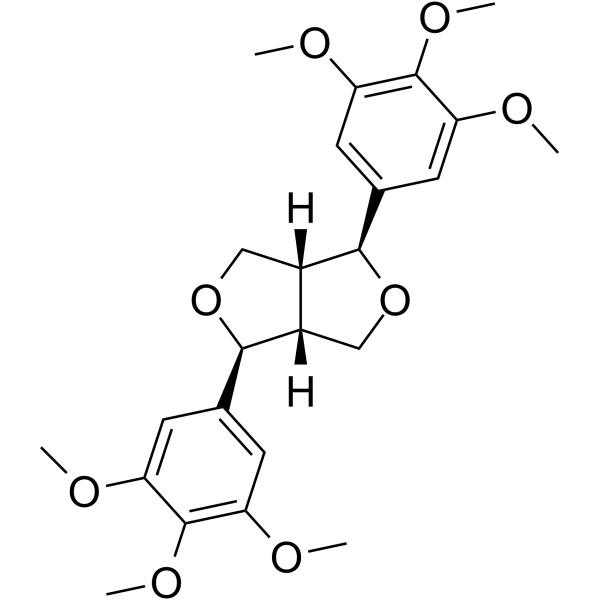
    Yangambin is a PAF receptor antagonist and UGT1A1/UGT1A3 inhibitor, with an IC50 of 29.7 μM and a Ki of 17.1 μM against human UGT1A1, and an IC50 of 56.5 μM and a Ki of 66.8 μM against human UGT1A3. Yangambin blocks PAF-mediated responses, inhibits LTB4-mediated neutrophil infiltration, and suppresses inflammatory events and anaphylactic contraction. Yangambin acts as a central nervous system inhibitor to reduce spontaneous activity, and also exhibits analgesic, anticonvulsant, antileishmanial, vasodilatory and hypotensive effects. Yangambin blocks voltage-gated Ca 2+ channels, reduces the production of NO, TNF-α, IL-6 and PGE2 in cells, increases the production of IL-10, and exerts a protective effect against cardiovascular injury. Yangambin can be used in research related to allergies, cutaneous leishmaniasis, central nervous system diseases and cardiovascular diseases .
    Yangambin
  • HY-117572

    P2Y Receptor Others
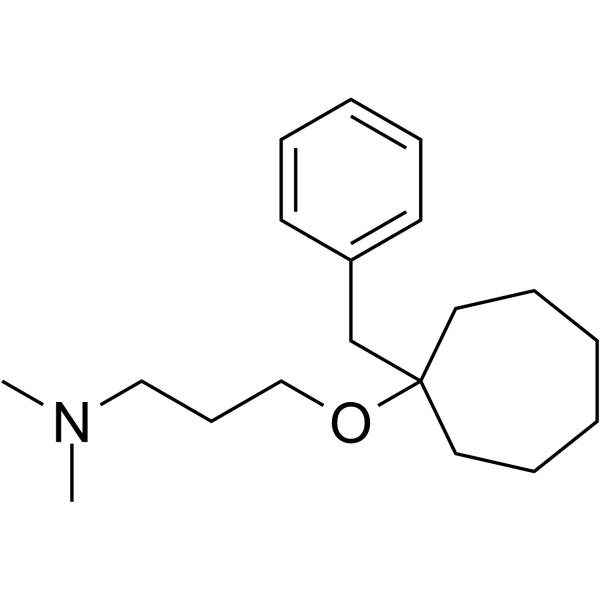
    MRS2567 is a P2Y receptor antagonist with the activity of inhibiting contraction of mouse mesenteric arteries. MRS2567 can inhibit the sustained contraction caused by UTP and UDP, and inhibit the Na +, K +, 2Cl - co-transport-dependent signaling pathway, thereby affecting the myogenic tone of mouse mesenteric arteries.
    MRS2567

Inquiry Online

Your information is safe with us. * Required Fields.

Salutation


Country or Region *

Applicant Name *


Organization Name *

Department *


Email Address *


Product Name *

Cat. No.


Requested quantity *

Phone Number *


Remarks

Inquiry Online

Inquiry Information

Product Name:
Cat. No.:
Quantity:
MCE Japan Authorized Agent:

